There’s a quiet, seething frustration that comes from watching a 43-year-old computer do what you can’t. Scott Manley, a Kerbal Space Program veteran, has just added another notch to the ZX Spectrum’s legendary resume: landing a spacecraft on the Mun with surgical precision, all while running on the machine’s original Sinclair BASIC and a jury-rigged serial connection.
The achievement isn’t just a flex of retro computing nostalgia—it’s a technical marvel. The ZX Spectrum, released in 1982, wasn’t built for real-time control of a physics-based space sim. Its original models lacked serial ports entirely, relying on the ZX Interface 1 to add RS-232 connectivity at a glacial 19.2 kbit/s. Later revisions included built-in ports, but the bottleneck remains: the Spectrum’s 3.5 MHz Z80 processor spends cycles bit-banging to communicate with a modern PC running kRPC, a tool that bridges the game to external scripts.
Yet despite these limitations, the Spectrum’s landing was smooth. No last-second panic, no skimming the surface at 200 m/s, no Kerbal corpses strewn across the Mun’s terrain. Just a gentle, calculated touchdown—exactly the kind of execution that sends human players into a spiral of self-doubt.
The Setup: How a 1980s Computer Outsmarts Modern Reflexes
A Python intermediary handles the heavy lifting between the Spectrum and kRPC, translating the machine’s BASIC commands into real-time game inputs. The result is a daisy-chained control system that, despite its age, operates with eerie efficiency. The Spectrum’s lack of hardware acceleration isn’t a flaw here—it’s a constraint that forces brute-force precision. Every instruction is deliberate, every calculation weighed. There’s no room for impulsive throttling or misjudged burns.
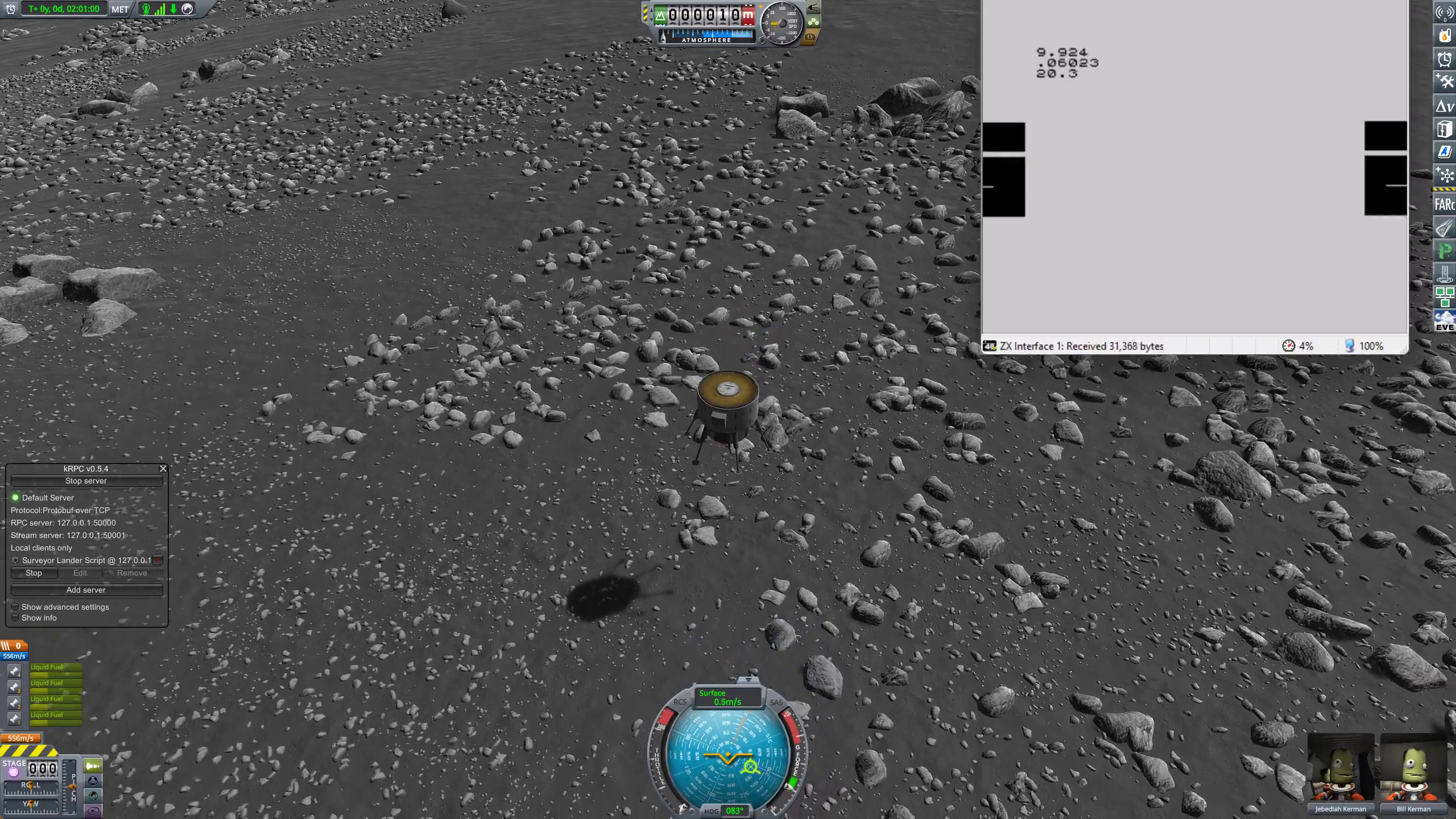
For those who’ve struggled with Mun landings, the contrast is brutal. Human players thrash controllers in desperation, juggling altitude, velocity, and fuel reserves in a frantic dance of trial and error. The Spectrum? It treats the problem like a math exercise: solve for the optimal descent profile, execute the solution, and land without drama.
Key Specs: The Machine Behind the Precision
- Processor: 3.5 MHz Z80 (original models)
- RAM: 16 KB (48 KB in later +2 models)
- Storage: Built-in BASIC ROM + cassette tape or microdrive (no hard drives)
- Serial Port: 19.2 kbit/s (via ZX Interface 1 or built-in port in +2/+3 models)
- Programming: Sinclair BASIC (the Spectrum’s native language)
- Connection Method: Bit-banged serial communication to a PC running kRPC
- Landing Result: Flawless Mun touchdown (no Kerbal fatalities)
The specs read like a relic, but the real story is in the tradeoffs. The Spectrum’s slowness forces optimization—no wasted cycles, no sloppy inputs. It’s the antithesis of modern gaming, where brute force often trumps finesse. Yet here, constraints become strengths. The machine’s limitations don’t just enable the landing; they demand it.
For the rest of us, it’s a reminder that raw processing power isn’t always the key to success. Sometimes, it’s about doing the math right—and the ZX Spectrum, of all things, just proved it can still outperform human instinct.