When a graphics card dies, most people recycle it. But a team of hardware enthusiasts took a different approach: they refused to let an RTX 5070 Ti with a literal hole in its PCB become e-waste. Instead, they turned it into a hybrid beast by splicing in an RTX 2080 Ti’s core and an AMD RX 580’s power delivery system. The result? A card so visually unhinged it looks like something from a mad scientist’s lab—and yet, it just set a world-record benchmark.
The project, led by YouTuber Paulo Gomes, began last year as a proof-of-concept to salvage a dead GPU. The latest iteration, however, pushed the experiment further by integrating an Asus RTX 2080 Ti PCB as its foundation. The goal wasn’t just to revive the card—it was to make it perform better than stock, despite its Frankenstein-like construction.
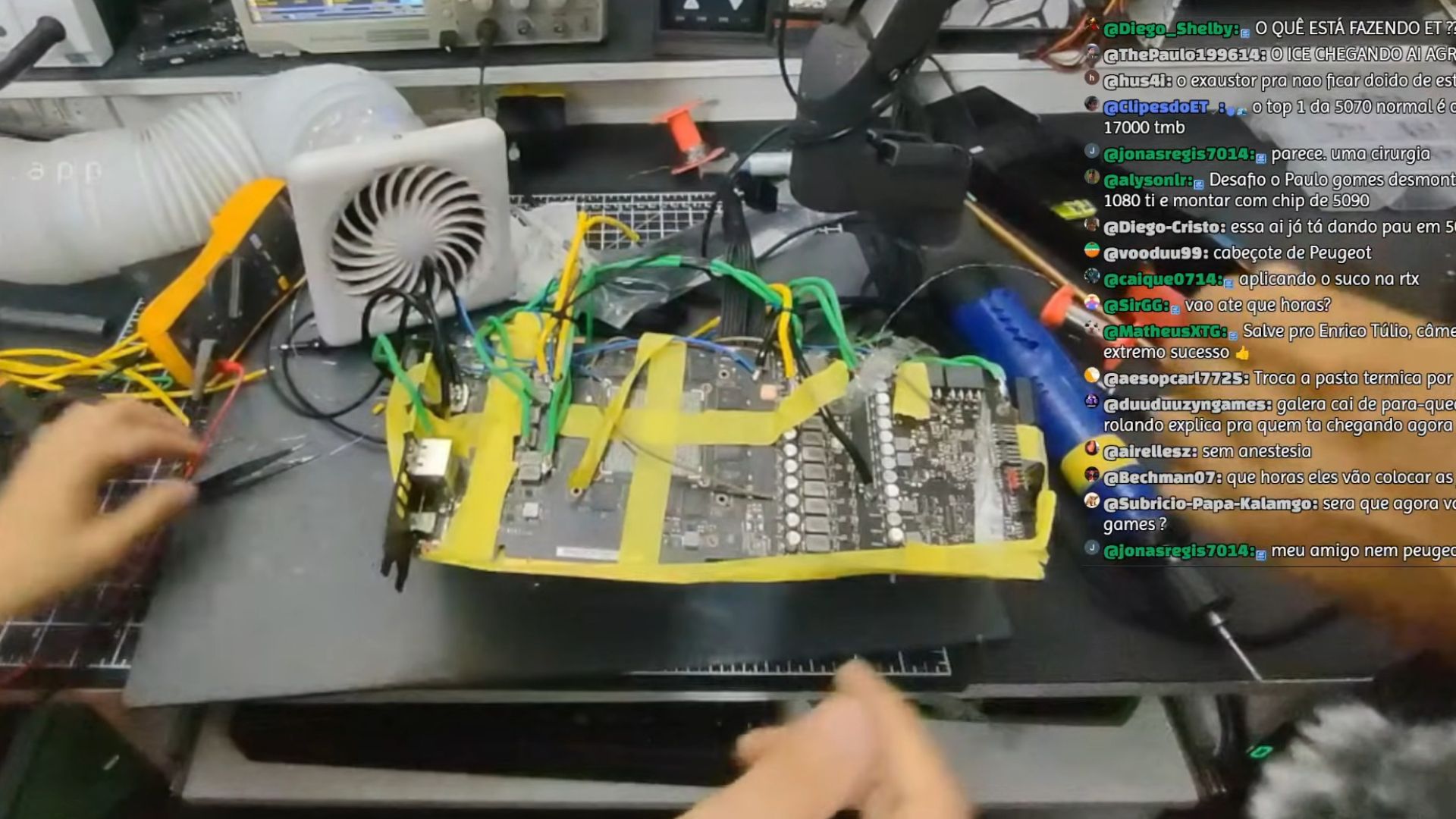
After seven hours of live-streamed debugging, the team managed to coax the card into running Unigine Superposition’s 8K optimized preset. The final score? 11,150, enough to claim the top spot for an RTX 5070 Ti in the benchmark’s online leaderboard. But the journey wasn’t without chaos: voltage spikes, thermal instability, and near-100°C wires threatened to derail the effort at every turn.
- Core clock: 3.23 GHz (well above Nvidia’s reference)
- Memory bandwidth: 34 Gbps (up from stock speeds)
- Voltage stability: Reduced drops from ~400 mV to ~30 mV
- Thermal quirks: Reported 50°C–80°C spikes in under a second
The modifications weren’t just about brute-force hacking—they involved meticulous rewiring to cut resistance and balance power delivery. Yellow tape, soldering irons, and a rat’s nest of cables became tools for optimization. Yet, even with these fixes, the card still exhibits bizarre behavior, like sudden thermal swings that would make most engineers wince.
So why does this matter? Because it proves that even in hardware’s death throes, creativity can outpace limitations. The RTX 5070 Ti Franken-card isn’t just a benchmark blip—it’s a testament to what happens when enthusiasts treat dead tech as a canvas rather than scrap. And yes, it’s the most cursed-looking GPU anyone has ever built. But then again, the best tech often is.