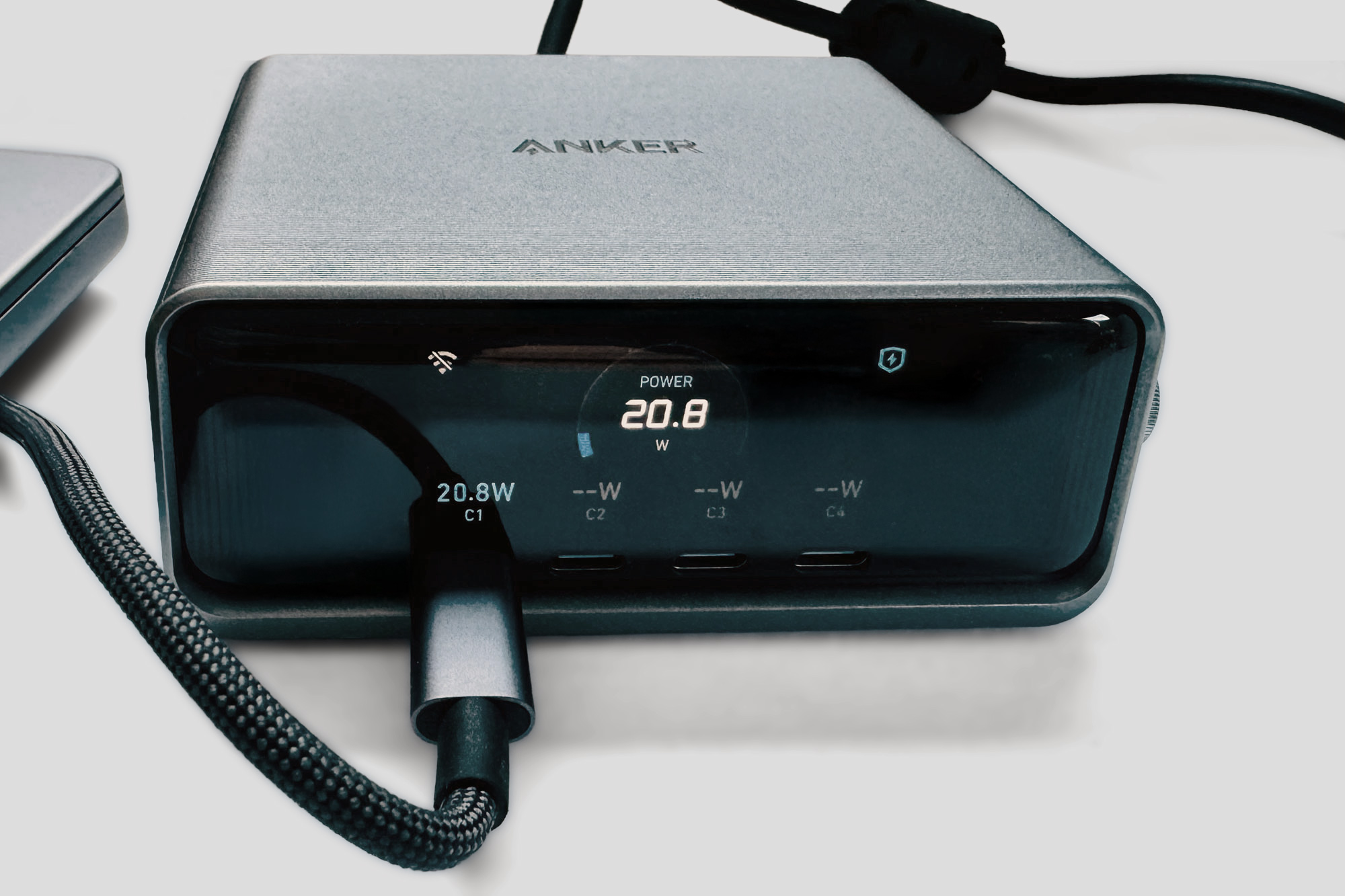
The 250W desktop charging station from Anker arrives at a pivotal moment for the power delivery market. While multi-port chargers have long been a staple in tech accessories, this iteration focuses less on raw performance and more on redefining user experience through smart design and cost efficiency.
Traditionally, high-wattage chargers have leaned toward bulk, often requiring users to sacrifice desk space for power output. Anker’s solution flips that dynamic. With a footprint under 5.7 inches deep, it delivers up to 250 watts across three ports—enough to handle laptops (up to 140W), phones, and tablets simultaneously—without imposing on limited workstation real estate. The discount to $89 further positions it as a value proposition in a segment where premium pricing has been the norm.
Redesigning the Power Delivery Experience
The device’s port configuration is its most notable feature, balancing power needs with practicality
- 1x USB-C PD 3.0 (24V/10A) – Designed for high-wattage laptops and fast-charging peripherals.
- 1x USB-A PD 3.0 (24V/5A) – Supports mid-range devices or dual-charging scenarios.
- 1x USB-C 2.0 (5V/3A) – A legacy inclusion for older peripherals, ensuring backward compatibility without compromising on primary functionality.
The aluminum chassis and I/O shield add to its durability, distinguishing it from competitors that often rely on cheaper plastic builds. Anker has avoided gimmicks like wireless charging or smart power scheduling, opting instead for a no-nonsense approach that prioritizes reliability over novelty.
Market Positioning and Competition
The $89 price point is the most compelling aspect of this release. Historically, 250W chargers in this category have commanded prices closer to $139 or higher, leaving little room for budget-conscious users without compromising on power delivery. This discount doesn’t just make it accessible; it challenges the status quo by proving that high-wattage charging doesn’t need to come with a premium price tag.
When compared to alternatives in its class, Anker’s design stands out not just for its compactness but also for its practicality. Larger competitors often stretch beyond 6 inches in depth, forcing users to choose between functionality and desk aesthetics. This station bridges that gap, offering the performance of premium models without the spatial trade-offs.
Long-Term Viability
The question now isn’t whether this device can deliver on its promise—benchmarks confirm it handles sustained loads with stability—but rather how Anker will sustain this pricing model. Durability under prolonged use and the ability to maintain build quality at this price point will determine its longevity in a competitive market.
For users who treat their desks as precision instruments, where every cable must serve a purpose and no port should feel like an afterthought, this station is a standout. It’s not just about charging; it’s about reimagining how power delivery fits into modern workflows—efficiently, compactly, and without unnecessary complexity.