A single detail—256GB of DDR5-7400 memory running on a consumer-grade platform—summarizes the leap ASRock’s Z890I Nova WiFi R2.0 has made in memory technology.
Most platforms today cap out at DDR5-7200, but this board, paired with two 128GB CQDIMM modules from Kingston, shatters that ceiling. The achievement isn’t just about raw speed; it’s about redefining what’s possible for memory capacity and bandwidth in a single system.
CQDIMM (Clocked Unbuffered DIMM) is built on a 4-rank CUDIMM design, allowing each module to hold up to 128GB while maintaining native DDR5-7200 speeds. By fine-tuning both hardware and software, ASRock has extended that performance to DDR5-7400, creating a configuration that balances massive capacity with high-speed data transfer—critical for AI training, rendering, and professional-grade workloads.
This isn’t just an incremental update; it’s a step toward addressing the growing demands of next-generation computing. For power users and enterprises, this means more memory bandwidth without sacrificing capacity—a balance that’s become increasingly difficult to maintain as workloads grow in complexity.
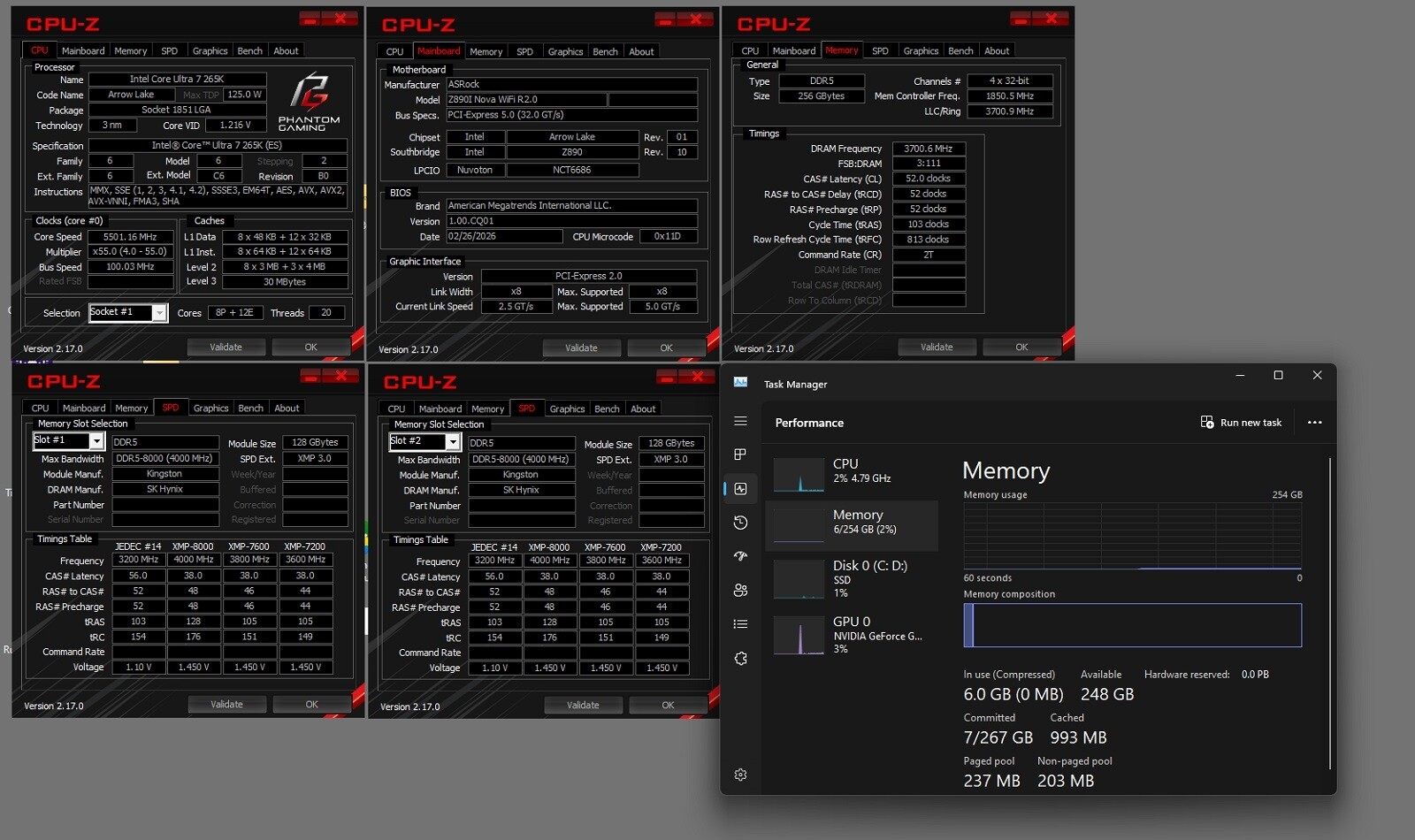
- Memory Support: 256GB DDR5-7400 (via two 128GB CQDIMM modules)
- Module Type: CQDIMM (4-rank CUDIMM design, max 128GB per module)
- Native Speed: DDR5-7200 (optimized to DDR5-7400 on this platform)
- Use Cases: AI computing, content creation, professional workloads
The practical implication is clear: systems built around this motherboard can now handle datasets and computations that would previously require multiple machines or expensive distributed setups. For enterprises, this means reduced latency in data processing and more efficient use of high-end GPUs like the RTX 5090, which itself demands significant memory bandwidth to operate at its full potential.
While the price point remains a consideration—such performance typically comes with premium hardware costs—the Z890I Nova WiFi R2.0 sets a new standard for what’s achievable in mainstream platforms. For now, it stands as a milestone, proving that memory capacity and speed don’t have to be mutually exclusive.