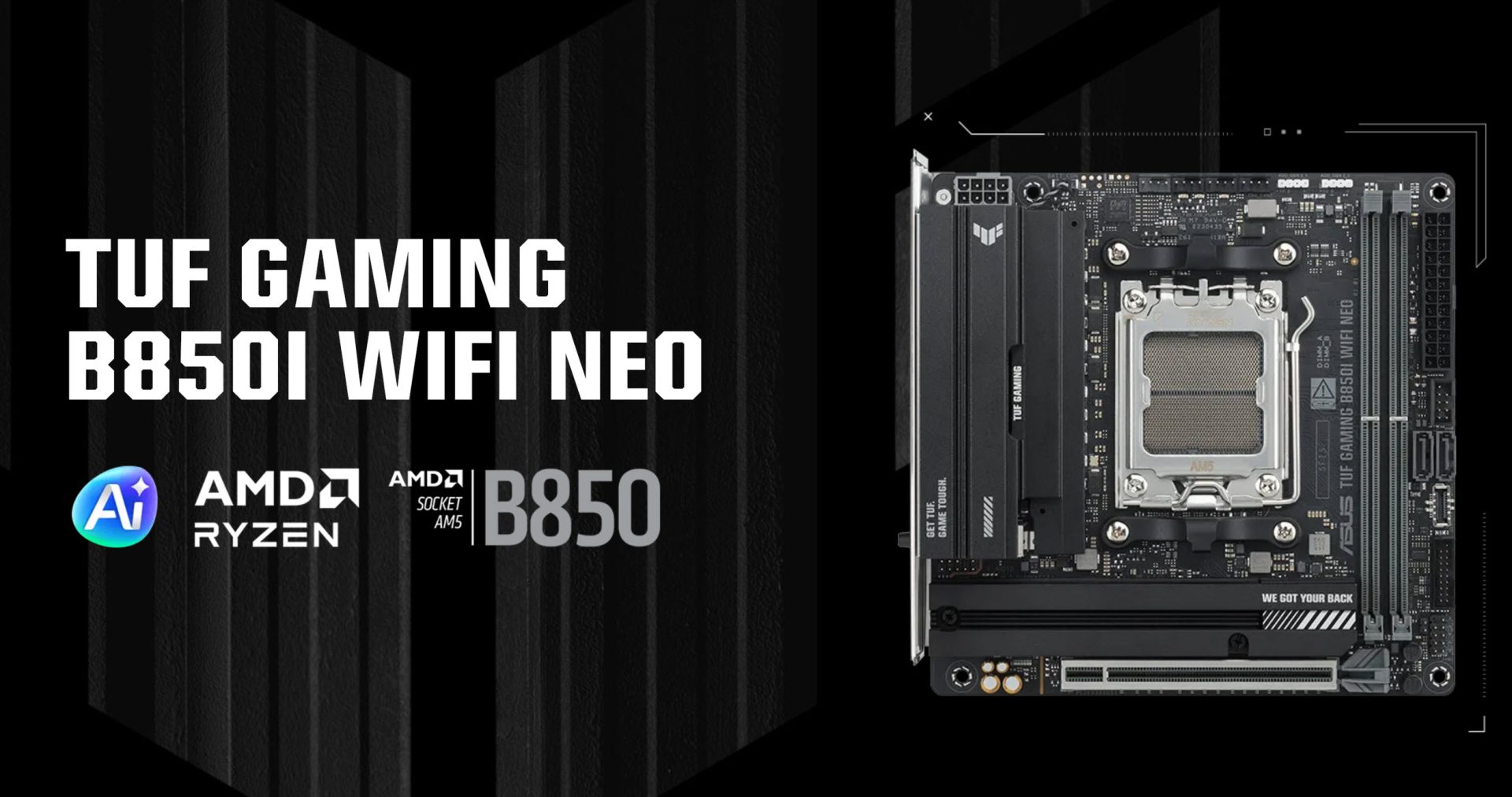
A builder’s workflow hinges on balance: performance that keeps up with modern workloads, but cost that doesn’t force compromises elsewhere in the system. The TUF Gaming B850I WIFI NEO from ASUS delivers exactly that—AM5 compatibility, PCIe 5.0 lanes for next-gen GPUs and SSDs, and enterprise-grade durability, all on a mini-ITX board priced to challenge conventional wisdom about what a high-end motherboard should cost.
This isn’t just a rebranded budget board. It’s an engineering compromise that ASUS has executed carefully: cutting corners where it shouldn’t (like VRM cooling), but not where it matters—like signal integrity, connectivity, and long-term upgrade paths.
The Specs at a Glance
- Form factor: mini-ITX (170 × 170 mm)
- Socket: AM5 (Ryzen 7000 series)
- Chipset: B850 (no PCIe 4.0 lanes, but PCIe 5.0 x16 for GPU and M.2 slots)
- RAM support: Dual-channel DDR5 up to 128 GB, official QVL list provided
- Storage: Two M.2 slots (one PCIe 5.0, one PCIe 4.0), six SATA ports
- Networking: Intel Wi-Fi 6E (2x2) and Intel 2.5G Ethernet with ASUS Aura Sync integration
- Audio: SupremeFX A1 with ESS Sabre DAC for high-fidelity output
- VRM: 10+2 phases, 45A per phase, heatsink included (but not active cooling)
- Cooling: Two M.2 heatsinks (one with active fan), pre-installed I/O shield, TUF components (capacitors, chokes, MOSFETs)
- Ports: 1x USB-C, 3x USB-A (Type-A), 4x USB 3.2 Gen 1, 6x SATA, HDMI 2.1 output
- Price: $150 (MSRP, subject to regional availability)
The board’s most interesting tradeoff is its chipset choice. The B850 lacks native PCIe 4.0 lanes, which usually means slower M.2 performance for secondary drives or limited overclocking headroom on the CPU. But ASUS has mitigated this by routing one of the two M.2 slots via PCIe 5.0—meaning the primary slot can max out at 110 GB/s, while the secondary drops to 32 GB/s (PCIe 4.0). For most users, especially those pairing it with a high-end GPU, this won’t be a bottleneck.
Where the B850I WIFI NEO shines is in connectivity. The inclusion of Wi-Fi 6E and 2.5G Ethernet isn’t just about speed—it’s about future-proofing. Many budget motherboards still ship with older Wi-Fi 5 or no wired gigabit, leaving builders scrambling for upgrades later. This board avoids that pitfall entirely.
Why It Matters
The real story here is platform lock-in versus flexibility. AM5 systems are designed to last, but motherboards in this price tier often cut corners on features that developers and power users rely on daily—like stable PCIe 4.0 lanes for multiple M.2 drives or robust VRM cooling for sustained workloads. The B850I WIFI NEO doesn’t solve every problem (the lack of active VRM cooling is a notable omission), but it addresses the most critical ones without overpromising.
For developers building workstations, this means less time debugging storage bottlenecks and more time focusing on code. For gamers, it means not having to choose between a fast SSD and a high-end GPU because of lane limitations. And for budget-conscious builders, it’s proof that you don’t need to spend $250+ to get PCIe 5.0 support, Wi-Fi 6E, and enterprise-grade build quality.
What remains unconfirmed is long-term support. ASUS hasn’t specified if future BIOS updates will add features like CPU overclocking (B850 chipsets typically don’t support it), so users eyeing Ryzen 7000’s performance headroom should check update schedules post-launch.
The TUF Gaming B850I WIFI NEO launches with an MSRP of $150, placing it squarely in the ‘premium budget’ segment. Availability depends on regional stock, but ASUS has historically moved quickly to clear initial batches—so expect it on shelves within weeks.