Few franchises have been as relentlessly mocked as Doom* at the movies. The 2005 adaptation, with its 18% Rotten Tomatoes score, sits alongside Ghost Rider and Assassin’s Creed as a cautionary tale of what happens when Hollywood tries to translate a first-person shooter into live action. But the real crime isn’t that Doom exists—it’s that critics treated it like a serious film when it was never meant to be one.
This isn’t Alien, a slow-burn horror masterpiece with existential weight. It’s not Event Horizon, a cursed spaceship allegory wrapped in religious dread. Doom is a four-beer, shout-at-the-screen brawler where the opening scene drops you into a squad of doomed marines so sleazy and over-the-top they might as well be walking out of a Top Secret! parody. Sarge (Dwayne Johnson in his pre-Rock days) flexes shirtless because why waste time on subtlety, while the greasy Portman and the Bible-reading Goat—who catches fruit without looking—set the tone: these aren’t heroes. They’re idiots with guns, and they’re about to die.
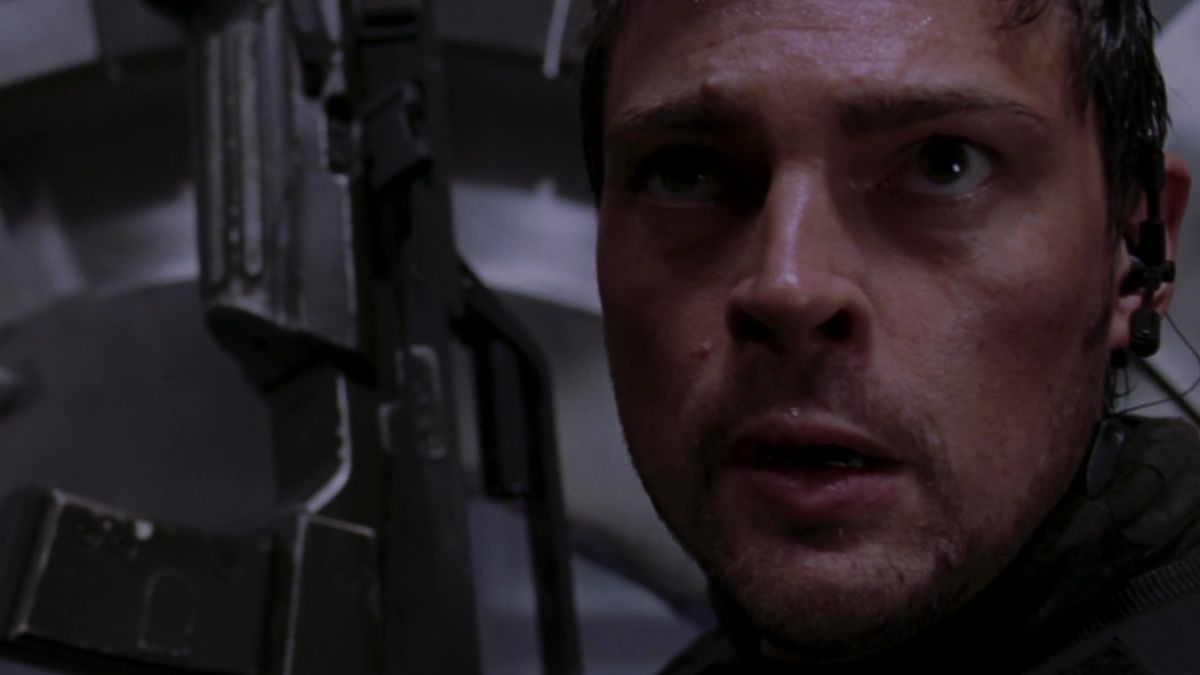
The film’s Mars-bound crew is a masterclass in character introduction through absurdity. The Kid, wide-eyed and doomed, is the obvious sacrificial lamb. Reaper (Karl Urban, channeling a proto-Dredd vibe) methodically cleans his weapons, the only one in the group who seems to understand the gravity of their mission. And then there’s Duke, tuning a Futuretronics Galaxian 2 to remind you that this is a world where videogames exist—because of course they do. This isn’t worldbuilding; it’s a middle finger to anyone expecting depth.
And that’s the point. Doom doesn’t apologize for being dumb. It leans into it. The opening act is a love letter to ‘80s action-horror, where characters bark one-liners, chew scenery, and die in increasingly creative ways. When the marines arrive on Mars, they’re greeted by Pinky Pinzerowski—a technician with a mechanical lower body—because why not? The film’s pseudoscience explanation for the demons (ancient alien experiments) is lazy, but it’s also a deliberate choice to avoid the religious symbolism that might offend purists. For fans who grew up during the Satanic Panic, the pentagrams and demonic imagery might carry weight. For everyone else, it’s just another excuse for explosions.
The real magic happens when Doom stops trying to be smart. The pacing is relentless, the gore is gloriously unhinged (a computer monitor as a weapon in 2046? Yes.), and the first-person sequence—a rare moment where the film fully commits to the source material—is a four-minute, adrenaline-fueled train ride through a haunted house of demons. It’s not just a set piece; it’s a middle finger to every other videogame movie that tried to be serious.
Compare it to Doom: Annihilation (2019), which ends on a cliffhanger because someone thought a sequel was inevitable. Doom (2005) knows better. It throws in a bare-knuckle boss fight, a finale that feels like a punchline, and then walks away—no sequels, no reboots, just a defiant ‘fuck off’ to the audience. The 2019 version tried to split the difference between ancient aliens and Hell demons, but the imps looked so weak it was a wonder anyone took it seriously. Doom (2005) doesn’t care. It’s a love letter to the original game’s chaos, where the only rule is ‘have fun.’
Clint Mansell’s score—pulsing, aggressive, and perfectly matched to the film’s energy—is the cherry on top. It’s not Aliens’ haunting themes or The Thing’s paranoia. It’s pure, unfiltered action-horror, the kind of soundtrack that makes you want to grab a controller and blow something up. Doom* (2005) isn’t the worst videogame movie. It’s the only one that got it right.