The GeForce RTX 2080 arrived in late 2018 as more than just a performance upgrade—it was a turning point in how games render light and shadow. While rasterization had dominated for decades, the RTX 2080 introduced the first consumer-grade GPU capable of real-time ray tracing, a technique previously reserved for offline film production. This wasn’t just about faster frames; it was about reimagining the entire graphics pipeline.
From Fixed Pipelines to Flexible Compute
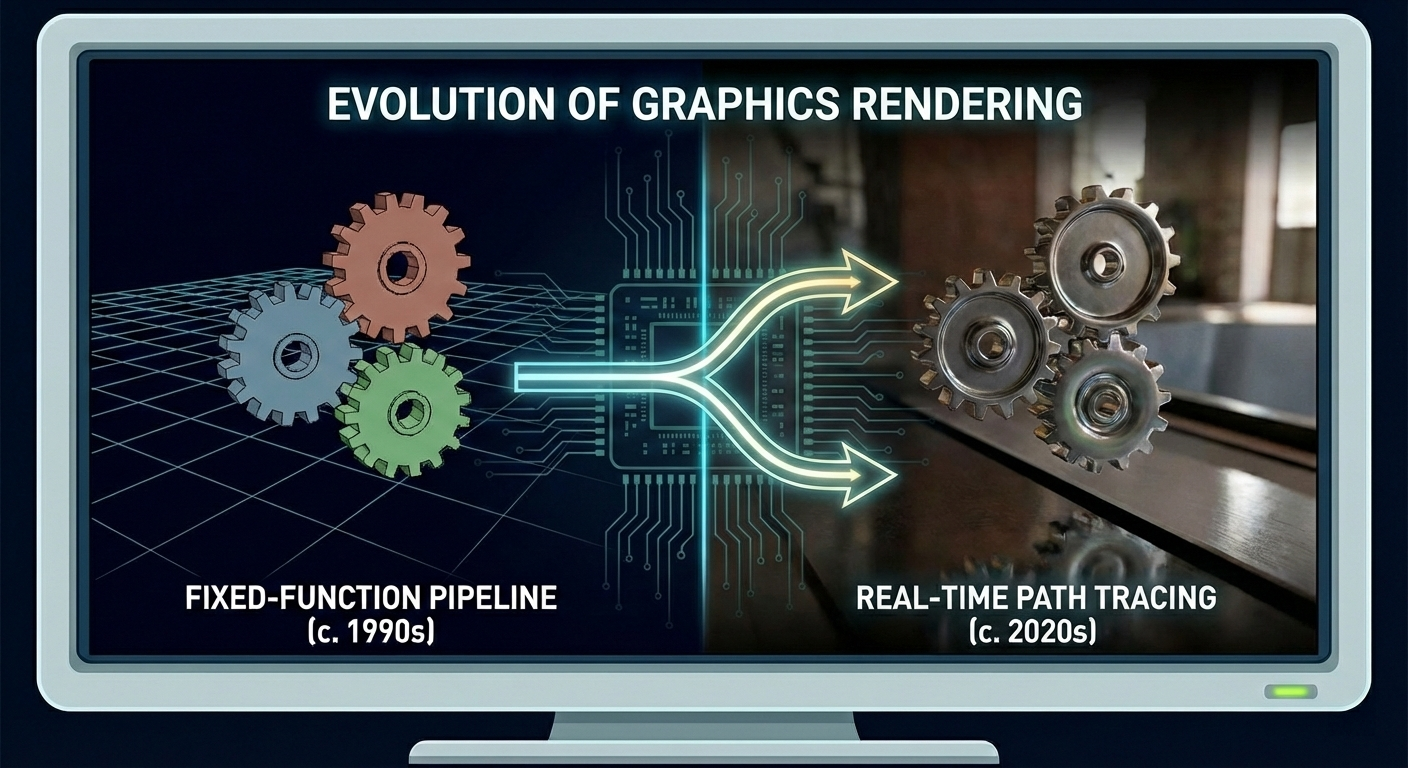
Before the RTX 2080, GPUs were constrained by rigid, hardware-defined stages. Vertex transformations, lighting calculations, and texturing were locked into silicon, forcing developers to work around limitations with clever tricks like lightmaps and environment mapping. The shift to programmable shaders in the early 2000s broke that mold, but even then, GPUs remained specialized—separate units for vertices and pixels led to inefficiencies.
A Pipeline Built for Hybrid Rendering
The RTX 2080 didn’t replace rasterization; it enhanced it. Modern games now blend both approaches: rasterization handles geometry efficiently, while ray tracing adds realism to lighting effects. This hybrid model became the foundation for titles like Cyberpunk 2077 and Minecraft RTX, where dynamic reflections and physically accurate shadows run in real time.
But raw ray tracing still required brute-force calculations. To make it practical, NVIDIA paired RT cores with Tensor cores, which powered DLSS Super Resolution. This AI-driven upscaling rendered frames at lower resolutions, then intelligently upscaled them with minimal quality loss—effectively doubling performance in ray-traced scenes.
Legacy and the Future
The RTX 2080’s impact extends beyond its launch. It proved that real-time ray tracing wasn’t just a gimmick—it was a viable path forward. Later architectures like Ampere and Blackwell refined the approach, adding features like mesh shaders and variable rate shading to further optimize hybrid pipelines. Today, games push boundaries with techniques like path tracing, where nearly all lighting is simulated via ray-based methods, though even this remains computationally intensive.
What began as a fixed-function pipeline has evolved into a flexible, AI-augmented system where hardware and software co-design every frame. The RTX 2080 wasn’t just a GPU—it was the catalyst for a new era in gaming visuals.