What is this partnership really about? At its core, the collaboration between Dassault Systèmes and NVIDIA is not just about combining two powerful technologies—it’s about redefining how industries think about AI. The result is an architecture that transforms Virtual Twin simulations into self-optimizing, science-backed Industry World Models. These are not static digital replicas but dynamic, AI-enhanced systems capable of learning, predicting, and even autonomously adjusting production processes in real time.
Unlike conventional AI tools that operate in silos, this framework integrates seamlessly with existing industrial workflows. The goal? To create a unified digital thread that spans from initial design to final production, ensuring every decision is data-driven, physics-validated, and scalable across global operations.
What’s actually changing? The partnership introduces three key innovations
- Agentic Virtual Companions—AI assistants embedded within the 3DEXPERIENCE platform that act as industrial co-pilots, providing real-time insights, troubleshooting, and optimization suggestions based on deep domain expertise.
- Physics-Aware AI—A fusion of NVIDIA’s AI libraries with Dassault’s simulation tools, enabling models to not just predict outcomes but explain them through scientific principles, reducing reliance on guesswork.
- Autonomous Production Systems—Factories that can self-adjust to disruptions, reallocate resources dynamically, and even redesign processes on the fly using AI-driven Virtual Twins.
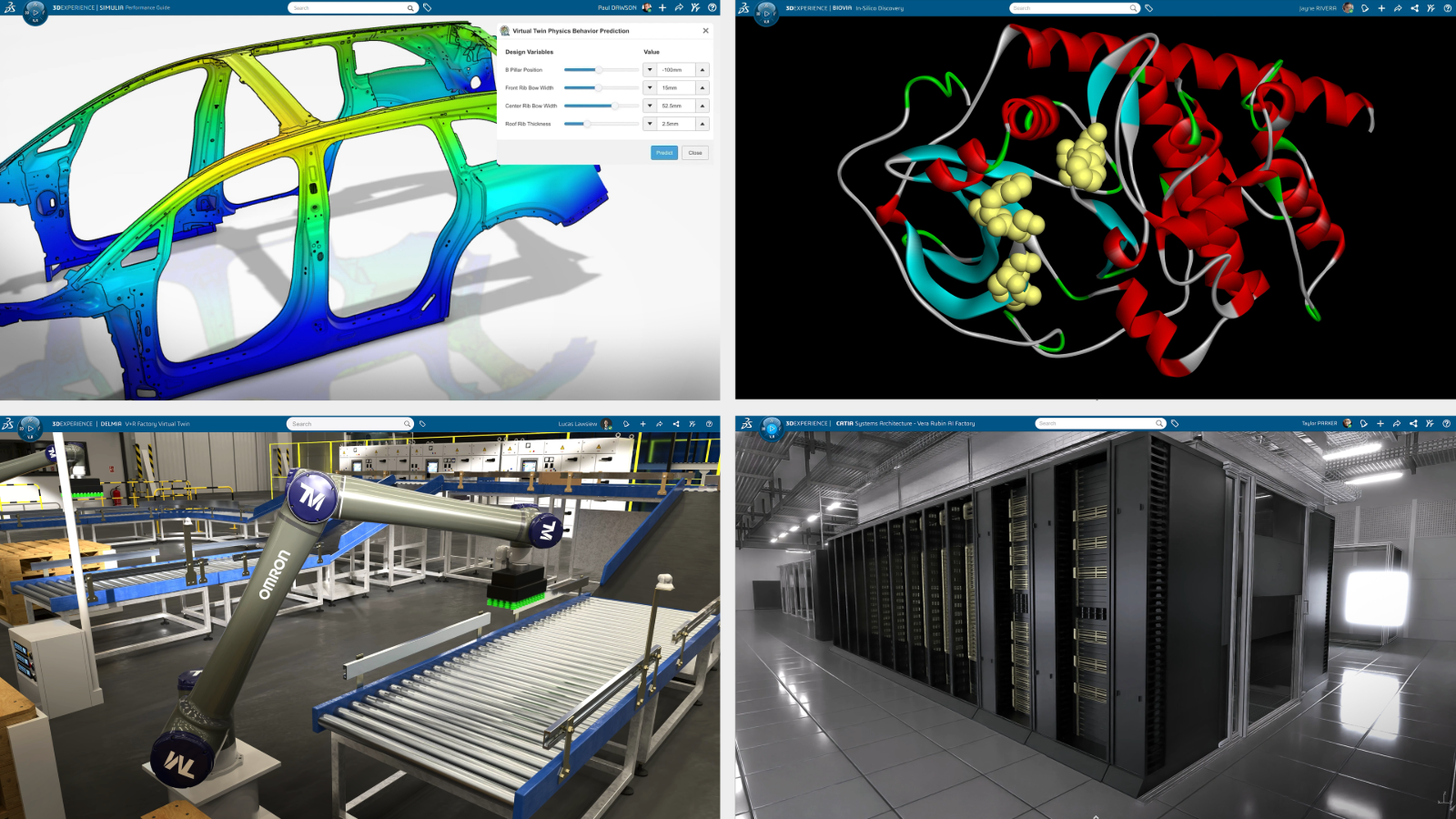
Why should industries care? The implications are vast. For manufacturers, this means fewer physical prototypes, faster time-to-market, and production lines that adapt without human intervention. In biology and materials science, researchers can simulate molecular interactions at unprecedented speeds, accelerating discoveries like drug development or advanced composites. Even engineering teams gain access to real-time multi-physics simulations, where AI anticipates structural weaknesses, thermal stresses, or fluid dynamics before they become costly problems.
The real breakthrough? Trust. Industrial AI has long struggled with skepticism—what if the model is wrong? What if the data is biased? This partnership addresses those concerns by grounding AI in validated physics and industrial best practices, not just machine learning. The result is a system where AI doesn’t just crunch numbers—it understands the laws governing the physical world.
When will this be available, and what will it cost? The collaboration is already in motion, with early deployments expected later this year. Dassault Systèmes’ OUTSCALE cloud will host AI factories—sovereign, secure environments where companies can run these models without compromising data integrity. Pricing will vary by use case, but the focus is on scalability; industries can start with pilot programs in specific departments (e.g., R&D or supply chain) before expanding.
NVIDIA’s role extends beyond hardware—its Omniverse platform will serve as the digital backbone, enabling real-time collaboration between AI models, human engineers, and physical systems. For example, an engineer in Paris could tweak a design in a Virtual Twin, and within minutes, an AI companion in Shanghai could simulate its impact on a global production line, flagging potential bottlenecks before they occur.
Who stands to benefit first? Early adopters are already lining up. Bel Group, for instance, will use the combined power of the partnership to design fully recyclable food packaging—a process that typically requires years of physical testing. By leveraging AI-driven Virtual Twins, they can iterate designs in weeks, slashing development costs while meeting sustainability goals. Meanwhile, OMRON is exploring fully autonomous factories where AI companions monitor quality control, predict equipment failures, and even retrain robotic arms mid-production.
In aerospace, the National Institute for Aviation Research (NIAR) sees a future where digital certification replaces much of the paperwork-heavy approval process. Instead of submitting physical test results, engineers could run AI-validated simulations that prove compliance with regulations—a game-changer for industries where delays cost millions.
What’s the long-term vision? The partnership isn’t just about incremental improvements; it’s about reimagining how industries operate. The ultimate goal is a world where AI isn’t a tool but a partner in innovation—one that learns from every production run, every design iteration, and every scientific discovery. For Dassault Systèmes, this means evolving from a software provider to a digital sovereignty enabler, ensuring industries retain control over their data while unlocking AI’s full potential. For NVIDIA, it’s about pushing the boundaries of physical AI, where simulations aren’t just digital mirrors of reality but active participants in shaping it.
The announcement at 3DEXPERIENCE World was more than a product launch—it was a manifest for the next decade of industrial AI. The message is clear: the future isn’t just digital. It’s autonomous, adaptive, and science-driven. And for the first time, industries have the tools to make it a reality.