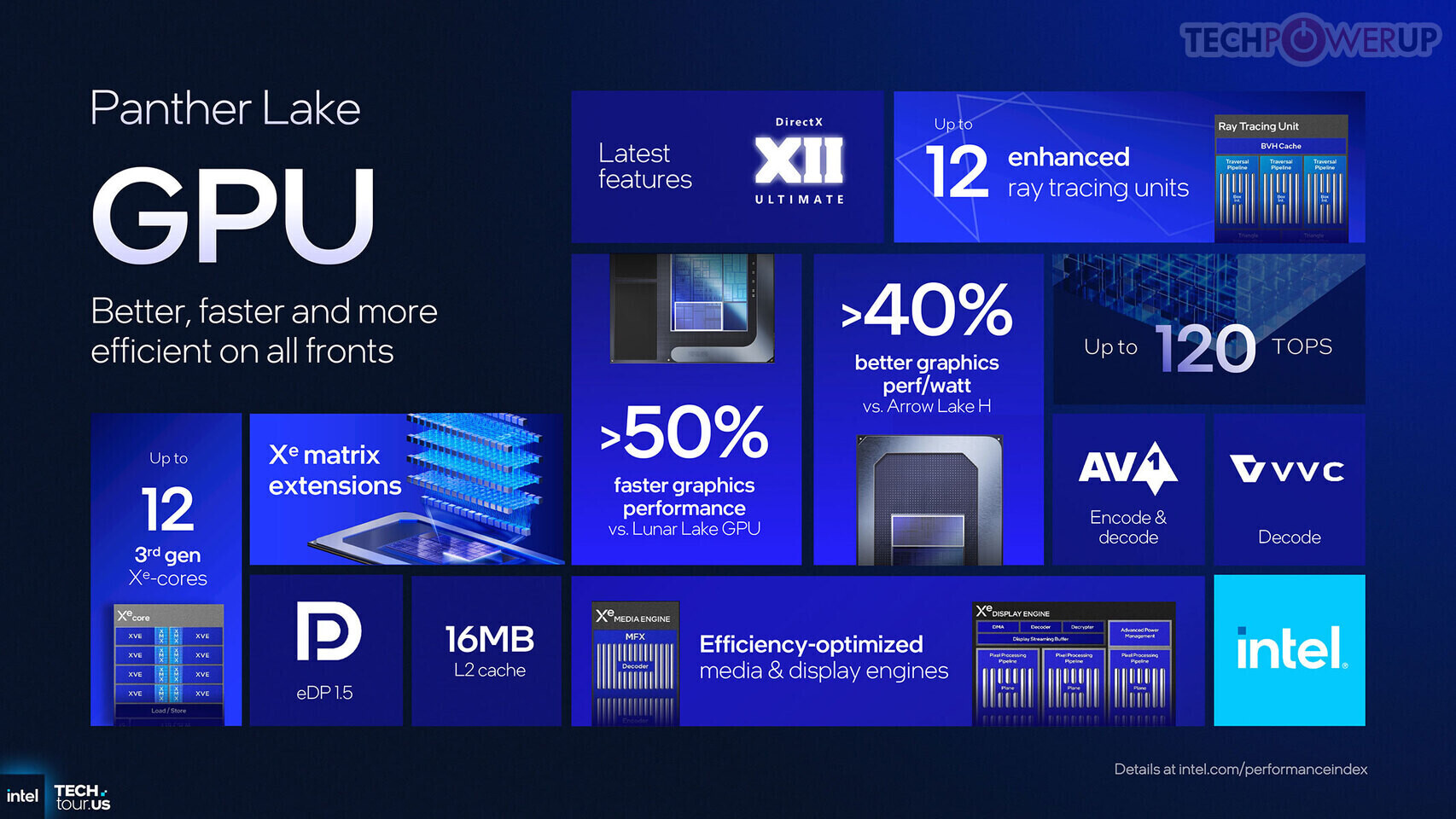
For years, integrated graphics have been the domain of compromise—low power, modest performance, and a clear separation between what’s affordable and what’s capable. Intel’s new Arc B370 challenges that narrative. Built into the Core Ultra 5 338H, this 10-core Xe3-based GPU doesn’t just bridge the gap between budget and performance; it narrows it to a whisper.
The B370’s arrival is particularly notable because it doesn’t rely on brute-force specs to compete. While the B390—with its 12 cores and higher base clock—has been the darling of early Panther Lake-H benchmarks, the B370’s efficiency is its secret weapon. At 20 watts, the two GPUs are nearly indistinguishable in synthetic workloads, a testament to Intel’s fine-tuning of its Xe3 architecture. Even at 35 watts, where the B370’s 2.4 GHz clock sits just 0.1 GHz behind the B390’s 2.5 GHz, the performance gap shrinks to a modest 6%. That’s not just progress—it’s a statement.
What makes this even more intriguing is the B370’s potential to redefine value in mobile graphics. For users who don’t need the absolute peak performance of a Core Ultra 300 system, the B370 offers a compelling alternative. It supports up to 8533 MHz LPDDR5X memory—a speed typically reserved for high-end configurations—and maintains full compatibility with Intel’s 4K display capabilities. This isn’t just an upgrade; it’s a reimagining of what an integrated GPU can deliver without requiring a premium price tag.
The implications for the broader market are significant. If Intel can sustain this level of performance in a lower-tier iGPU, it could pressure competitors to rethink their own integrated graphics strategies. AMD’s Radeon 890M, for instance, has long been the benchmark for mobile iGPU performance, but the B370’s efficiency suggests Intel is no longer content to play second fiddle. For OEMs, this means more flexibility in configuring systems without sacrificing graphics capability.
Yet questions remain. The Core Ultra 5 338H is still an engineering sample, and real-world performance can vary based on driver optimization, thermal throttling, and system integration. Intel has promised further refinements with Panther Lake-H’s full launch, but whether the B370 can maintain its lead—or even close the gap further—will depend on how aggressively Intel pushes clock speeds and power efficiency in the final silicon.
One thing is clear: the B370 isn’t just filling a niche. It’s setting a new benchmark for what an integrated GPU can achieve, and it’s doing so at a time when the industry is hungry for alternatives that don’t require sacrificing performance for affordability. As CES 2026 approaches, all eyes will be on whether Intel can turn this engineering sample into a mainstream reality—or if the B370 will remain a tantalizing glimpse of what’s possible.
For now, the message is unmistakable: in the world of mobile graphics, the line between budget and capability just got a lot fuzzier.
Why This Matters
The B370’s performance isn’t just about raw numbers—it’s about redefining expectations. For gamers and creators who’ve grown accustomed to discrete GPUs, an integrated solution that delivers near-flagship performance without the power draw could be a game-changer. It also signals Intel’s willingness to innovate beyond the high-end, ensuring that even mid-range systems can deliver compelling visual experiences. As the company prepares to unveil more details at CES 2026, the B370 serves as a reminder that sometimes, the most disruptive advancements aren’t found in the flagship products—but in the ones that rethink the rules entirely.
What’s Next
With the Core Ultra 5 series still in its early stages, the next few months will be critical in determining whether the B370’s promise translates into real-world performance. Intel’s ability to optimize drivers, refine power management, and ensure stability will dictate how widely this GPU is adopted. If successful, we could see a shift in how OEMs configure systems, with more emphasis on integrated graphics that don’t compromise on capability. For consumers, this could mean thinner, lighter, and more efficient devices that don’t require a discrete GPU for demanding tasks.
The B370 isn’t just an upgrade—it’s a challenge to the status quo. And if Intel delivers on its potential, it could redefine what we expect from integrated graphics for years to come.