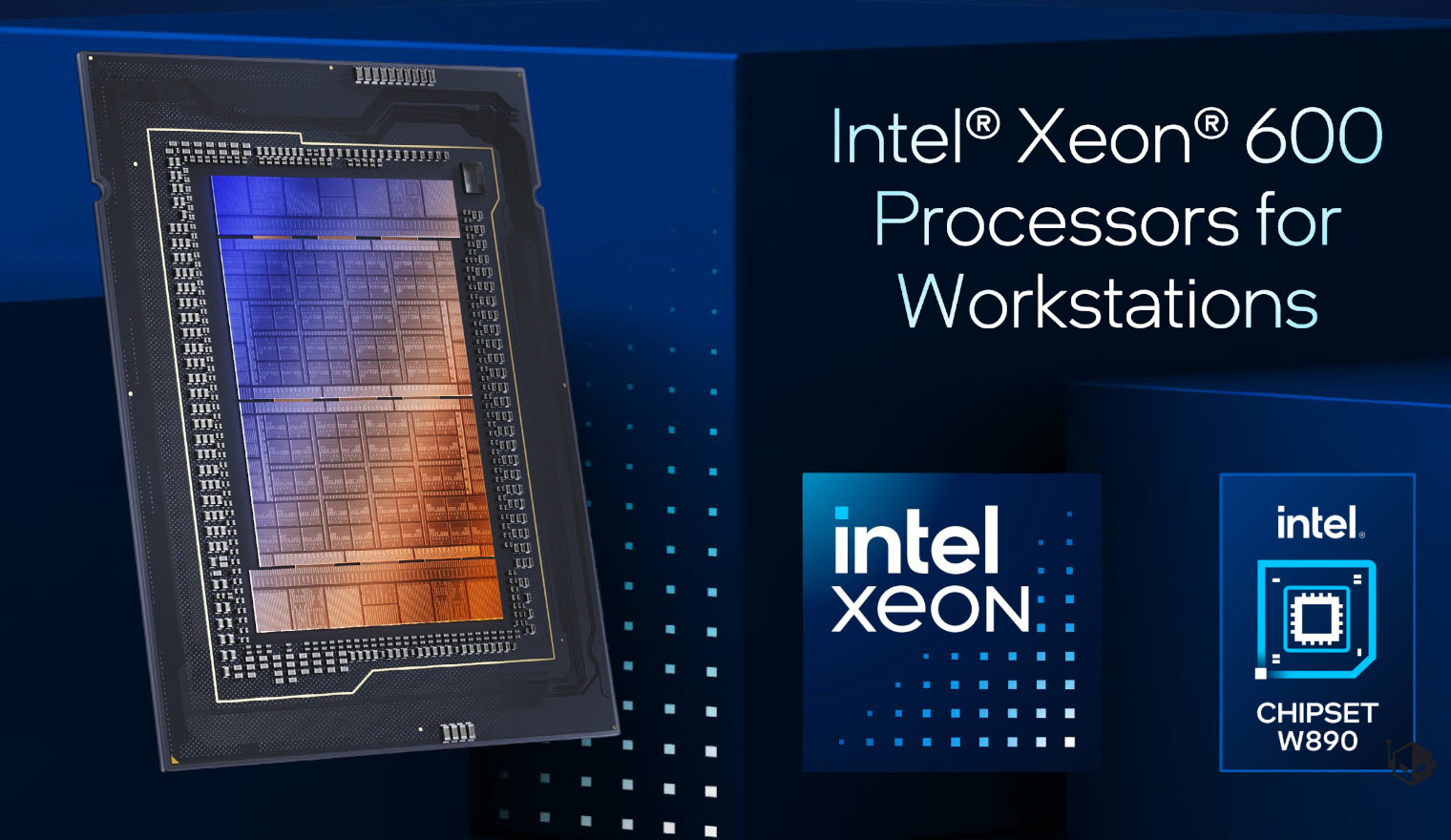
Intel has launched its latest workstation CPUs, the Xeon 600 series, codenamed Granite Rapids, marking a significant leap in core count, memory bandwidth, and efficiency compared to its predecessor. The lineup consolidates mainstream and expert workstation offerings under a single brand, simplifying selection for professionals in AI development, media, energy modeling, and high-performance computing.
The flagship Xeon 698X sets the bar with 86 cores, 172 threads, and a base clock of 2.0 GHz, boosting up to 4.8 GHz. It features 336 MB of L3 cache, 128 PCIe 5.0 lanes, and support for DDR5-6400 UDIMM or DDR5-8000 RDIMM across eight channels. The chip’s base TDP is 350W, with a maximum turbo power of 420W—substantially more efficient than the previous generation’s Xeon W-3500 series.
Unlike server-focused UCC-class chips, Granite Rapids uses a modular approach with XCC (dual-chiplet), HCC (high-core-count), and LCC (lower-core-count) dies to balance performance and form factor constraints. The top-tier XCC-based models (Xeon 698X and 696X) dominate with up to 86 and 64 cores, respectively, while HCC dies power mid-range chips (48–24 cores), and LCC dies handle entry-level SKUs (20–12 cores).
- Xeon 698X: 86 cores / 172 threads, 2.0–4.8 GHz, 336 MB L3, DDR5-8000 RDIMM/6400 UDIMM, 128 PCIe 5.0, 350W TDP, $7699
- Xeon 696X: 64 cores / 128 threads, 2.4–4.8 GHz, 336 MB L3, DDR5-8000 RDIMM/6400 UDIMM, 128 PCIe 5.0, 350W TDP, $5599
- Xeon 678X: 48 cores / 96 threads, 2.4–4.9 GHz, 192 MB L3, DDR5-6400, 128 PCIe 5.0, 300W TDP, $3749
- Xeon 676X: 32 cores / 64 threads, 2.8–4.9 GHz, 144 MB L3, DDR5-6400, 128 PCIe 5.0, 275W TDP, $2499
- Xeon 674X: 28 cores / 56 threads, 3.0–4.9 GHz, 144 MB L3, DDR5-6400, 128 PCIe 5.0, 270W TDP, $2199
- Xeon 658X: 24 cores / 48 threads, 3.0–4.9 GHz, 144 MB L3, DDR5-6400, 128 PCIe 5.0, 250W TDP, $1699
- Xeon 656: 20 cores / 40 threads, 2.8–4.8 GHz, 72 MB L3, DDR5-6400, 80 PCIe 5.0, 210W TDP, $1399
- Xeon 654: 18 cores / 36 threads, 3.1–4.8 GHz, 72 MB L3, DDR5-6400, 80 PCIe 5.0, 200W TDP, $1199
- Xeon 638: 16 cores / 32 threads, 3.2–4.8 GHz, 48 MB L3, DDR5-6400, 80 PCIe 5.0, 180W TDP, $899
- Xeon 636: 12 cores / 24 threads, 3.5–4.7 GHz, 48 MB L3, DDR5-6400, 80 PCIe 5.0, 170W TDP, $639
- Xeon 634: 12 cores / 24 threads, 2.7–4.6 GHz, 48 MB L3, DDR5-6400, 80 PCIe 5.0, 150W TDP, $499
The Xeon 600 series introduces full overclocking support across six unlocked SKUs, including advanced telemetry, per-die tuning, and AVX-512 optimizations. Intel has partnered with OCBASE to integrate these features into the OCCT app, offering dynamic overclocking, stability testing, and benchmarking for both Windows and Linux. The platform is anchored by the W890 chipset, which supports Wi-Fi 7, 2.5GbE LAN, USB 3.2 Gen 2x2 (20Gbps), and up to 4 TB of DDR5 memory (8-channel) or 2 TB (4-channel). PCIe 5.0 lanes are fully utilized, with 128 available on high-end models, enabling multi-GPU setups for AI and rendering workloads.
Performance gains are notable across key workloads, with the Xeon 698X delivering up to 61% faster financial modeling, 74% faster Blender rendering, and 24% improvements in linear algebra tasks compared to the prior-generation Xeon W-3595X. The series also excels in AI acceleration, thanks to AMX (Advanced Matrix Extensions) support for INT8, BFloat16, and FP16 operations, making it a strong contender for AI developers.
Intel positions the Xeon 600 as a more cost-effective alternative to AMD’s Threadripper 9000, offering comparable core counts at lower prices. For example, the 64-core Xeon 696X ($5599) undercuts AMD’s 64-core Threadripper 9985WX ($7999) by $2400, while the 86-core Xeon 698X ($7699) remains significantly cheaper than the 96-core Threadripper 9995WX ($11699). Even entry-level models like the 24-core Xeon 658X ($1699) outperform AMD’s 24-core Threadripper 9960X ($1419) in memory bandwidth and PCIe lanes.
Availability begins in late March, with five SKUs (Xeon 696X, 678X, 676X, 658X, and 654) offered in retail boxes. The launch aligns with Intel’s broader push into high-performance computing, particularly for AI and data-intensive applications, while the W890 platform ensures compatibility with upcoming Arc Pro GPUs and next-generation workstations.