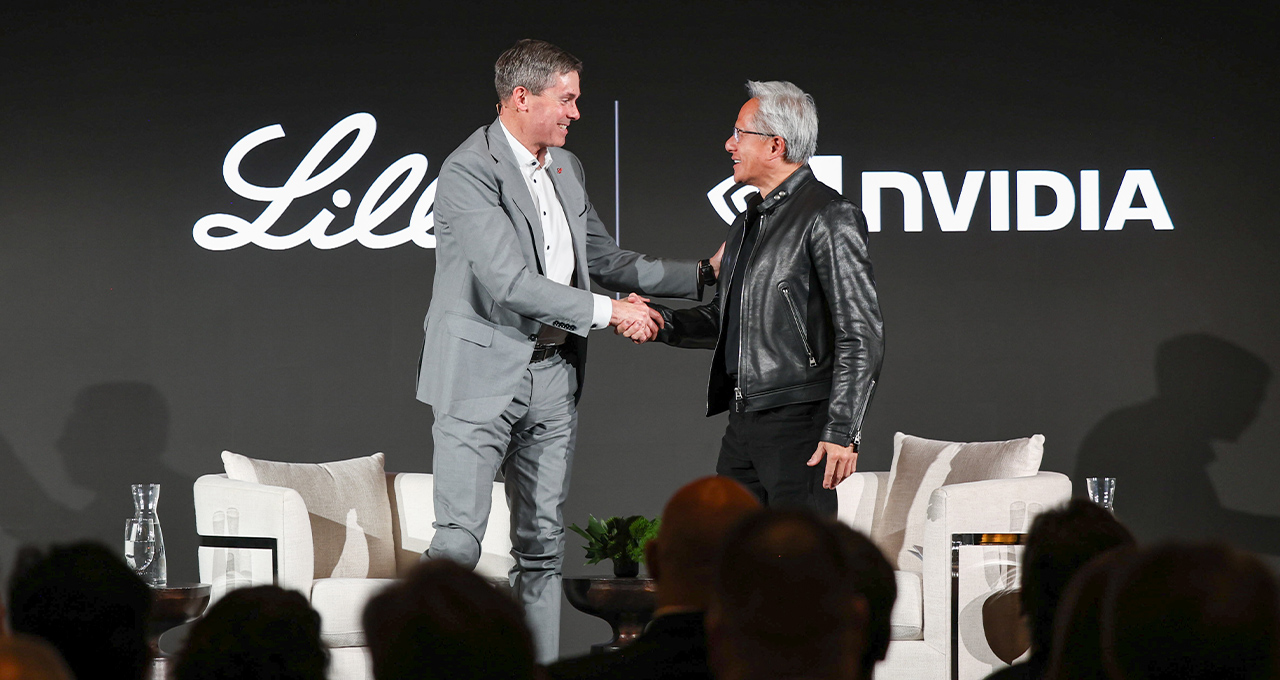
NVIDIA and Eli Lilly are pioneering an innovative approach to drug discovery that blends artificial intelligence with pharmaceutical innovation. This partnership aims to redefine the speed and precision of medical research, offering a roadmap for how AI can transform one of science’s most complex challenges.
The collaboration focuses on integrating NVIDIA’s cutting-edge computing capabilities—particularly its AI platforms—with Eli Lilly’s deep expertise in drug development. The goal is to streamline the discovery process, from initial molecular analysis to clinical trials, by leveraging data-driven insights and computational power that traditional methods struggle to match.
AI as the Accelerator
At the heart of this initiative is NVIDIA’s ability to process vast datasets with unprecedented speed. The company’s AI platforms, designed for high-performance computing, can analyze molecular structures, simulate drug interactions, and predict outcomes with a level of accuracy that accelerates research timelines significantly. For instance, tasks that might take months using conventional methods can be completed in weeks or even days when powered by these systems.
Eli Lilly’s role is to bring pharmaceutical domain knowledge to the table, ensuring that AI-driven insights are applied effectively in real-world drug development scenarios. This synergy between computational power and scientific expertise creates a feedback loop where AI models continuously learn from experimental data, refining their predictions over time.
A Blueprint for the Future
The partnership is not just about optimizing existing processes; it’s about reimagining what’s possible in drug discovery. NVIDIA’s founder and CEO has emphasized that this collaboration represents a ‘blueprint’ for how AI can be harnessed to solve complex problems in healthcare. The focus is on creating scalable, reproducible methods that can be adopted across the industry.
One of the key areas of exploration is the use of generative AI to design novel drug candidates. By training models on vast chemical databases, researchers can generate potential compounds that meet specific criteria—such as binding affinity or solubility—before they are synthesized in a lab. This approach drastically reduces the trial-and-error phase of drug development, saving both time and resources.
Performance and Efficiency
NVIDIA’s AI platforms, including its latest GPUs and accelerated computing frameworks, play a critical role in this efficiency. For example, NVIDIA’s A100 GPUs deliver up to 30 TeraFLOPS of performance for mixed-precision workloads, which is essential for training deep learning models on large-scale biochemical data. Additionally, the company’s cuDNN library and other optimized software tools ensure that these systems can handle the complex calculations required for molecular modeling.
Eli Lilly has already seen promising results in its internal AI initiatives. By integrating NVIDIA’s hardware with proprietary algorithms, the company has been able to speed up virtual screening—a process used to identify potential drug candidates from vast chemical libraries—by orders of magnitude. This efficiency translates directly into faster research cycles and a higher likelihood of discovering viable treatments.
Looking Ahead
The partnership between NVIDIA and Eli Lilly is poised to set new benchmarks in drug discovery, demonstrating how AI can bridge the gap between computational power and scientific innovation. As this collaboration matures, it could serve as a model for other industries looking to adopt similar approaches, proving that the future of medical research lies at the intersection of technology and biology.