NVIDIA’s next generation of gaming GPUs will prioritize ray tracing performance over raw rasterization speed, a shift that could reshape how consumers evaluate graphics cards—but at the cost of more conservative advancements in traditional rendering.
The RTX 60-series is expected to leverage the Rubin architecture, already used in NVIDIA’s AI GPUs. This design focuses on enhancing real-time path tracing and neural rendering capabilities through fifth-generation RT cores and sixth-generation Tensor cores. While raster performance will see modest gains—around 30% to 35% over the current Blackwell-based RTX 50-series—the primary focus is on pushing ray tracing efficiency, potentially making DLSS 5 more accessible across a wider range of GPUs.
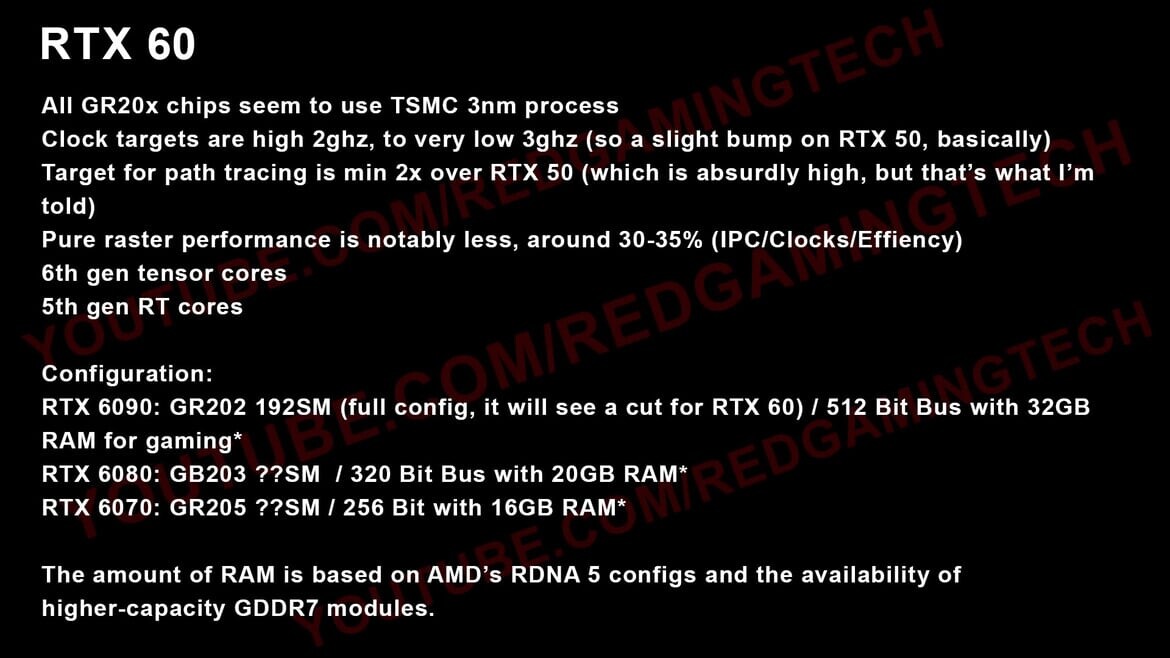
- Architecture: Rubin (TSMC 3 nm FinFET node)
- RT Cores: 5th Gen RT cores (targeting 100% ray tracing performance increase over Blackwell)
- Tensor Cores: 6th Gen Tensor cores (optimized for DLSS 5 and AI rendering)
- Memory: GDDR7, with bus widths varying by SKU
- Clock Speeds: High 2 GHz to low 3 GHz range
The top-tier RTX 6090 will retain a 512-bit memory interface and likely 32 GB of GDDR7, similar to its predecessor. The RTX 6080 is expected to move to a 320-bit bus with 20 GB of memory, offering at least 25% more bandwidth than the RTX 5080. The mid-range RTX 6070 will see the most significant memory upgrade—16 GB on a 256-bit bus—with a reported 33% bandwidth increase over the RTX 5070.
However, the shift to a TSMC 3 nm node may limit further clock speed increases, keeping performance in check compared to more aggressive foundry advancements. Whether this balance will satisfy both enthusiasts and AI workloads remains an open question, as NVIDIA appears to prioritize ray tracing scalability over raw raster performance.
Availability and pricing are not yet confirmed, but the RTX 60-series is expected to debut in late 2025 or early 2026. For now, consumers must weigh whether the focus on ray tracing justifies the transition from Blackwell, especially if traditional raster performance sees only incremental gains.