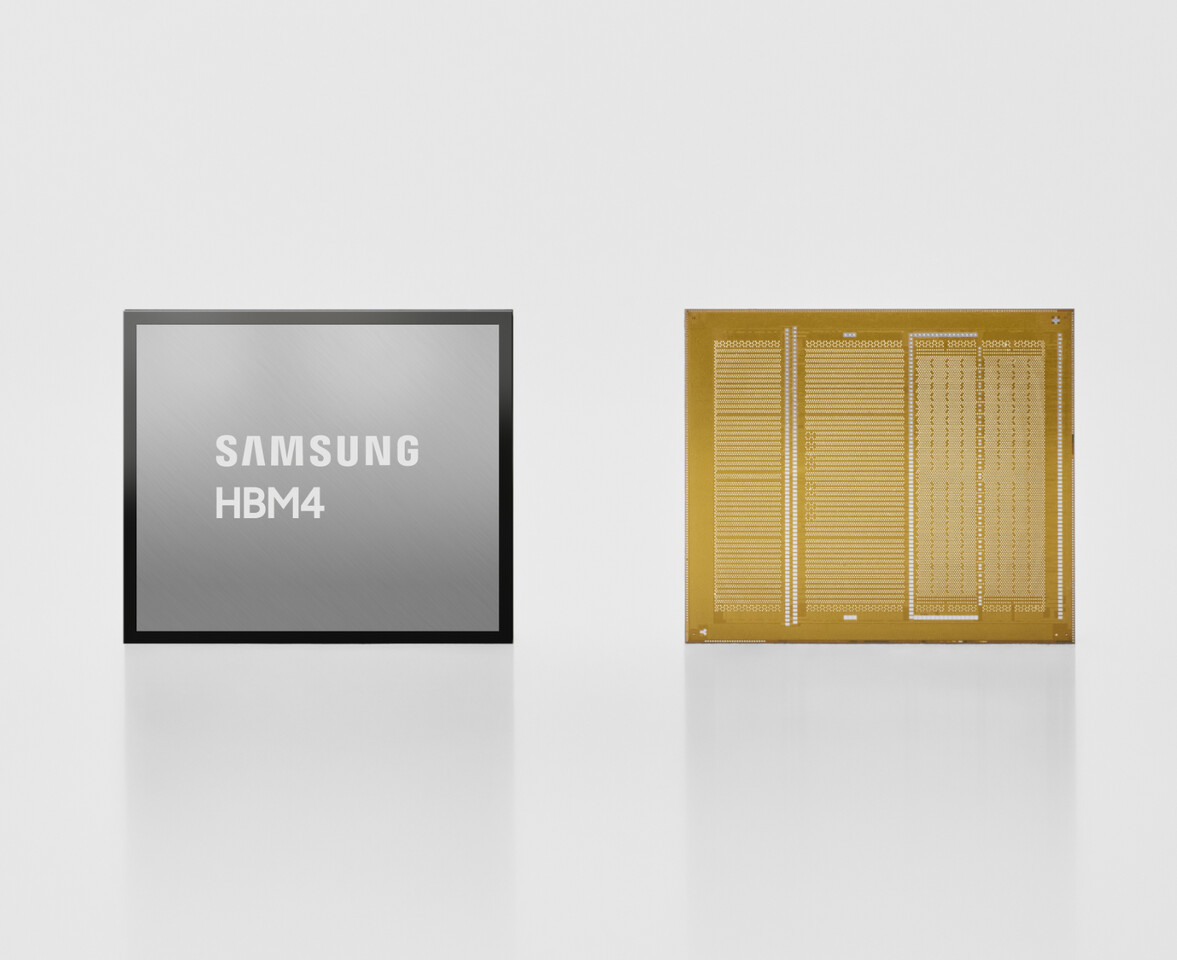
Samsung Electronics has achieved a milestone in memory technology with the commercial launch of its HBM4, marking the first industry-wide deployment of this next-generation high-bandwidth memory. The move underscores Samsung’s dominance in advanced DRAM and positioning for the exploding demand in AI and datacenter infrastructure.
The HBM4 leverages Samsung’s sixth-generation 10nm-class DRAM process and 4nm logic technology, enabling stable production without redesigns. This approach delivers unparalleled performance, including a peak speed of 13 Gbps—nearly 50% faster than the 8 Gbps industry benchmark—and up to 3.3 terabytes per second (TB/s) bandwidth per stack, a 2.7x improvement over its predecessor, HBM3E.
Beyond raw speed, HBM4 addresses critical challenges in AI computing. By doubling data I/O pins from 1,024 to 2,048, Samsung has optimized power efficiency by 40% and thermal management with a 30% boost in heat dissipation. This ensures reliability in high-density environments where power and cooling constraints are common.
The AI and Datacenter Revolution
HBM4’s capabilities are tailored for the demands of modern AI training and inference. The memory supports capacities from 24GB to 36GB using 12-layer stacking, with plans to expand to 48GB via 16-layer configurations. This aligns with the growing need for larger memory footprints in AI accelerators and GPUs, reducing bottlenecks that slow down model training.
Samsung’s DTCO (Design Technology Co-Optimization) framework—integrating its foundry and memory teams—ensures rapid iteration and high yield. The company is expanding production capacity to meet projected demand, with HBM sales expected to triple in 2026 compared to last year. Sampling for HBM4E, an enhanced variant, is set to begin in the second half of 2026, followed by custom HBM samples in 2027.
Partnerships and the Future Roadmap
Samsung is deepening collaborations with GPU manufacturers and hyperscalers to integrate HBM4 into next-generation ASICs and AI systems. The memory’s efficiency and scalability make it a critical enabler for high-performance computing clusters, where reducing total cost of ownership (TCO) is paramount.
Looking ahead, Samsung’s roadmap includes further advancements in HBM technology. The company’s in-house expertise in advanced packaging and DRAM production ensures a resilient supply chain, ready to support the surging global demand for AI infrastructure.