The 990-foot HDMI cable, while demonstrating the limits of current HDMI 2.1 standards, presents a stark contrast between technical capability and real-world usability. Its arrival follows years of incremental improvements in cable technology, where longer lengths have typically required active components or significant signal degradation. This cable, however, achieves its length without those compromises—supporting resolutions up to 16K@24Hz with Dynamic HDR while maintaining a bandwidth of 48 Gbps. Yet, the question lingers: who needs a cable this long, and what does it mean for the future of connectivity?
What Was Known Before
Before this cable, ultra-long HDMI connections were rare and often came with trade-offs. Traditional solutions for distances beyond 50 feet relied on fiber optics or active signal boosters to maintain quality. Passive cables, while simpler, suffered from signal loss the longer they became, making them impractical for anything beyond short runs in controlled environments. The introduction of HDMI 2.1 had expanded the possibilities, but even then, most implementations stuck to shorter lengths where weight and signal integrity weren’t as critical.
What Changed Now
The 990-foot cable eliminates those trade-offs by design. It avoids the ‘snake in a can’ construction seen in older ultra-long cables, which used loose conductors that could bend or kink, leading to signal degradation. Instead, it employs a tightly braided shield and high-quality copper conductors, ensuring minimal interference and consistent performance across its entire length. This isn’t just about raw specs—it’s about redefining what’s possible without active components.
- Length: 990 feet (301.46 meters)
- Weight: 2.5 pounds
- Temperature range: -40°C to +85°C
- Connector type: Single 59-pin HDMI 2.1
- Bandwidth: Supports up to 48 Gbps
- Resolutions: 4K@60Hz, 8K@30Hz, 16K@24Hz with Dynamic HDR
The cable’s durability is another standout feature. Built to withstand extreme temperatures from -40°C to +85°C, it’s designed for environments where traditional cables would fail—think outdoor installations, large venues, or industrial settings. Its weight of just 2.5 pounds, while significant compared to shorter cables, is a testament to its engineering, making it easier to handle than similar-length alternatives.
Key Details
The cable’s compatibility with HDMI 2.1 standards ensures it works seamlessly with modern displays and devices, but its length introduces new challenges. Heat buildup becomes a concern over such extended runs, requiring careful management in high-power setups. Signal degradation is also a potential issue if not properly managed, though the manufacturer claims to have mitigated this through advanced shielding and conductor design.
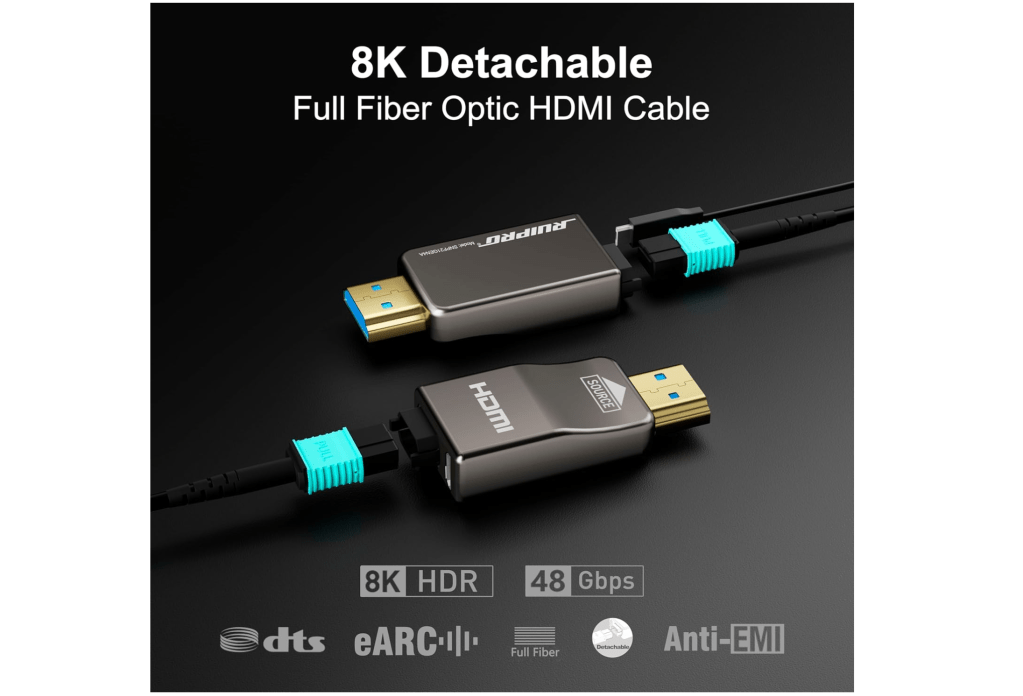
Pricing remains a barrier to widespread adoption. At $199, it’s positioned as a premium product, but for most users, the cost doesn’t justify the impracticality of its length. A single cable could replace multiple shorter ones in a professional setup, but the logistical challenges—storage, deployment, and maintenance—make it a niche solution at best.
Where This Fits in the Market
The cable’s market potential is narrow but specific. It targets large-scale installations where distance and environmental conditions make traditional cables impractical. Stadiums, convention centers, or outdoor venues are the most likely candidates, where the need for long runs outweighs concerns about weight or cost. For these use cases, it offers a plug-and-play solution that eliminates the need for complex wiring or signal boosters.
Yet, its arrival forces the industry to reconsider how we approach connectivity. As AI-driven workflows demand more bandwidth and processing power, will other interfaces like DisplayPort or USB-C see similar advancements? Or is this cable a one-off experiment that proves what’s possible but doesn’t change how most people work?
The Reality Check
For now, the 990-foot HDMI cable remains a curiosity—a technical achievement that pushes the limits of current standards but doesn’t yet fit into the workflows of most users. It challenges the status quo by asking if longer lengths are necessary in an era where wireless solutions and modular connectivity are becoming more prevalent.
The $199 price point is another hurdle, but it’s not just about cost. It’s about whether the cable solves a problem that doesn’t truly exist for most users. For those who prioritize efficiency and portability, this cable is a statement piece rather than a practical tool. It’s a reminder that innovation isn’t always about incremental improvements; sometimes it’s about asking, ‘What if we did this differently?’ and then seeing if anyone actually wants to use the result.
The message for buyers and users is clear: this cable exists for specific, high-end scenarios where distance and durability are non-negotiable. For everyone else, the conversation around efficiency continues—where portability, cost, and performance balance without requiring a 990-foot commitment.