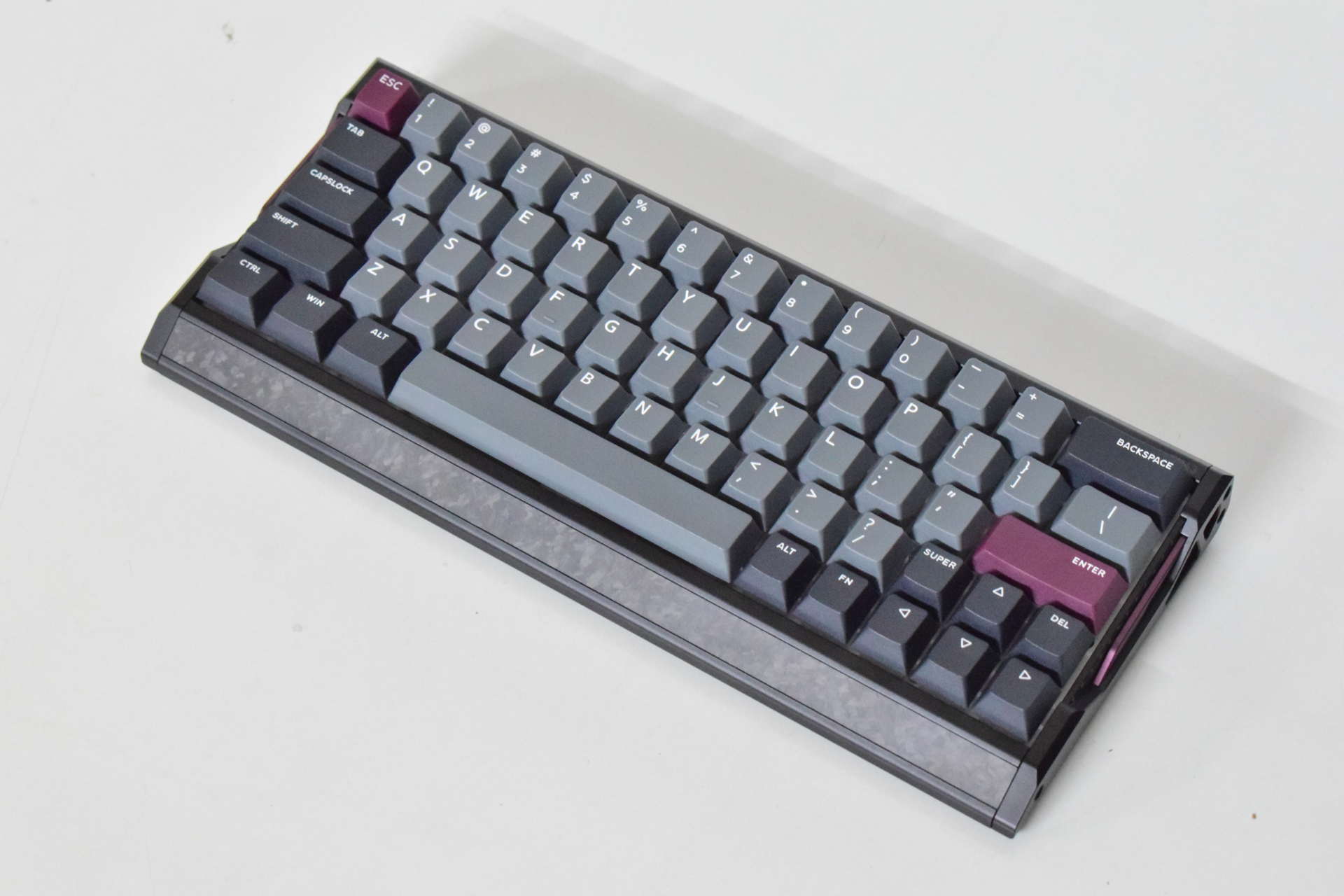
The EV63 is not just another mechanical keyboard; it represents a fundamental shift in how key presses are registered. While traditional keyboards depend on physical contact between a stem and switch to trigger a signal, the EV63 uses Hall-effect sensors—commonly found in industrial applications—to detect magnetic fields instead. This eliminates any delay between finger movement and key registration, resulting in an actuation distance of just 0.2 millimeters and a response time so fast it feels almost predictive.
For users who demand the highest level of performance, the EV63 offers
- Hall-effect switches with no physical contact points
- Actuation distance of 0.2 mm (faster than most mechanical keyboards)
- Sub-1 ms response time for near-instant feedback
- 78 keys including a dedicated function layer
- Per-key RGB backlighting with adjustable brightness
- Aluminum frame and pre-lubricated stabilizers for stability
The build quality is undeniably premium, with an aluminum chassis that adds weight without compromising portability. The PBT keycaps are designed to resist wear, while the stabilizers—critical for larger keys like the spacebar—are tuned to minimize wobble. Backlighting is a standout feature, offering per-key RGB customization with effects ranging from static colors to dynamic animations, though brightness can be reduced to prevent eye strain.
But innovation comes at a cost. The EV63 requires an external power supply (5V/3A via USB-C), meaning it won’t work with standard laptop or phone chargers without an adapter. This is a significant hurdle for users who value plug-and-play convenience. Additionally, the price—around $200 at launch—places it firmly in luxury territory rather than as an everyday tool.
So who truly benefits? Competitive gamers or professionals who demand ultra-responsive input might find the EV63’s speed and precision worth the investment. For most users, however, the difference between 1 ms and 5 ms response times is negligible, and the price premium may not justify the upgrade. If a $80–$120 mechanical keyboard already meets your needs, the EV63’s features are more of a curiosity than a necessity.
The EV63 pushes the boundaries of what a keyboard can achieve, but it does so with constraints that ground it in reality. It’s a product that feels like the future, yet its requirements keep it firmly in the present. For now, it remains a niche choice for those willing to pay for cutting-edge technology—not a mainstream staple.