Hard drives aren’t dead—at least not yet. At its annual Innovation Day event, Western Digital (WD) unveiled a bold vision to redefine HDDs as the backbone of AI infrastructure, targeting 100TB capacities by 2029 and introducing breakthroughs in bandwidth, power efficiency, and software integration that could reshape data economics.
The strategy hinges on three pillars: scaling capacity beyond flash competition, unlocking performance once reserved for SSDs, and optimizing drives for the vast, cold datasets that power modern AI. If executed, WD’s roadmap could extend the lifespan of HDDs far beyond archival storage, directly competing with QLC SSDs in cost-sensitive AI tiers.
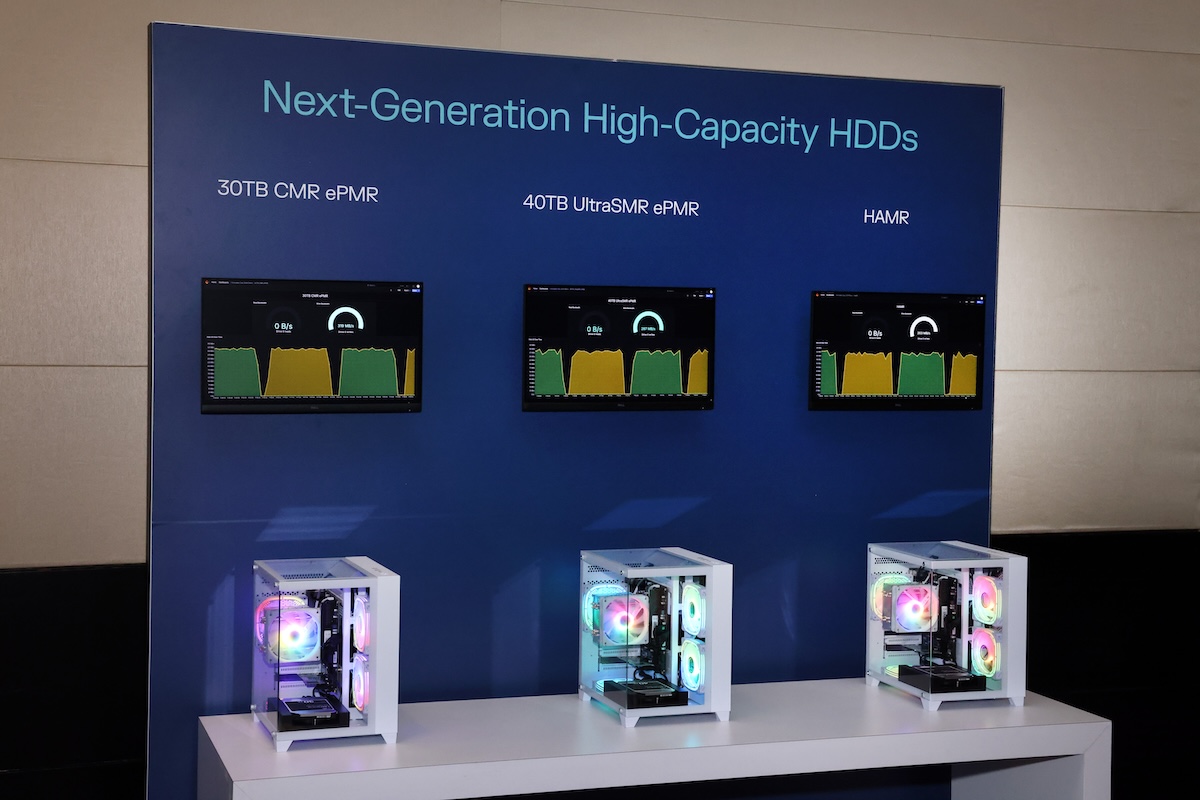
- 100TB+ HDDs: 40TB UltraSMR ePMR drives in customer testing (H2 2026), 60TB ePMR by 2027, and 100TB HAMR drives projected for 2029.
- 4x sequential I/O: High-bandwidth drives (multi-head read/write) and Dual Pivot technology (dual-actuator, no capacity loss) target 2028 release.
- 20% lower power: Cold AI data drives cut energy use while maintaining sub-second access, bridging the gap between flash and tape.
- Unified platform: Open API software layer (2027) simplifies deployment across HDDs and flash, enabling mid-scale customers to achieve hyperscale efficiency.
- 90% AI/cloud revenue: WD’s financials now reflect a pivot to data-intensive workloads, with gross profits doubling year-over-year.
- HAMR/ePMR synergy: Shared architecture allows seamless transitions between technologies, reducing customer risk and manufacturing costs.
- QLC SSD competitor: Claims of sustained I/O per TB as capacities grow—critical for AI workloads where latency and density matter.
The stakes are high. While QLC SSDs have encroached on HDD territory with higher capacities and lower latency, they remain prohibitively expensive for bulk data storage. WD’s bet is that AI’s insatiable appetite for raw capacity—and its tolerance for slightly higher latency in cold datasets—creates an opening for HDDs to reclaim relevance.
Performance breakthroughs
Two technologies lie at the heart of WD’s AI ambitions: High-bandwidth drives and Dual Pivot. The former uses multiple read/write heads to double bandwidth over today’s HDDs, with a long-term path to even greater gains. Dual Pivot, meanwhile, crams a second actuator into a standard 3.5-inch drive without sacrificing capacity or requiring software changes. The result? Up to double the sequential I/O per drive, with no architectural overhaul needed by customers.
Combined, these innovations could deliver 4x sequential I/O while maintaining performance density as capacities climb—a direct challenge to flash’s latency advantages. WD emphasizes compatibility: applications see a single storage device, not a hybrid system. Early validation from customers suggests the technology works, but real-world adoption hinges on 2028 production timelines.
Cold data, hot opportunity
systems generate mountains of data that are rarely accessed but must be available instantly—think training datasets, historical logs, or model backups. Traditional HDDs are too power-hungry for this cold tier, while tape is too slow. WD’s answer? Power-optimized HDDs that consume 20% less energy while delivering sub-second access. The tradeoff? Slightly higher latency than flash, but at a fraction of the cost per terabyte.
This isn’t just about saving watts. By enabling lower-cost storage tiers for cold data, WD could help AI teams reduce capital expenditures while improving sustainability—a critical factor as data centers expand. The challenge is convincing enterprises that HDDs can handle the occasional spike in activity without degrading performance.
WD isn’t just tinkering with hardware. Its Platforms business is expanding with an intelligent software layer (launching in 2027) designed to simplify deployment across HDDs and flash. Targeted at organizations managing 200 petabytes or more, the API-driven platform aims to shorten time-to-production and reduce qualification risk—effectively democratizing hyperscale storage efficiency.
For mid-scale customers, this means achieving near-hyperscale economics without overhauling infrastructure. The software sits atop existing systems, avoiding the disruption of architectural changes. If successful, it could accelerate HDD adoption in AI workflows where flash is overkill but tape is impractical.
The flash vs. HDD battle
WD’s roadmap isn’t just about incremental upgrades. It’s a full-throttle attempt to reposition HDDs as a viable alternative to QLC SSDs in AI storage stacks. The key question: Can WD deliver on sustained I/O per TB as capacities grow? Early benchmarks and customer validations are promising, but real-world testing at scale will determine whether HDDs can escape their archival niche.
Analysts note that data growth isn’t slowing, but accessibility is becoming the bottleneck as AI models demand more data, faster. WD’s focus on cold storage performance and power efficiency addresses this directly. Yet, the company must prove that its performance gains translate into usable workload improvements—not just theoretical specs.
For now, WD’s Innovation Day roadmap signals a company doubling down on HDDs as a cornerstone of AI infrastructure. Whether it succeeds will depend on execution, timing, and the willingness of AI teams to embrace a hybrid flash-HDD future. One thing is clear: the HDD isn’t going quietly.