Custom PC builds often push boundaries, but few have embraced sheer absurdity with the same enthusiasm as Billet Labs’ latest creation. Instead of settling for a standard liquid-cooled rig, they transformed a 50-kilogram Victorian cast-iron radiator into the centerpiece of a gaming PC—turning it into a functional heat exchanger while battling rust, leaks, and a pump that sounded like a haunted workshop.
The result? A 99-kilogram beast that runs on a Ryzen 7 9800X3D, RTX 5080, and 32GB of RAM, all tucked beneath a relic of 19th-century engineering. It’s not just a statement piece; it’s a testament to what happens when you treat a radiator like a cooling loop.
The Challenge: Turning a Radiator Into a Cooling System
The project began with a simple idea: integrate a PC’s cooling loop into the radiator’s internal piping. But cast iron isn’t designed for fluid dynamics. The team had to 3D scan the radiator’s underside, design a custom tray for components, and fabricate copper pipes to connect the loop—all while ensuring no debris clogged the pump. Rust inside the radiator became a recurring nightmare, forcing multiple flushes and even an eight-meter drain hose to clear sediment.
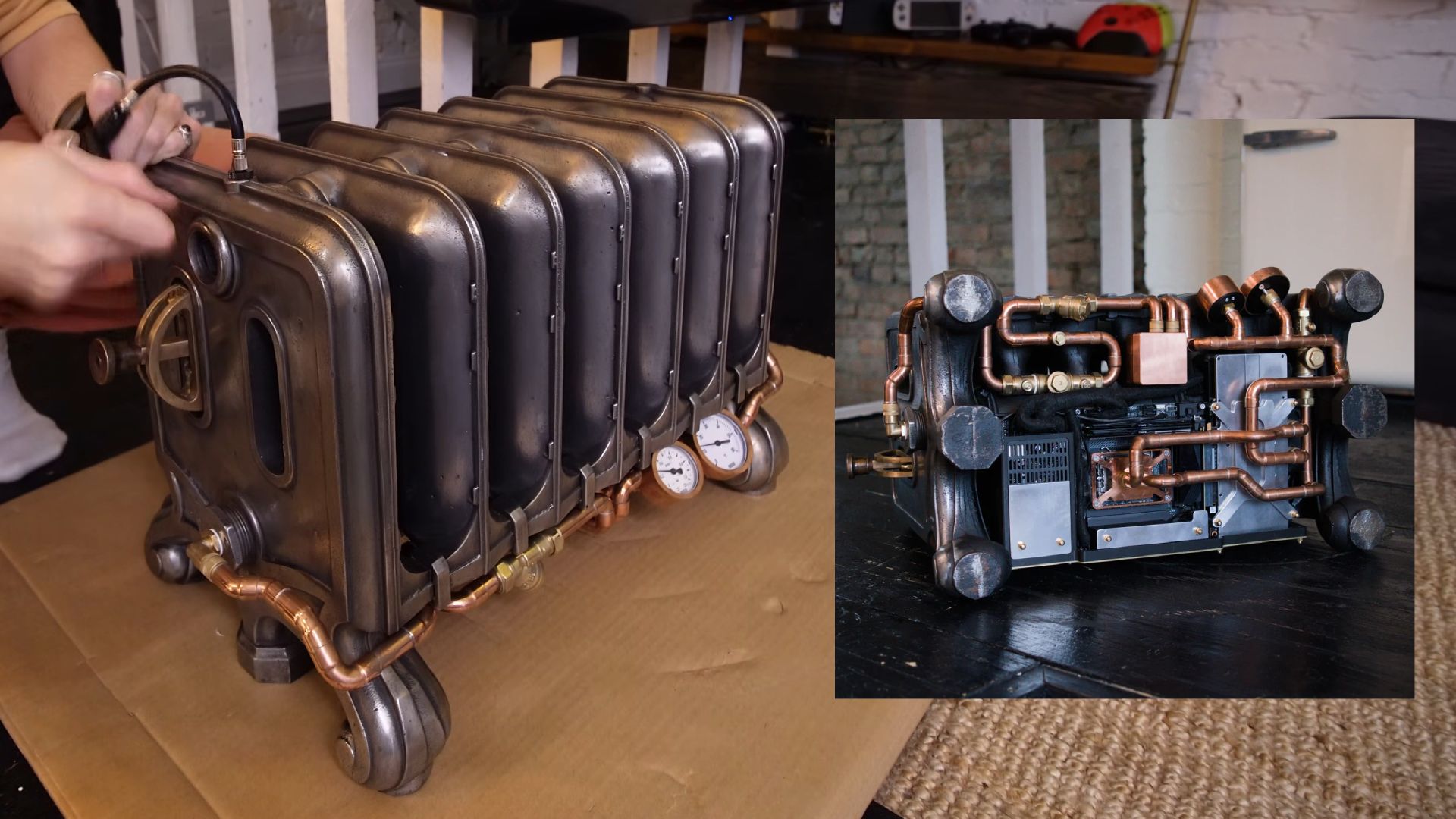
Weighing in at nearly 100 kilograms, the build required 18 liters of water to fill the system. The first attempt at priming the loop took eight hours due to air bubbles, and the pump initially failed from copper shavings. Even after repairs, the system remained noisy—a side effect of stubborn air pockets that required physically moving the radiator to dislodge.
Performance: Steampunk Meets Reality
Despite the chaos, the build achieves functional results. Under load in Cyberpunk 2077, the Ryzen 7 9800X3D peaks at 68°C with fans off, while the coolant stabilizes at a reasonable equilibrium. The RTX 5080 handles modern titles without issue, though the radiator’s thermal mass likely smooths out temperature spikes. The real victory isn’t raw performance—it’s the sheer audacity of the design.
Every detail screams bespoke: a brass gear lever as the power switch, pressure gauges mounted on the front, and plumbing that looks like it belongs in a Jules Verne novel. Yet for all its charm, this isn’t a build most would replicate. The 99-kilogram weight, the rust-fighting battles, and the pump’s eerie groans make it a one-of-a-kind experiment—proof that custom PC culture still thrives at the edge of reason.
For the rest of us, it’s a reminder that sometimes, the most impressive builds aren’t about specs. They’re about turning an object meant for heating a room into a cooling solution—and making it work, no matter the cost.