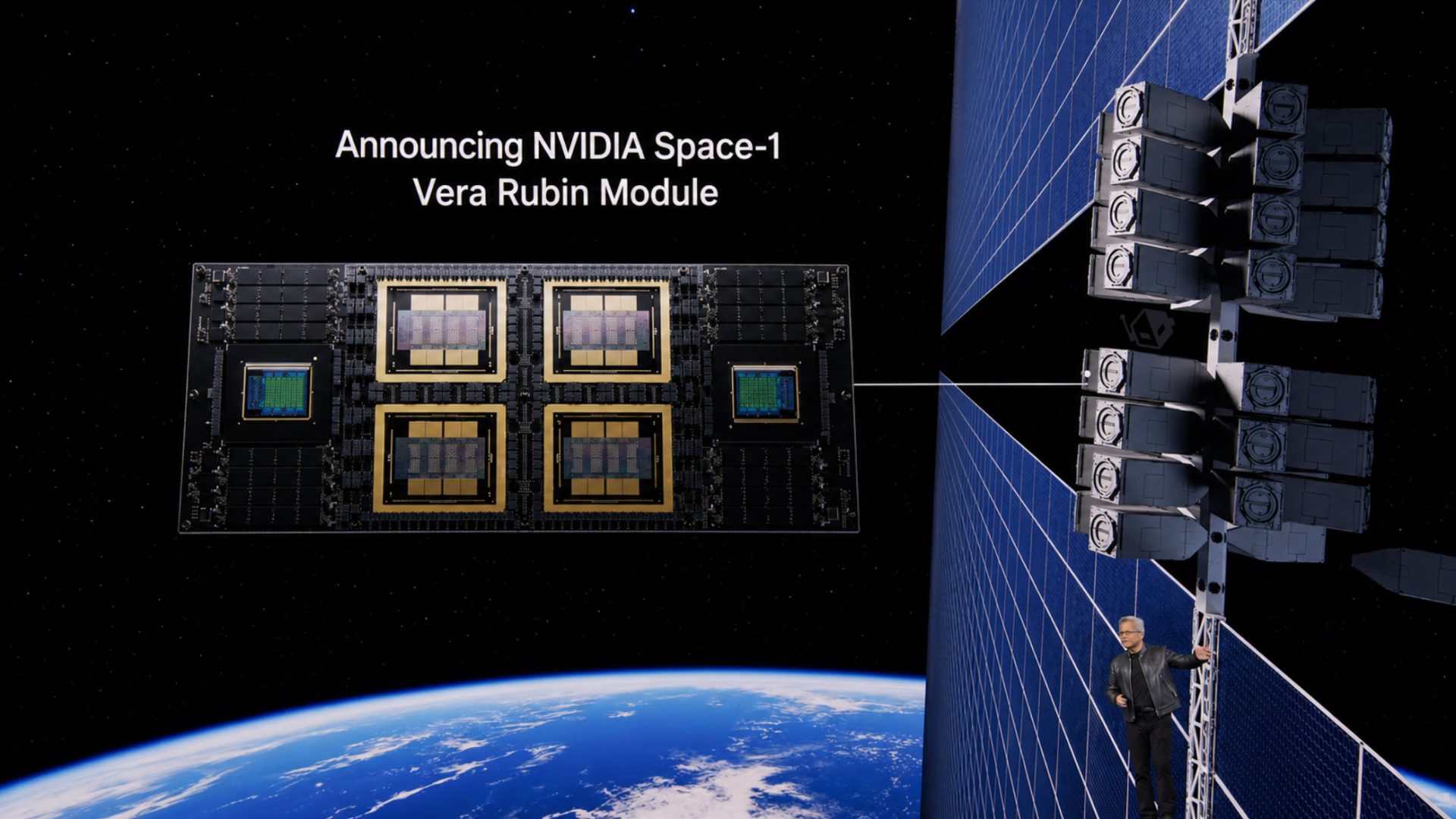
Hardware Industry NVIDIA Silently Builds an Orbital AI Empire With 5 Partners, Racing Elon Musk to Put Datacenters in Space Hassan Mujtaba • at EDT Add on Google NVIDIA is reaching for the stars, literally, as the company plans to build its future AI datacenters in outer space as terrestrial resources become a major constraint. Our Planet Might Not Be Able To Sustain Future AI Datacenter Demands. That's Why NVIDIA Is Looking Into Space As The Next Horizon For AI Chips Outer Space is becoming the new real estate gold mine for AI datacenters. Building data centers in space can be costly, but as commercial spaceships such as SpaceX's Starship and Falcon Heavy become viable, companies are seeing outer space as the new frontier to scale out their AI capacity. Related Story NVIDIA’s Vera CPU Locks In CoreWeave, Meta, Oracle and Alibaba as Early Buyers, Opening a Multi-Billion-Dollar Front Beyond Rubin RacksCurrently, AI datacenters being built on Earth are worth billions of dollars, and the entire industry is spending trillions in getting these facilities up and running for their compute needs. Not only is the construction cost high, but the power and cooling requirements are also massive, and these facilities can cause adverse effects to the surrounding flora and fauna. Recently, there have been major backlashes against data centers, which are gobbling up local water supplies at an unprecedented rate, and power bills in towns where they are based are rising, affecting communities & even countries as a whole. So in a sense, AI datacenters are not just a burden to everyone around them, but also a burden for our planet. NVIDIA plans to solve this issue entirely by sending off AI datacenters to space. For this purpose, NVIDIA is working with five major firms: Starcloud, Planet Labs, Kepler Communications, Firefly Aerospace, and Sophia Space. NVIDIA just quietly partnered with 5 space companies.This is one of the most important moves in tech right now.They are officially taking AI infrastructure to orbit.Here are the 5 names that could define the next decade:— The Assembly (@InTheAssembly) Last year, NVIDIA announced that Starcloud, part of its Inception program for startups, would launch an AI-equipped satellite to orbit the Earth. The company has proposed a 5-Gigawatt data center, spanning 4 square kilometers for Outer Space, which will feature super-large solar plates for power & deep space vacuum as a cooling solution. With this approach, NVIDIA projects a 10x lower energy cost versus Earth-based AI data centers. Also, Power & Cooling in Space is unlimited, so your two biggest constraints are solved. Since then, NVIDIA has unveiled its latest Space-1 Vera Rubin model for data-center-class AI at scale. This Rubin module is designed specifically for Outer Space, featuring a tightly integrated GPU-CPU design that offers high-bandwidth interconnect and is powered completely by solar energy radiated from the Sun. Some features of the NVIDIA Space-1 Vera Rubin module include: Performance: The module offers up to 25 times the AI compute capability of the previous H100 GPU for orbital workloads. Purpose: It enables real-time AI processing for geospatial intelligence, autonomous operations, and on-orbit analytics. Architecture: It utilizes the same "Vera Rubin" architecture as NVIDIA's terrestrial chips for a unified development ecosystem. Partnerships: The hardware is planned for use by firms such as Aetherflux, Axiom Space, and Planet Labs. Application: It is intended for satellites and on-orbit servicing vehicles requiring high-performance AI inference in space. But NVIDIA isn't alone in the race to build AI data centers in outer space. Elon Musk's SpaceXAI has also partnered with Anthropic to build a multi-Gigawatt "Orbital" AI data center. SpaceXAI also believes that an orbital compute installation will address some of the major bottlenecks of terrestrial-based systems, such as Power, Land, and Cooling. With unlimited power and cooling, AI chips will then become a major bottleneck. Another bottleneck can arise from deliveries to space itself, as the reliance on commercial "outer space" shipments to move many hundreds of thousands of GPUs will be a task in itself. But at the pace at which AI is moving right now, the outer space AI Datacenter dream is far from a dream, and aiming to become a reality very soon. About the : A Software Engineer by training and a PC enthusiast by passion, Hassan Mujtaba serves as 's for hardware section. With years of experience in the industry, he specializes in deep-dive technical analysis of next-generation CPU and GPU architectures, motherboards, and cooling solutions. His work involves not only breaking news on upcoming technologies but also extensive hands-on reviews and benchmarking. Follow on Google to get more of our news coverage in your feeds. Further Reading Sipeed Crams 32GB LPDDR5 and a 60 TOPS NPU Into a Compact RISC-V Board That Hits 15 Tokens/s on Qwen-3.5 35B AI LLMs Elon Musk and Tim Cook Join US President Trump’s China Trip This Week, Yet NVIDIA’s Jensen Wasn’t On The List NVIDIA Squashes Vera Rubin Rumors, First Shipments Rolling Out In July To Major AI Customers With Mass Production In 2H 26 Intel’s Lip-Bu Tan Teases “Exciting New Products” With NVIDIA as He Hoods Jensen Huang at Carnegie Mellon Doctorate Ceremony Read all on NVIDIA Silently Builds an Orbital AI Empire With 5 Partners, Racing Elon Musk to Put Datacenters in Space