The semiconductor industry’s hidden backbone just got stronger. ASML, the Dutch engineering marvel that manufactures the world’s only extreme ultraviolet (EUV) lithography machines, closed 2025 with total net sales of €32.7 billion—nearly double its 2023 figures—and a net income of €9.6 billion, marking another year of near-unassailable dominance. For context, this is more than the GDP of 130 countries. The company’s fourth quarter alone generated €9.7 billion in sales, fueled in part by deliveries of its latest High NA EUV systems, which promise to shrink transistor features down to 2 nm—a leap that will define the next wave of AI accelerators and high-performance chips.
ASML doesn’t just sell machines; it sells the future. Without its EUV systems, no company—from TSMC to Intel—can produce chips at 5 nm or finer. The company’s €38.8 billion backlog (orders already booked but not yet fulfilled) acts as a real-time barometer for the industry’s appetite for advanced manufacturing. In 2025, customers like NVIDIA, AMD, and Samsung placed enough orders to keep ASML’s factories running at full capacity well into 2027. The shift toward AI-driven workloads has accelerated demand, with clients now planning capacity expansions that ASML’s CEO described as ‘robust’ and ‘sustainable.’
The financials also reveal a company betting big on its own innovation pipeline. ASML spent heavily on R&D (around €1.2 billion in Q1 2026 alone) and announced a new €12 billion share buyback program, a signal to investors that it expects continued growth. Meanwhile, internal restructuring—streamlining its Technology and IT divisions—suggests a push to eliminate inefficiencies as it races toward even smaller process nodes.
The numbers behind the dominance
ASML’s 2025 performance was built on several key pillars
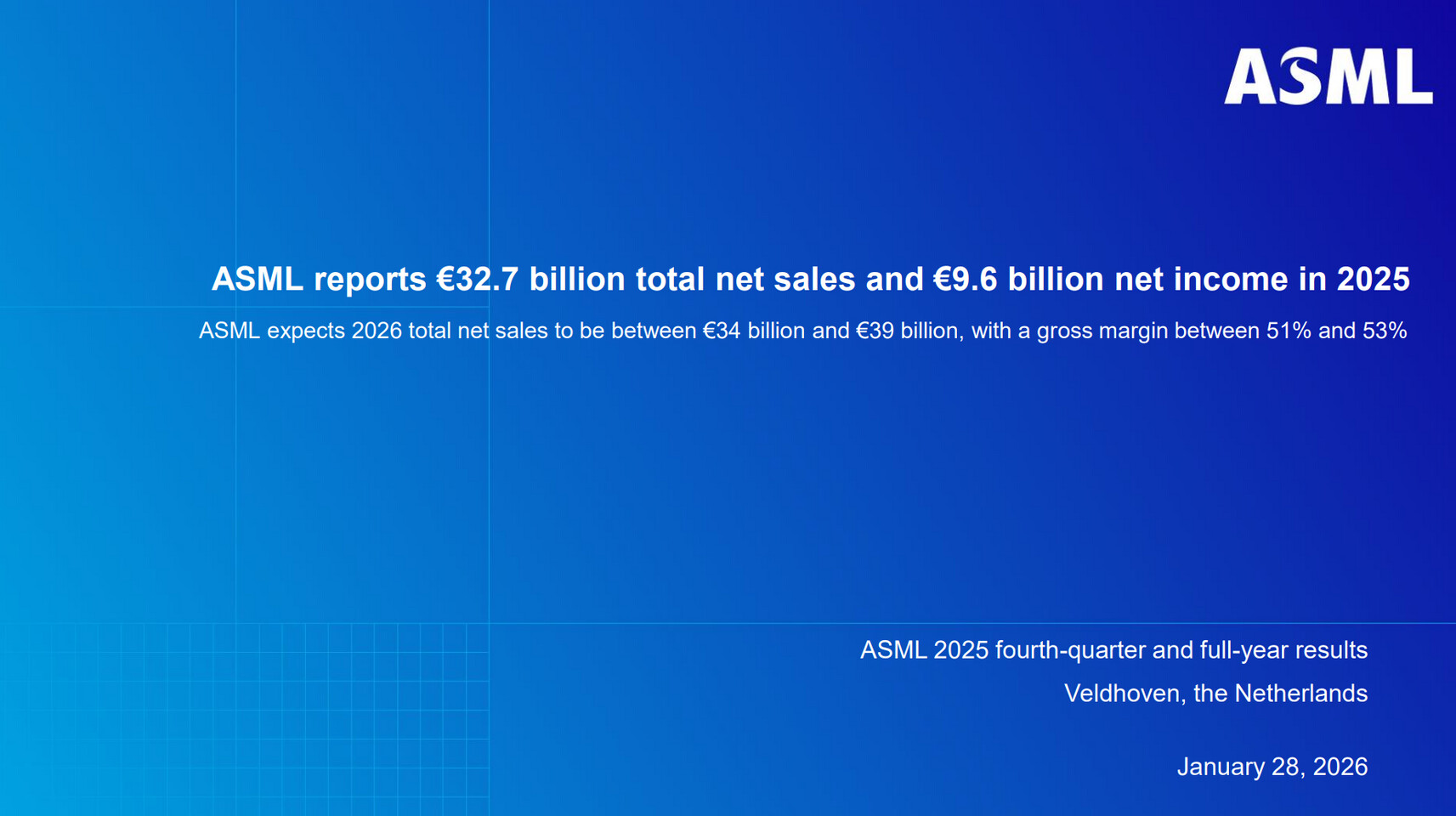
- Total net sales: €32.7 billion (up from €17.6 billion in 2023).
- Net income: €9.6 billion, with a gross margin of 52.8%.
- Q4 2025 sales: €9.7 billion, including revenue from two High NA EUV systems—its most advanced lithography tools to date.
- Backlog: €38.8 billion at year-end, a measure of how deeply ASML is embedded in the supply chain.
- 2026 guidance: Sales projected between €34 billion and €39 billion, with gross margins holding steady at 51–53%.
- Dividend: €7.50 per share for 2025, a 17% increase over 2024.
- Share buyback: A new €12 billion program (replacing a €7.6 billion program that concluded in December 2025).
These figures aren’t just about profits—they reflect ASML’s role as the gatekeeper of semiconductor progress. The High NA EUV machines, for example, enable 2 nm manufacturing, a critical milestone for chips requiring massive transistor density, like those in next-gen GPUs or AI data centers. Without ASML’s tools, the transition from 5 nm to 2 nm would stall, creating a bottleneck that could delay entire product cycles.
What’s next for ASML—and the industry
The company’s outlook hinges on two major trends: the relentless march of AI and the geopolitical tensions over semiconductor independence. ASML’s customers—primarily foundries in Taiwan, South Korea, and the U.S.—are investing heavily in EUV capacity to meet AI demand. TSMC alone plans to spend tens of billions on new fabs equipped with ASML’s machines. Meanwhile, China’s push for domestic EUV alternatives remains a long-term threat, though no competitor has yet matched ASML’s precision or scale.
Internally, ASML is focusing on efficiency. By restructuring its Technology and IT teams, the company aims to accelerate R&D for future generations of lithography—likely targeting sub-2 nm nodes in the coming decade. The €12 billion share buyback also signals confidence in long-term growth, though it may limit immediate reinvestment in areas outside core EUV development.
For the broader tech ecosystem, ASML’s financial health is a double-edged sword. On one hand, its dominance ensures that advanced chips will keep getting smaller and more efficient. On the other, the lack of viable alternatives means any disruption—whether from geopolitical sanctions or a sudden shift in demand—could send shockwaves through the industry. With AI and high-performance computing driving the next wave of innovation, ASML’s role as the unseen architect of progress has never been more critical.