The demand for high-performance computing in industrial automation, AI inference, and edge data centers is pushing hardware manufacturers to rethink system design. Traditional platforms often struggle to balance raw processing power with the reliability and remote manageability required for 24/7 operations. ASRock Industrial’s latest flagship motherboard, the IMB-X1904, addresses these challenges head-on by combining Intel Xeon 600 processors with a feature set optimized for mission-critical workloads.
Designed as a backbone for AI-driven industrial systems, the IMB-X1904 leverages the W890 chipset to deliver up to 86 P-cores, positioning it as a platform capable of handling complex AI models, real-time video analytics, and data-intensive automation tasks. The motherboard’s architecture reflects a deliberate shift toward scalability, with six PCIe Gen 5 x16 slots and dual MCIO connectors supporting high-end GPUs, accelerators, and networking fabrics—critical for next-generation edge computing deployments.
Key Specifications and Performance
- Processor: Intel Xeon 600 series (up to 86 P-cores)
- Chipset: W890
- Memory: Quad-channel DDR5-5200 ECC RDIMM/RDIMM-3DS (up to 2TB)
- Expansion: Six PCIe Gen 5 x16 slots, one PCIe Gen 5 x8 slot, dual MCIO (PCIe Gen 5 x8)
- Storage: Two M.2 Key M slots (PCIe Gen 5 x4 / Gen 4 x4), one U.2 port, eight SATA3 with Intel RAID 0/1/5/10
- Connectivity: Four USB 3.2 Gen 2, six USB 3.2 Gen 1, three USB 2.0, two COM, one VGA, four GPIO
- Networking: Dual Intel 1G LAN (or optional 10G LAN in IMB-X1904-10G variant)
- Optional Management: AI-M2-OOB-1G module for remote power control, BIOS recovery, and hardware health monitoring
The IMB-X1904’s memory subsystem stands out with support for up to 2TB of DDR5-5200 RDIMM, a configuration that aligns with the growing need for large working datasets in AI training and inference. The use of ECC memory further enhances reliability, a critical factor in industrial environments where data integrity cannot be compromised. Meanwhile, the PCIe Gen 5 expansion slots enable the integration of multiple high-end GPUs—such as NVIDIA’s RTX 5090 or AMD’s Instinct MI300X—without bottlenecking bandwidth, making it a viable platform for accelerator-driven workloads.
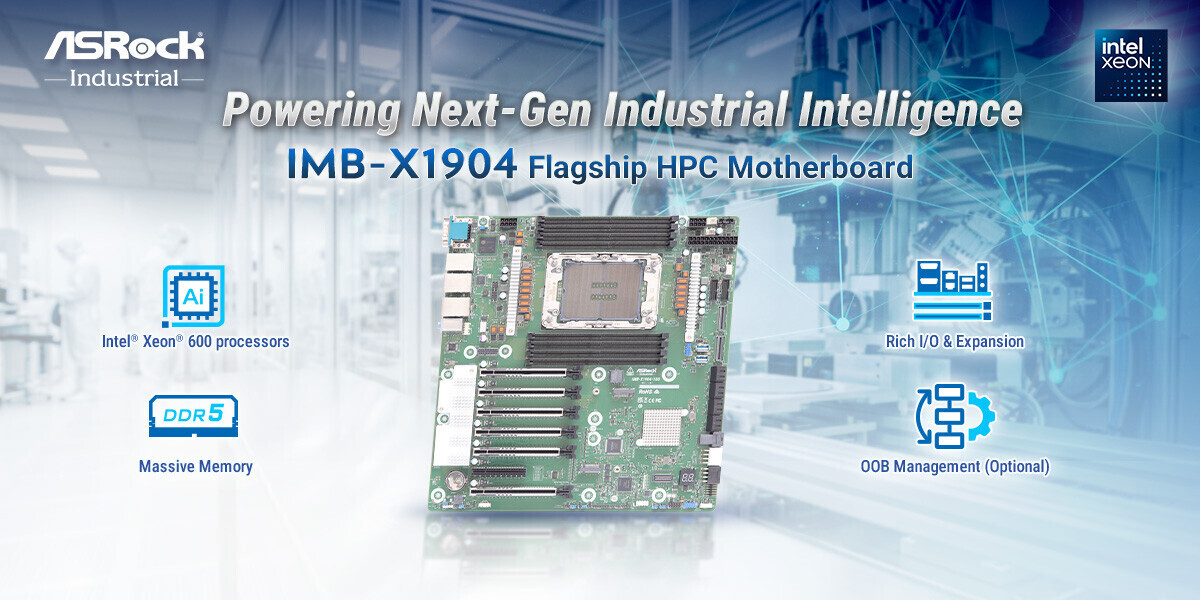
For deployments requiring remote management, ASRock Industrial offers the optional AI-M2-OOB-1G module. This hardware-level solution provides out-of-band control, allowing administrators to power systems on/off, reset configurations, and monitor hardware health even if the primary OS is unresponsive. Such features are particularly valuable in distributed edge computing setups, where physical access may be limited or impractical.
Industry Implications and Use Cases
The IMB-X1904 is not just an incremental upgrade—it represents a strategic response to the evolving demands of industrial computing. Traditional HPC systems often prioritize raw performance at the expense of operational stability, but the IMB-X1904’s design philosophy emphasizes longevity, remote operability, and scalability. This makes it well-suited for applications like
- AI-driven predictive maintenance in manufacturing
- Real-time video analytics for quality control
- High-fidelity simulation in aerospace and automotive testing
- Edge-based data acquisition in smart factories
While the motherboard’s power requirements and thermal considerations are not explicitly detailed, its alignment with Intel’s Xeon 600 series suggests compatibility with high-wattage workloads—potentially up to 1350W in extreme configurations, similar to the demands of high-end GPUs like the RTX 5090. This level of power efficiency, combined with its expandability, positions the IMB-X1904 as a candidate for next-generation data centers and industrial clusters.
ASRock Industrial’s portfolio now includes multiple HPC motherboards, ranging from Xeon 600-based models like the IMB-X1904 to lower-tier options powered by Intel Xeon W-series processors. This modular approach allows customers to select a platform tailored to their specific performance and budget requirements, whether for AI acceleration, high-performance computing, or traditional industrial automation.
With the official launch announced at CES 2026, the IMB-X1904 is poised to enter markets where reliability and scalability are non-negotiable. Its arrival underscores a broader industry trend: the convergence of consumer-grade performance demands with industrial-grade durability—a balance that will define the next generation of high-performance computing.