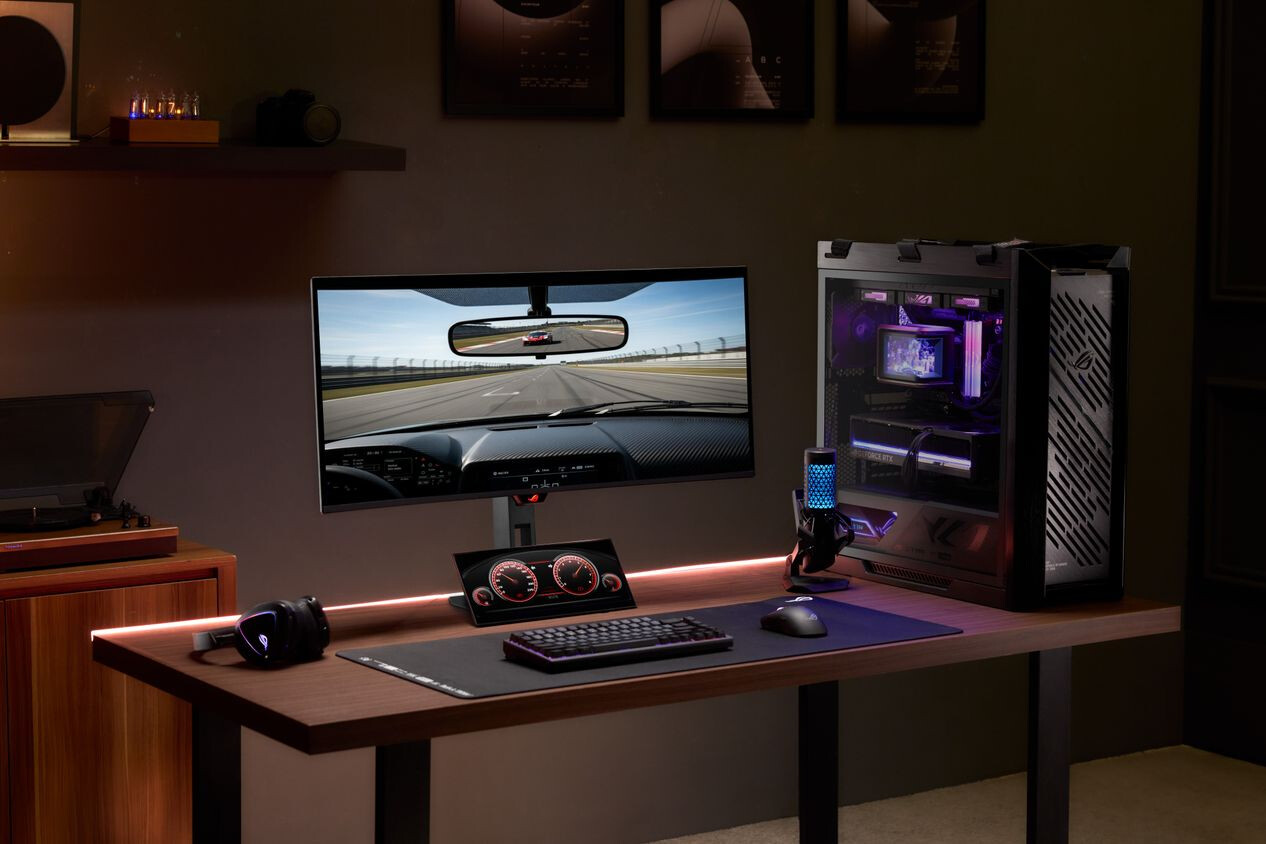
Gaming monitors are evolving beyond raw performance metrics. Enthusiasts now expect displays that not only deliver buttery-smooth gameplay at high refresh rates, but also seamlessly integrate into complex setups—whether for streaming, system monitoring, or multitasking. ASUS ROG has responded with two new models: the Strix OLED XG34WCDMS and the Strix XG129C, each designed to address distinct needs within the modern gaming ecosystem.
The Strix OLED XG34WCDMS stands out as a 34-inch WQHD (3440 x 1440) RGB Tandem QD-OLED panel with a 280 Hz refresh rate and 0.03 ms gray-to-gray response time. It’s built to balance visual performance with practical durability, featuring BlackShield Film for enhanced scratch resistance and deeper blacks. Meanwhile, the Strix XG129C takes a different approach—an ultra-wide 24:9 aspect ratio secondary display that doubles as a touch-enabled desktop command center, complete with AIDA64 Extreme support.
Key Specs
- Display:
- Strix OLED XG34WCDMS: 34-inch WQHD (3440 x 1440), 280 Hz, 0.03 ms GTG, RGB Tandem QD-OLED
- Strix XG129C: 24:9 ultra-wide, 10-point touch, AIDA64 Extreme support
- Performance:
- VESA DisplayHDR 500 True Black compliance (XG34WCDMS)
- 99% DCI-P3 color gamut, true 10-bit color depth
- Delta E < 2 for color accuracy (XG34WCDMS)
The XG34WCDMS is engineered for enthusiast gamers who prioritize visual fidelity without sacrificing responsiveness. Its 280 Hz refresh rate and QD-OLED panel ensure sharp, vibrant images with near-perfect blacks, while the BlackShield Film adds a layer of practical protection. The Strix XG129C, on the other hand, is tailored for those who need an always-on secondary display—whether for streaming overlays, system diagnostics, or productivity tasks. Its 10-point touch interface and AIDA64 Extreme support make it a versatile addition to any setup.
For PC builders and power users, these monitors represent a shift toward more modular and functional peripherals. The XG34WCDMS is ideal for primary setups where performance and image quality are paramount, while the XG129C fills a niche for those who want an immersive secondary display that also serves as a control hub. However, the lack of a confirmed release window means adoption timelines remain uncertain.
Ultimately, these models reflect ASUS ROG’s strategy to cater to both high-end gamers and productivity-focused users. The XG34WCDMS is a step down from its 360 Hz sibling but offers a compelling balance of performance and cost. Meanwhile, the XG129C redefines what a secondary monitor can be—blurring the line between utility and luxury.