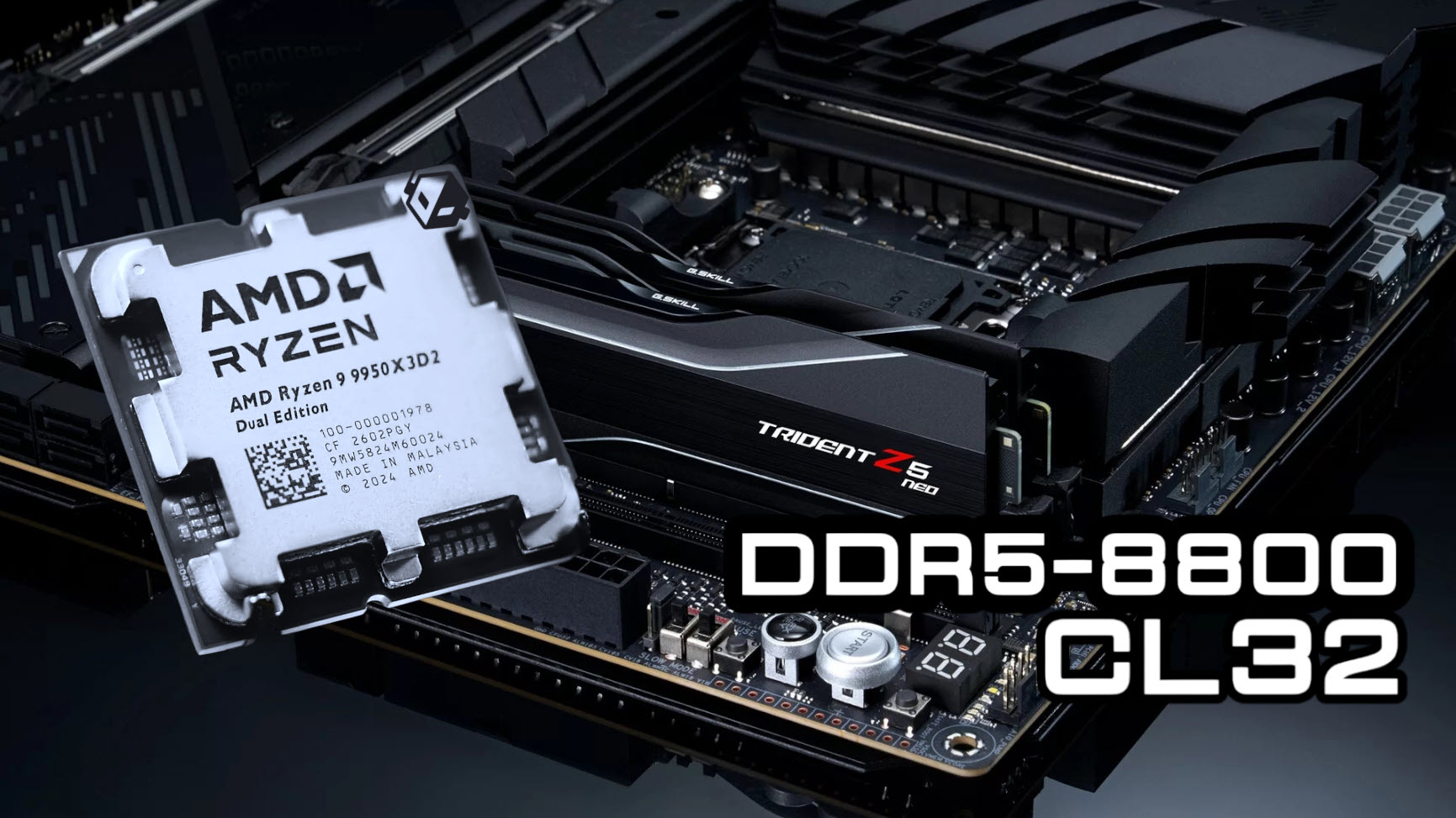
The ASUS ROG X870E APEX motherboard has emerged as a standout performer in the world of high-end desktop builds, particularly when paired with AMD's latest Ryzen processors. It showcases a remarkable ability to push DDR5 memory speeds to unprecedented levels, specifically achieving stable operation at DDR5-8800 with a CL32 timing on the Ryzen 9 9950X3D CPU. This level of performance is not just a technical achievement but also a practical one, offering real-world benefits for users who demand both speed and reliability in their computing setups.
At the heart of this motherboard lies ASUS's robust design philosophy, which translates into a feature-rich platform that caters to enthusiasts and power users. The X870E APEX is built on AMD's AM5 socket, ensuring compatibility with the latest generation of Ryzen processors, including the 9000-series chips. This compatibility extends to advanced memory support, allowing users to leverage the full potential of DDR5 memory modules. The motherboard's ability to stabilize DDR5-8800 at CL32 is a testament to its engineering prowess and the attention to detail in its design.
Key specs of the ASUS ROG X870E APEX include support for up to 128GB of DDR5 memory across four DIMM slots, with official support for memory speeds up to DDR5-6400. However, it is the motherboard's overclocking capabilities that truly set it apart. The inclusion of a robust power delivery system ensures stable operation even under heavy loads, which is crucial when pushing memory speeds to such high levels. Additionally, the motherboard features a comprehensive connectivity suite, including USB 3.2 Gen 2x2, Thunderbolt 4, and Wi-Fi 6E, providing users with ample options for both internal and external expansion.
- Chipset: AMD X870
- Socket: AM5
- Memory Support: DDR5, up to 128GB (4x DIMM slots), official support for DDR5-6400, overclocking to DDR5-8800 CL32
- Expansion Slots: 3x PCIe 5.0 x16 (x16/x0, x8/x8, x4/x4), 1x PCIe 4.0 x16 (x4)
- Connectivity: USB 3.2 Gen 2x2, Thunderbolt 4, Wi-Fi 6E, 2.5G Ethernet
- Power Delivery: 18+1 VRM phases, 105A CPU power stage, ProCool II socket for better cooling
The practical implications of these specifications are significant. For users who rely on memory-intensive applications such as video editing, 3D rendering, or scientific simulations, the ability to run DDR5-8800 memory offers substantial performance gains. This is not just about raw speed; it's about reducing latency and improving overall system responsiveness. However, achieving such high memory speeds comes with tradeoffs. Users need to ensure that their cooling solutions are adequate to handle the increased power draw of both the CPU and memory modules. Additionally, the stability of DDR5-8800 at CL32 may require careful tuning and monitoring, which could be a hurdle for less experienced users.
Looking ahead, the ASUS ROG X870E APEX represents a significant step forward in motherboard technology, particularly in its ability to push the boundaries of DDR5 memory performance. While it is designed with high-end users in mind, its features and capabilities also hint at what could become more mainstream as memory speeds continue to increase. For now, it stands as a benchmark for what is possible in desktop computing, offering a glimpse into the future of high-performance systems.