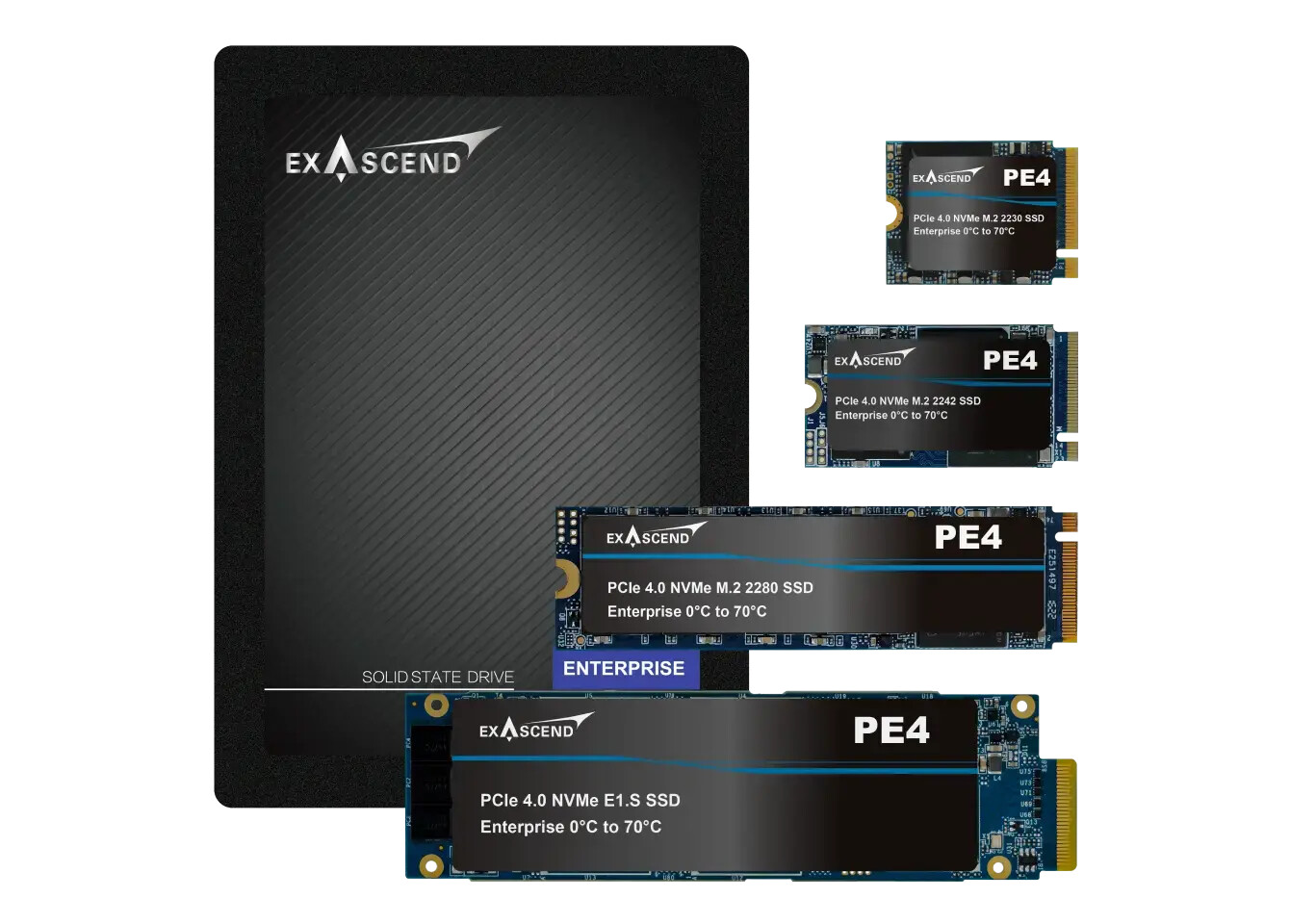
The Exascend PE4 16 TB M.2 NVMe SSD is set to redefine the boundaries of storage capacity within the M.2 form factor. Priced at $15,935, this drive offers an unprecedented 16 TB of storage in a single M.2 2280 slot, catering to users with no budget constraints and a need for extreme performance.
This SSD utilizes a PCIe 4.0 interface, delivering sequential read speeds of up to 3,270 MB/s and write speeds reaching 2,980 MB/s. Despite these speeds being just shy of the theoretical maximum of 3 GB/s for PCIe 4.0, they are more than sufficient for most high-performance applications. The drive is built with TLC 3D NAND Flash storage modules, ensuring durability with a total bytes written (TBW) rating of 16,640 TB and a mean time between failures (MTBF) of about two million hours.
The Exascend PE4's power efficiency is notable, with idle power consumption under 1.3 W and active power reaching up to 7.2 W under full load. This makes it an attractive option for systems where both performance and efficiency are critical. The drive also comes with a five-year warranty, although Exascend claims the hardware will significantly outlast this period.
Why It Matters
The Exascend PE4 16 TB M.2 NVMe SSD is not just about raw capacity; it's about integrating that capacity into existing systems with minimal additional hardware requirements. This drive eliminates the need for multiple drives or complex RAID setups, simplifying storage architecture while maximizing performance. Its power efficiency and durability make it suitable for 24/7 operation in high-demand environments.
What to Watch Next
The introduction of such a high-capacity SSD raises questions about the future of storage density and pricing. As technology advances, we can expect to see more drives pushing the limits of what's possible within the M.2 form factor. However, the current price point suggests that these innovations will likely remain niche for now, catering to specialized markets where cost is not a primary concern. The focus will shift towards balancing capacity with affordability, making high-density storage more accessible in the future.