The South Pole isn’t known for its high-performance computing hubs, but that’s where you’ll find one now. At the IceCube Neutrino Observatory, researchers are using a system that packs the same computational punch as a full data center—yet fits on a desk. This isn’t a fluke; it’s the new reality for institutions leveraging NVIDIA’s DGX Spark, a desktop supercomputer designed to democratize AI-driven research.
The device’s arrival on campuses signals a shift in how universities approach complex projects. No longer reliant on cloud-based solutions or distant supercomputing clusters, labs and faculty offices can now run large-scale AI workloads locally. With performance reaching petaflop levels, DGX Spark is enabling breakthroughs in fields like climate modeling, particle physics, and even autonomous systems—all while operating within the confines of a standard lab environment.
The implications are immediate. Universities can now deploy advanced AI tools without the latency or cost barriers of remote processing. For example, a team studying neutrino interactions at the IceCube Observatory can analyze vast datasets in real time, accelerating discoveries that were once limited by computational constraints.
A Supercomputer in a Box
What makes DGX Spark unique isn’t just its power—it’s its accessibility. The system combines NVIDIA’s latest AI accelerators with high-bandwidth networking and enterprise-grade storage, all housed in a compact, rack-mounted form factor. This allows institutions to integrate it seamlessly into existing lab setups, whether in a faculty office, a shared research space, or even a portable deployment like the one at the South Pole.
Key specifications include
- Petaflop-class performance: Capable of handling the most demanding AI and high-performance computing (HPC) workloads locally.
- Modular design: Supports configurations with up to eight A100 or H100 GPUs, depending on the use case.
- High-speed networking: Equipped with NVIDIA Spectrum networking for low-latency data transfer, critical for collaborative research.
- Scalability: Can be clustered for even greater computational power, making it suitable for both small labs and large-scale academic initiatives.
This level of performance wasn’t just reserved for corporate R&D or national labs—it’s now within reach for universities and research institutions worldwide. The result? Faster iterations, more experimentation, and discoveries that might have taken years in the past now unfolding in real time.
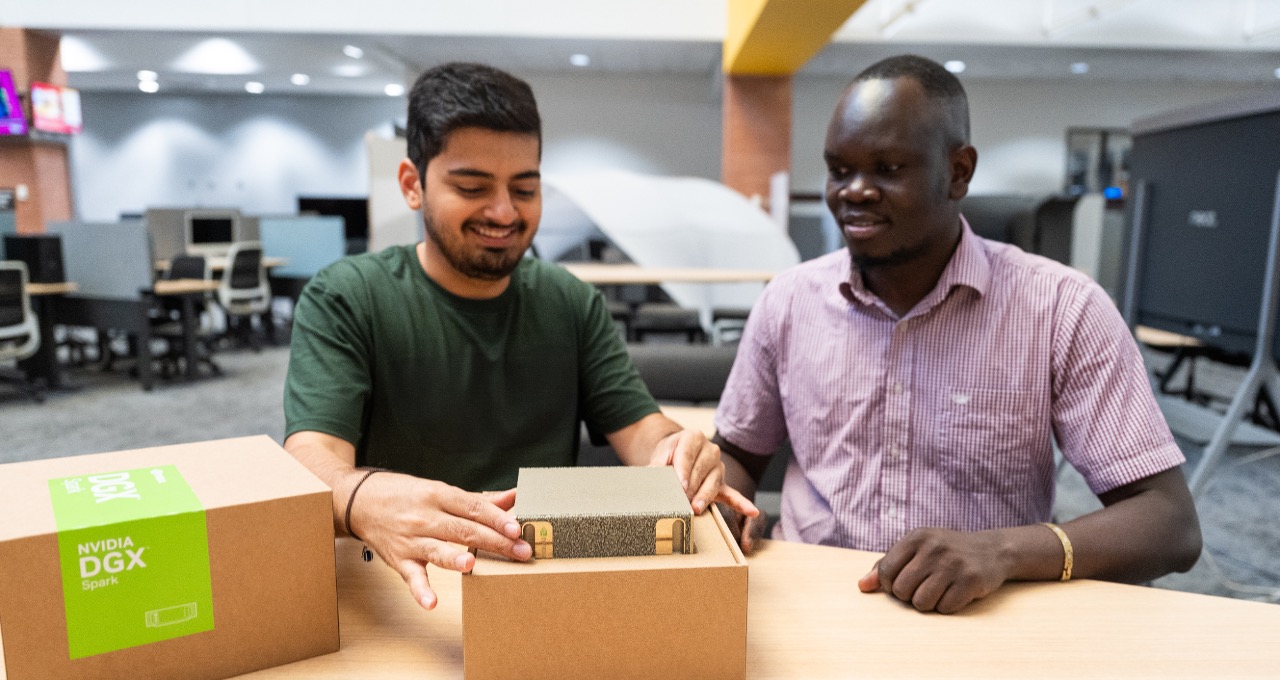
Beyond the Lab: A New Era for Academic Research
The impact of DGX Spark extends beyond technical specs. By bringing supercomputing capabilities to individual labs, NVIDIA is fostering a new era of collaborative research. Students and faculty can now engage with cutting-edge AI tools without needing to navigate the complexities of cloud computing or distant supercomputing centers. This shift is particularly transformative for fields where data volume and complexity are growing exponentially—such as genomics, materials science, and climate research.
Consider the implications for education. Curricula can now incorporate hands-on training with the same hardware used in professional AI research. Students working on autonomous vehicles, drug discovery, or even large language model fine-tuning can access the tools they’ll need in industry—all while still in school. The barrier between theoretical learning and practical application has never been lower.
For institutions investing in DGX Spark, the payoff isn’t just in computational power but in the speed of innovation. Projects that once required months of queue time on a supercomputer can now be completed in days—or even hours. This agility is a game-changer for academic research, where time-to-insight can be the difference between a groundbreaking discovery and an overlooked opportunity.
As DGX Spark continues to make its way into labs and research centers, one thing is clear: the future of academic computing isn’t just about bigger machines. It’s about making the right tools available to the right people, at the right time—no matter where they’re located.