Intel’s data center GPU ambitions are taking clearer shape, with the company confirming a two-pronged strategy that extends beyond its recently launched Xe3P-based 'Crescent Island' inference accelerators. In a presentation led by Anil Nanduri, Vice President of GTM and Product Management for AI Accelerators, Intel has revealed plans for a new GPU architecture codenamed 'Xe Next,' designed to follow the inference-focused 'Crescent Island' lineup. This marks a deliberate expansion into both AI inference and training workloads, positioning Intel to compete directly with NVIDIA and AMD in the most lucrative segments of the market.
The roadmap now includes
- A finalized 'Jaguar Shores' GPU for AI training and high-performance computing (HPC), expected to enter production by mid-2026 with potential late-year or early 2027 availability.
- Integration of HBM4 memory, with SK hynix identified as the primary supplier for these accelerators.
- A rack-scale design approach, targeting the highest-margin data center applications where NVIDIA currently dominates.
For consumers, Intel’s focus remains on refining its Xe3-based integrated graphics, as seen with the 'Panther Lake' iGPU in models like the Arc B390 and B380. These updates aim to improve compute density, vector and matrix unit performance, and cache capacity—delivering sustained throughput gains at comparable power levels to the Xe2 'Battlemage' architecture. Looking ahead, Intel is set to introduce 'Nova Lake' processors in late 2026, combining Xe3P-LPG for core GPU duties and Xe4 'Druid' architecture for media and display functions.
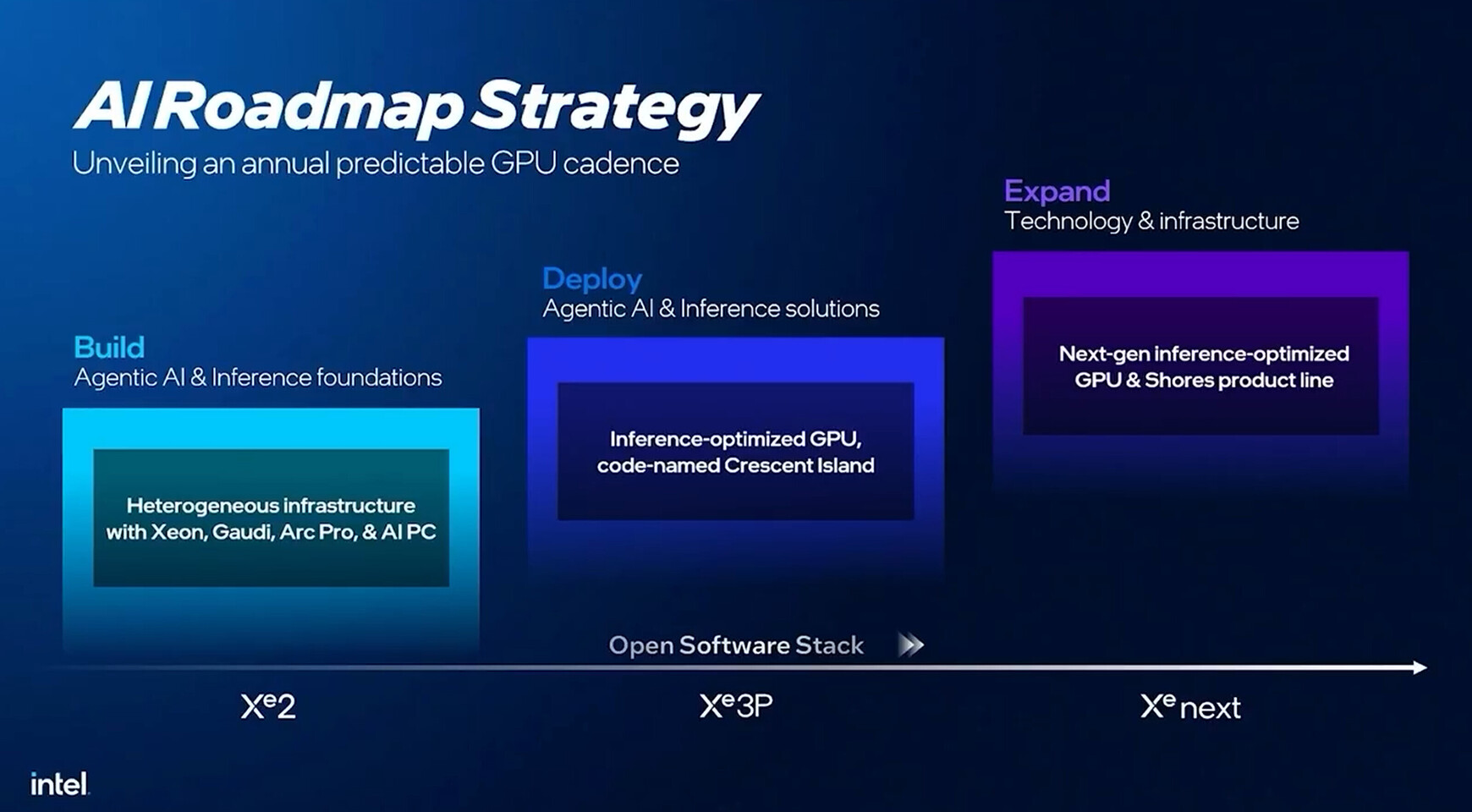
The confirmation of 'Xe Next' and 'Jaguar Shores' underscores Intel’s commitment to reclaiming ground in the AI accelerator space. While 'Crescent Island' targets inference workloads, 'Jaguar Shores' will address training and HPC, creating a balanced portfolio. The use of Intel’s in-house 18A process or collaboration with TSMC for manufacturing will be critical, though yields remain an open question. Meanwhile, the consumer GPU market sees incremental improvements with Xe3P, setting the stage for future 'Celestial' generation advancements.
With NVIDIA’s dominance in discrete GPUs nearing 94% market share and AI-driven demand pushing prices for high-end models like the RTX 5090 toward $5,000, Intel’s strategy could redefine competition in both data center and consumer segments. The company’s ability to execute on 'Jaguar Shores' and 'Xe Next' will determine its success in this evolving landscape.