For small businesses evaluating their next CPU upgrade, Intel’s Core Ultra Series 4 'Nova Lake-S' processors present a compelling but complex choice. The new line promises extreme core counts—up to 52 total cores in some configurations—but also introduces significant architectural changes that could reshape performance and efficiency for both enthusiasts and everyday workloads.
The most striking feature is the dual-die design, where two compute tiles are paired with a system-on-chip (SoC) tile. This approach allows Intel to push core counts beyond what was previously possible in desktop processors, while maintaining equal memory and PCIe access for both tiles. However, this also means that motherboard and software support will need to evolve to fully leverage these high-core configurations.
Key Specifications
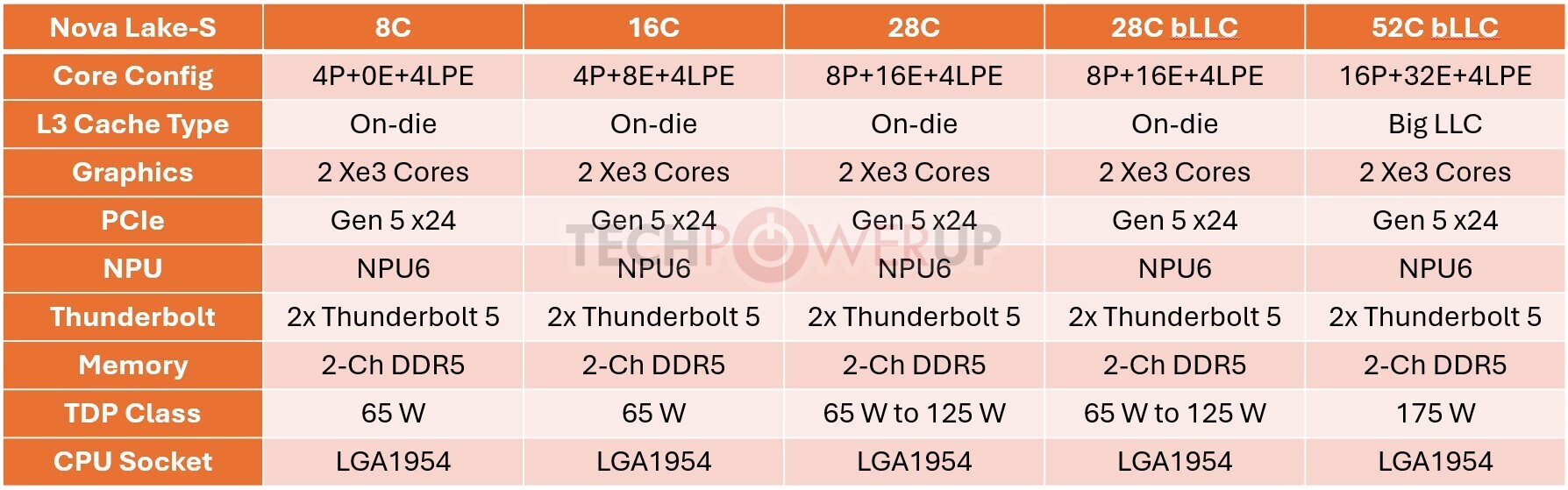
- Core Configurations: Ranging from 4P+0E+4LPE (8 cores) to 16P+32E+4LPE (52 cores), with variations in between. The 'P' stands for performance cores, 'E' for efficiency cores, and 'LPE' for low-power island E-cores.
- Cache Technology: Introduction of bLLC (big last-level cache), an in-package cache die that augments the on-die L3 cache. This is Intel’s response to AMD’s 3D V-Cache, promising improved performance for cache-intensive workloads.
- Memory Support: 2-channel DDR5 interface with increased native memory speeds and support for 4-rank DDR5 DIMMs, though exact maximum capacity is not yet confirmed.
- Graphics: Integrated Xe3 'Celestial' graphics architecture with up to 2 Xe3 cores, expected to match or exceed the performance of current 'Alchemist'-based iGPUs.
- I/O and Connectivity: Preparation for two Thunderbolt 5 or USB4 V2 ports (80 Gbps bidirectional or 120+40 Gbps asymmetric), though implementation will depend on motherboard vendors. All SKUs feature a next-generation NPU6 device for local acceleration of Microsoft Copilot+.
The dual-die configurations, in particular, are a notable departure from traditional CPU designs. While this approach allows Intel to achieve extreme core counts, it also introduces new challenges. For instance, managing thermal output and ensuring balanced performance across both tiles will be critical for stability and longevity. Additionally, the bLLC technology, while promising, remains unproven in real-world scenarios, so its actual impact on performance is still uncertain.
Who Benefits?
The high-core configurations are clearly aimed at enthusiasts and power users who demand maximum multitasking capabilities or run workloads that benefit from large core counts, such as video editing or 3D rendering. For small businesses, however, the value proposition is less clear. While some professional applications may benefit from the additional cores, most everyday business tasks—such as office productivity, web browsing, or basic data processing—will likely see minimal improvement over current-generation processors.
That said, the dual-die design and bLLC technology could offer long-term advantages for businesses with growing computational needs. If Intel can deliver on its promises of improved cache performance and efficiency, these processors may become a strong contender for workstations in fields like AI or scientific computing. However, the higher power consumption (up to 200 W TDP) and potential thermal challenges mean that not all businesses will find these SKUs practical.
Long-Term Roadmap
Intel has designed the new LGA1954 socket with longevity in mind, aiming for it to span several processor generations well into the decade. This suggests a commitment to backward compatibility and long-term support, which is a significant advantage for businesses investing in new hardware. The introduction of bLLC also hints at a broader trend toward more sophisticated cache architectures, which could influence future CPU designs across the industry.
For now, the Nova Lake-S series represents a bold step forward in desktop CPU architecture, but its success will depend on how well Intel can balance performance, efficiency, and real-world usability. Small businesses should weigh the potential benefits against the higher costs and power requirements before committing to an upgrade, especially if their current workloads do not yet necessitate such extreme core counts.
The most important change here is the introduction of dual-die configurations with bLLC, which could redefine what’s possible in desktop CPUs. Whether this translates into tangible performance gains for everyday users remains to be seen, but it marks a significant milestone in Intel’s roadmap.