Intel has pulled off a near-miracle with its Core Ultra Series 3 (Panther Lake) platform: a chip that doesn’t just match but in many cases surpasses the graphics performance of dedicated Nvidia GeForce RTX 4050 GPUs—while sipping power like a Core Ultra Series 2 laptop. The flagship Core Ultra X9-388H, with its 12 Xe3 GPU cores and 12 ray-tracing units, isn’t just an incremental upgrade. It’s a full-blown challenge to the notion that integrated graphics can’t handle modern games.
Panther Lake’s secret weapon? A combination of brute-force GPU performance, AI-driven frame generation, and a power efficiency that lets it sustain that performance for hours on battery. The result is a laptop chip that can push 140 FPS in Cyberpunk 2077 at 1080p Ultra settings—without needing a dedicated GPU. But whether this is a revolution or a gimmick depends on how you measure success.
Key specs: The numbers behind the hype
- CPU: 16 cores (4 P-cores, 8 E-cores, 4 LP E-cores) with up to 5.2GHz clock speeds
- GPU: 12 Xe3 cores, 12 ray-tracing units (X9-388H flagship)
- TDP: 25W (vs. 17W for Lunar Lake)
- Battery life: Up to 28 hours in 4K video playback (Lenovo prototype); 22 hours on a single screen (Asus ZenBook Duo)
- AI acceleration: 50 TOPS NPU + GPU-boosted 122 TOPS total
- VRAM: Up to 18GB (shared with system memory)
- Frame generation: XeSS 3 (AI upscaling + 3 interpolated frames per rendered frame)
- Comparison target: Nvidia GeForce RTX 4050 discrete GPU performance
The numbers tell a story: Panther Lake isn’t just faster than its predecessor (Lunar Lake). It’s faster than nearly every other integrated GPU on the market—and in some cases, faster than budget discrete GPUs when AI frame generation is enabled. But the real story isn’t raw power. It’s efficiency. While AMD’s Ryzen AI Max and Qualcomm’s Snapdragon X2 Elite Extreme push more cores and higher clock speeds, they do so at the cost of battery life. Intel’s gambit is to deliver near-desktop-class performance without the power draw.
A gaming chip that doesn’t need a GPU
For years, integrated graphics meant playing older games at low settings—or accepting frame rates so low they bordered on unplayable. Panther Lake changes that. In Shadow of the Tomb Raider, the X9-388H delivers 35 FPS at 1080p High settings without frame generation. Turn on XeSS 3, and that jumps to 140 FPS. The difference isn’t just about playability; it’s about redefining what integrated graphics can do.
But there’s a catch: not all games support AI frame generation. Metro: Exodus, for example, refuses to budge from 24 FPS at 1080p High, regardless of settings. And while Cyberpunk 2077 sees massive gains with XeSS, games like Forza Horizon 6 only benefit if they explicitly support the technology. The takeaway? Panther Lake isn’t a magic bullet—it’s a tool that works best when developers embrace its strengths.
Battery life that defies expectations
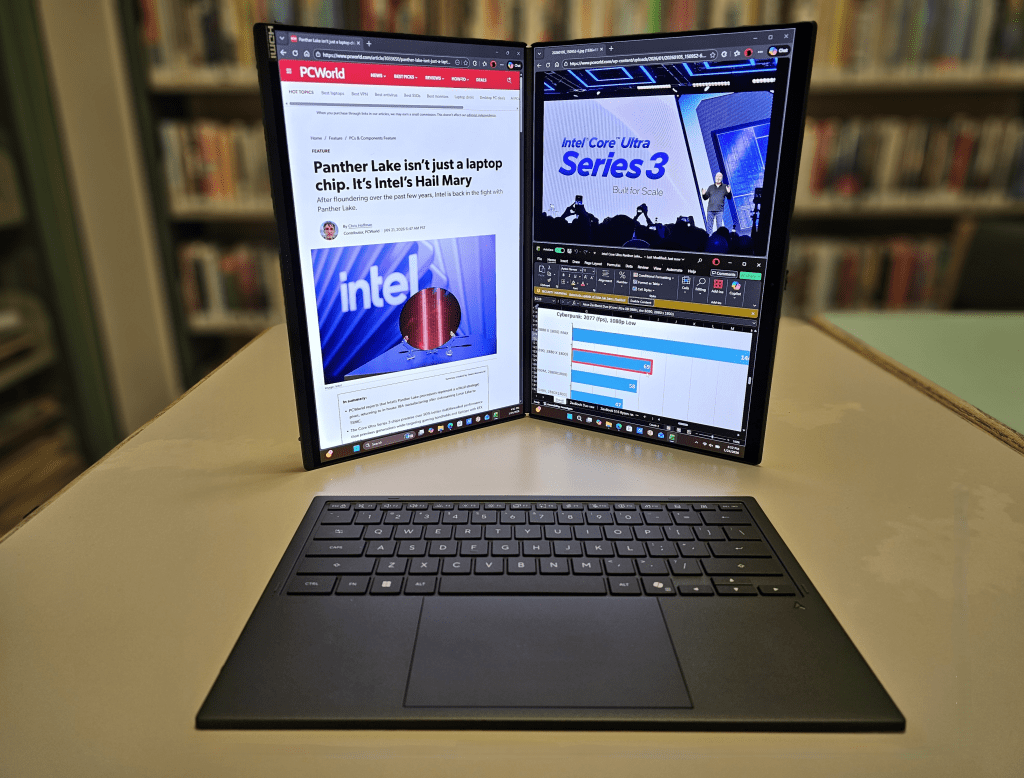
The Asus ZenBook Duo with a 99Wh battery (the largest allowed on planes) achieved 22 hours of single-screen use and up to 28 hours in 4K video playback. Even under load—simulating office work—the ZenBook Duo lasted nearly 14 hours, crushing competitors. The secret? A combination of Intel’s 18A process, larger batteries, and a chip that doesn’t throttle performance as aggressively as rivals.
Qualcomm’s Snapdragon chips run at full power all the time, while AMD’s Ryzen AI Max prioritizes raw performance over efficiency. Intel’s approach is different: it delivers near-peak performance on battery, then scales back when needed. The result is a laptop that can handle demanding tasks without sacrificing runtime.
Who wins in the end?
Panther Lake isn’t just about gaming. It’s about rethinking what a laptop CPU can do. The X9-388H’s CPU performance rivals Intel’s desktop Arrow Lake chips, while its power efficiency keeps it competitive with Lunar Lake. And with AI frame generation, it bridges the gap between integrated and discrete graphics in ways no other chip has.
But it’s not without competition. AMD’s Ryzen AI 400 and Qualcomm’s Snapdragon X2 Elite Extreme are coming, and both promise to push the envelope further. For now, though, Panther Lake stands alone—as the first chip to make integrated graphics feel like a viable alternative to dedicated GPUs.
Availability remains unclear, but if Intel’s claims hold, 2026 could be the year we finally retire the term ‘integrated graphics’—and start calling them something else entirely.