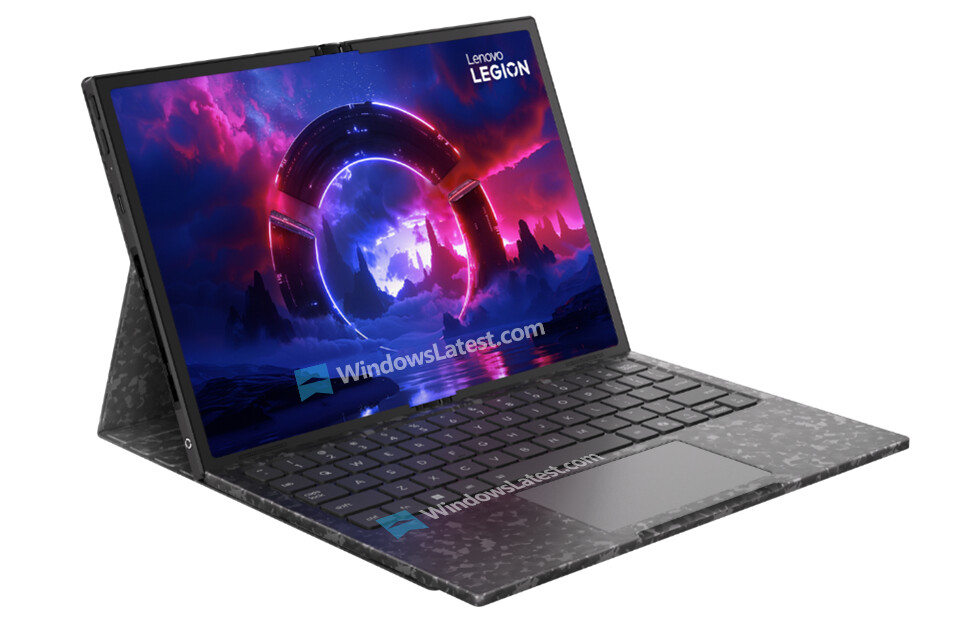
Lenovo is quietly reshaping its Legion Go lineup, and the latest leak suggests a bold departure from the traditional handheld design. Instead of sticking to the familiar 8.8-inch display, this new concept introduces a foldable OLED screen that can stretch from 7.7 inches in compact mode to a sprawling 11.7 inches when unfolded. The twist? It’s not just about gaming—it’s also positioning itself as a hybrid device capable of doubling as a mini-laptop.
This isn’t Lenovo’s first foray into flexible displays, but it is the most ambitious yet. While previous models like the Legion Go and its successor leaned heavily into gaming with their vertical FPS orientation, this concept takes that idea further by allowing the screen to pivot between portrait and landscape modes—even when detached from the controllers. That flexibility could open doors for creative workflows or multitasking setups, though whether it will deliver on that promise remains to be seen.
The hardware under the hood is no slouch either. The Core Ultra 7 258V processor, paired with 32 GB of RAM and a 48 Wh battery, suggests Lenovo is aiming this at users who demand both raw power and portability. That combination could make it a strong contender in the handheld gaming space, though it may also face stiff competition from established players like the OneXPlayer 2-in-1 devices.
Why This Concept Could Change the Game
The real innovation here lies in how Lenovo is rethinking the form factor. By making the display foldable and offering wireless controllers, it’s essentially creating a device that can adapt to different use cases—whether you’re gaming, working on documents, or splitting the screen for productivity tasks. The detachable keyboard accessory further cements its role as a hybrid between a handheld and a laptop.
Key Specs
- Display: 11.7-inch foldable OLED (7.7-inch compact mode)
- Processor: Intel Core Ultra 7 258V
- Memory: 32 GB LPDDR5x
- Battery: 48 Wh
- Controllers: Wireless, detachable (supports portrait/landscape modes)
The Core Ultra 7 chipset is a standout here, offering performance that rivals dedicated gaming hardware while maintaining efficiency. That’s crucial for a device that needs to balance gaming smoothness with all-day portability. The 32 GB of RAM ensures it won’t stumble on demanding tasks, whether it’s rendering graphics or running multiple apps simultaneously.
Who Is This For?
This concept isn’t just about raw specs—it’s about redefining what a handheld device can do. Gamers who want more screen real estate without sacrificing portability might find this appealing, especially if Lenovo sticks to its tradition of optimizing for vertical FPS mode. But the real appeal could be for professionals or creatives who need a device that can switch between gaming and productivity seamlessly.
A Niche in the Making?
Lenovo has already shown it’s capable of pushing boundaries with flexible displays, as seen with its ThinkBook Plus Gen 6 Rollable. However, foldable handhelds remain a niche market, even within the niche of gaming devices. The question is whether this concept will stay on the drawing board or evolve into a product that can break new ground.
Regardless, one thing is clear: Lenovo is betting big on this idea. If it moves forward, we could see an official reveal at MWC 2026 in March, though no pricing has been confirmed yet. For now, it’s just a concept—but concepts often pave the way for the future.