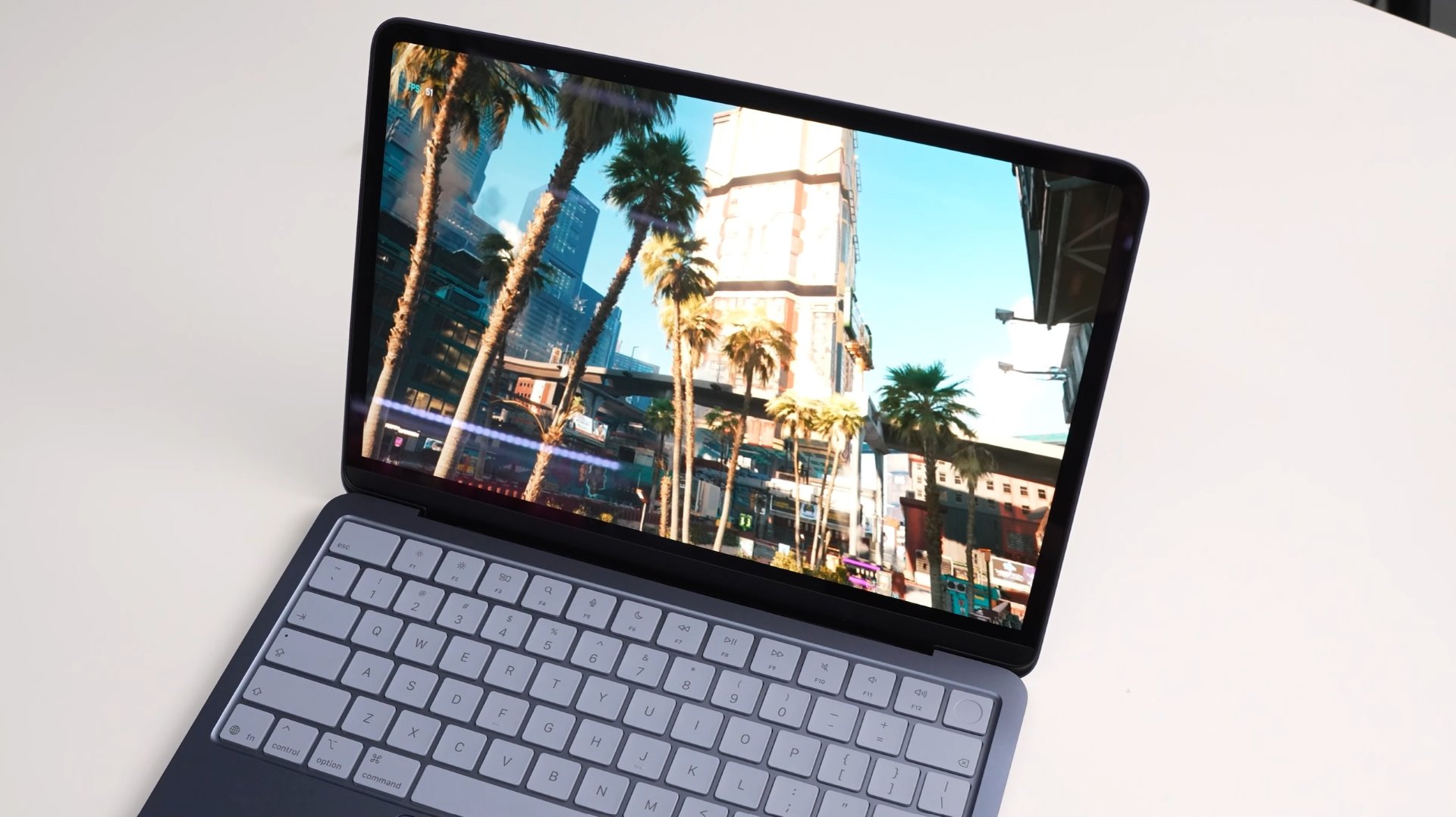
The MacBook Neo has quietly become a benchmark for what mobile computing can achieve when pushed to its limits. A recent experiment running Cyberpunk 2077 on the device revealed that even Apple's most affordable portable Mac can manage around 50 frames per second at the absolute lowest graphics settings, though the practical implications are more nuanced than raw numbers suggest.
This isn't a traditional gaming platform, but the test highlights how far mobile silicon has advanced. The A18 Pro chip, designed primarily for iPhones, shows it can handle demanding visual workloads when paired with optimized software—even if only at minimal graphical fidelity. The performance gap between this and traditional gaming hardware remains vast, but the experiment serves as a reminder that boundaries are constantly shifting.
Key Specifications
- Chip: A18 Pro (8-core CPU)
- Storage: 256GB or 512GB options
- Display: Likely Retina OLED, 1080p resolution
- Memory: 8GB unified (shared between CPU/GPU)
The 512GB variant is available at $699, while the base model starts at $599. These prices position it as a premium entry-level device, though its gaming capabilities are best described as 'emergency mode' rather than mainstream playable performance.
Performance Context
Comparing this to dedicated gaming hardware paints an expectedly stark picture. A laptop equipped with the RTX 4090, for example, outperforms Apple's M5 Max chip by roughly 63% in Cyberpunk 2077 benchmarks—even when both run at identical settings. The MacBook Neo's A18 Pro chip doesn't challenge this disparity, but the test does underscore how mobile processors are evolving to handle more complex visual tasks.
For creators working on lightweight 3D projects or video editing, the device's true strengths lie elsewhere—in battery life, portability, and integrated workflows. Its ability to run even demanding games at minimal settings is more of a curiosity than a practical feature for most users. The lack of proper cooling systems and the thermal throttling inherent in mobile designs further limit its gaming potential.
What's Still Unclear
The exact benchmark methodology used in this test remains unverified, making it difficult to draw concrete conclusions about real-world performance consistency. No official metrics or screenshots were provided to confirm the claimed 50FPS figure, leaving room for skepticism despite the visual demonstration.
For now, the MacBook Neo stands as a symbol of mobile computing's expanding capabilities rather than a viable gaming device. Its true value remains in its balance of performance and portability for professional workloads, where it excels far more reliably than in gaming scenarios. The experiment serves less as a product endorsement and more as a technological curiosity—one that pushes the envelope of what we expect from mobile hardware.