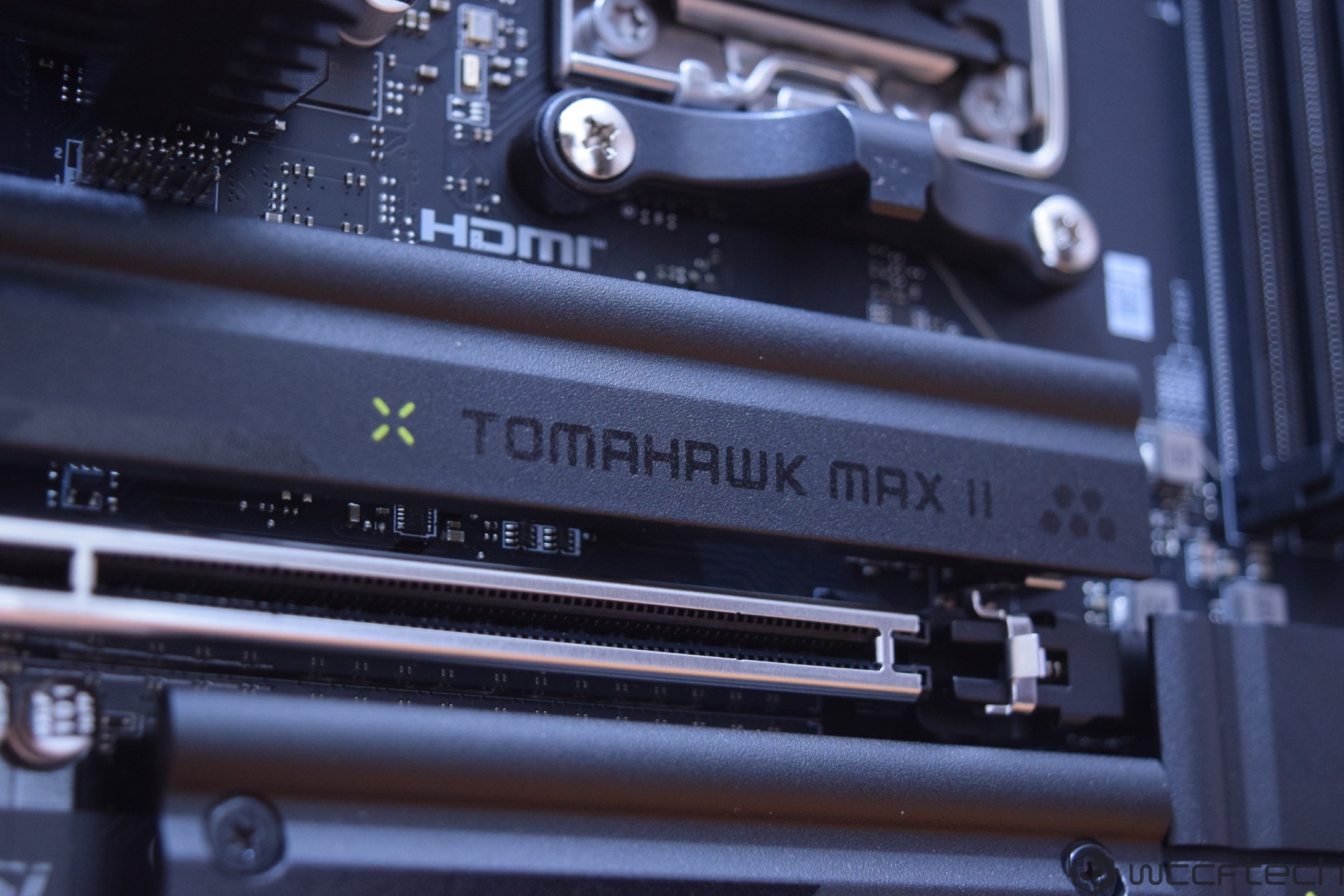
AMD’s AM5 platform has spent three years supporting Ryzen 7000, 8000, and now 9000 CPUs, but the 600-series chipsets launched alongside it have remained largely unchanged. That’s about to shift with the 800-series, a refresh designed to modernize entry-level and mid-range builds with Gen5 NVMe, DDR5, and—on some models—USB4. MSI’s B850 Tomahawk MAX WIFI II arrives as the first mainstream AM5 board to adopt these upgrades, priced at $239, just $11 above the original Tomahawk MAX WIFI. The question isn’t whether it’s an improvement over last-gen AM5 boards, but whether it’s worth the cost for Ryzen users still clinging to AM4.
The B850 chipset itself is a scaled-back version of the high-end X870, trading USB4 for USB 3.2 (20 Gbps) while retaining Gen5 NVMe lanes for SSDs and optional Gen5 GPU lanes—meaning some manufacturers may dedicate those to discrete graphics instead. This mirrors Intel’s B760 strategy: a budget-friendly platform that supports overclocking and DDR5 but lacks premium features like Thunderbolt or PCIe 5.0 for GPUs. MSI’s implementation leans into the MAX branding with a reinforced VRM, Wi-Fi 6E, and two M.2 slots (one Gen5, one Gen4), but the real story is in what it omits.
The Core Tradeoffs: Gen5 for SSDs, Not GPUs
Unlike the X870, the B850 doesn’t guarantee Gen5 GPU lanes. MSI’s board defaults to x16 Gen4 for graphics, freeing up Gen5 for NVMe storage—a practical choice for most users. This means a Ryzen 7 7800X3D or 9800X3D will see no PCIe bottleneck for GPUs, but storage speeds jump from Gen4’s 32 Gbps to Gen5’s 64 Gbps. The tradeoff is deliberate: AMD’s chipset roadmap suggests Gen5 GPU lanes will remain optional for mainstream boards, prioritizing SSD performance where it matters most.
Memory support is another upgrade. The B850 natively handles DDR5-5600, with MSI’s board overclocking to DDR5-6000 out of the box—a meaningful jump for Ryzen 7000/8000 CPUs, which benefit from higher memory speeds. However, DDR4 compatibility is gone, forcing users into DDR5 territory even for budget builds. Pricing reflects this: a DDR4-capable B650 board might still sell for $150–$200, but the B850’s $239 price aligns with Intel’s B760 competitors, not AMD’s own 600-series.
Who Should Care?
The B850 Tomahawk MAX WIFI II is a clear upgrade for three groups
- Ryzen 7000/8000/9000 users moving from AM4: The Gen5 NVMe and DDR5 support make it a smoother transition than a 600-series board, though cooler compatibility remains unchanged.
- Storage-focused builders prioritizing Gen5 SSDs over GPU upgrades: The single Gen5 M.2 slot is a limitation, but paired with a Gen4 slot, it’s still faster than most B650 boards.
- Wi-Fi 6E and VRM reliability seekers: MSI’s MAX VRM and built-in Wi-Fi 6E justify the premium over no-name B850 alternatives.
For everyone else, the value proposition weakens. A Ryzen 7 5800X on a B650 or even a high-end X670E still delivers comparable performance at lower cost. The B850’s appeal lies in future-proofing: DDR5 and Gen5 NVMe are table stakes for 2026 builds, and the $239 price is reasonable for that. But it’s not a must-buy—just the best option for those who need the latest features without paying X870 prices.
Key Specs
- Chipset: AMD B850
- Socket: AM5 (LGA 1718)
- Memory: 4x DDR5 slots (up to DDR5-6000)
- Storage: 2x M.2 (1x Gen5, 1x Gen4), 4x SATA 6Gb/s
- PCIe: x16 Gen4 (GPU), x8 Gen5 (optional NVMe)
- USB: 1x USB4 (via chipset), 2x USB3.2 Gen2 (20 Gbps), 6x USB3.2 Gen1, 8x USB2.0
- Networking: Intel Wi-Fi 6E, Realtek 2.5G Ethernet
- VRM: 14+2+1 phase (MAX series)
- Form Factor: ATX
- Price: $239
The B850 Tomahawk MAX WIFI II isn’t revolutionary, but it’s a pragmatic refresh. For Ryzen 7000/8000/9000 users tired of AM4’s limitations, it’s the most compelling AM5 entry point. For others, the $239 ask may feel steep—especially when a B650 or even a used X570 can do nearly as much for less. AMD’s chipset strategy now hinges on whether the 800-series can lure builders away from older platforms, or if it’ll remain a niche upgrade for early adopters.
Availability is expected to align with broader B850 releases, with MSI likely shipping stock in the coming weeks.