Industrial motherboard maker has quietly expanded its portfolio to cover both AMD's high-end server and client processor families in a single platform. The move positions the company as a one-stop supplier for edge computing systems that need to straddle EPYC 4005 for heavy-duty data centers and Ryzen 9000 for AI-enhanced analytics—yet critical details such as availability and pricing are still being finalized.
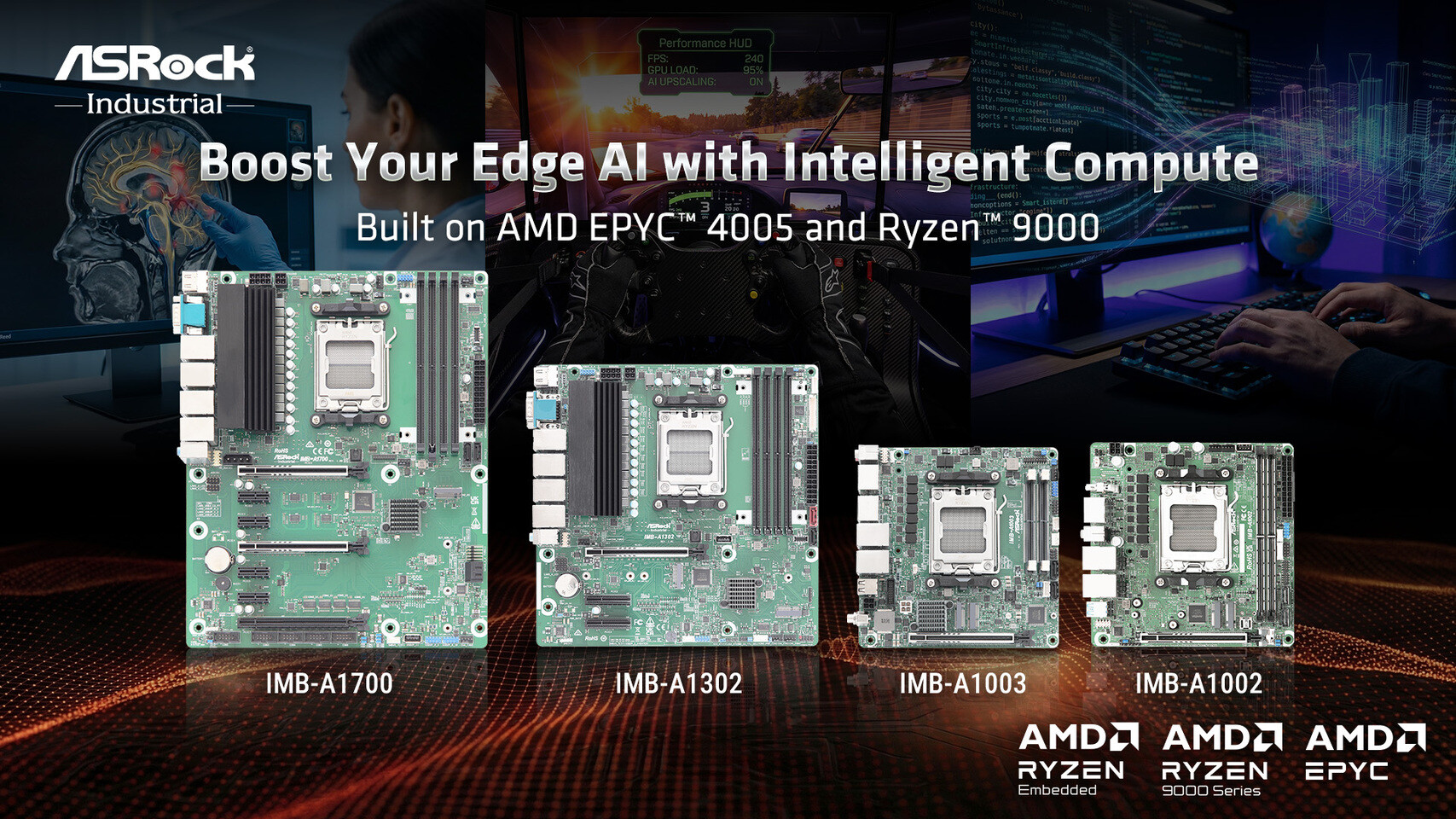
At the core of this new lineup is a family of four boards: one ATX (IMB-A1700), one microATX (IMB-A1302), and two Mini-ITX models (IMB-A1003 and IMB-A1002). They are designed to support AMD's latest EPYC 4005 processors—up to 16 cores, 32 threads—alongside the Zen 5-based Ryzen 9000 series, which brings desktop-grade performance into compact industrial form factors.
Key specs at a glance
- IMB-A1700 (ATX):
- 4 × DDR5-5600 ECC/non-ECC U-DIMM slots, up to 256 GB RAM
- 2 × PCIe Gen 5 x16 (configurable as one x16 or two x8), 1 × PCIe Gen 4 x4, 4 × PCIe Gen 4 x1
- 1 × M.2 Key M (NVMe), 4 × SATA3 with RAID 0/1/10
- 7 × USB 3.2 Gen 2, 8 × USB 2.0, 6 × COM, 3 × 2.5G LAN + 1 × 1G LAN
- Quad-display via HDMI 2.0b and DisplayPort 1.2++
The IMB-A1700 is the flagship of this group, targeting high-performance edge servers with its generous memory capacity (up to 256 GB) and robust PCIe Gen 5 expansion. It’s aimed at AI-driven video analytics, computer vision, and high-end development systems where throughput and multitasking are critical.
- IMB-A1302 (microATX):
- 4 × DDR5-5600 ECC/non-ECC U-DIMM slots, up to 256 GB RAM
- 1 × PCIe Gen 5 x16, 2 × PCIe Gen 4 x4
- 1 × M.2 Key E (wireless), 1 × M.2 Key M (NVMe), 2 × SATA3 with RAID 0/1
- 7 × USB 3.2 Gen 2, 6 × USB 2.0, 2 × COM, 4 × 2.5G LAN + 1 × 1G LAN
- Quad-display via HDMI 2.0, VGA, optional LVDS/eDP
The microATX version (IMB-A1302) strikes a balance between performance and space efficiency, making it suitable for video analytics systems and AI-enabled development platforms where footprint matters but processing power doesn’t wane.
- IMB-A1003 & IMB-A1002 (Mini-ITX):
- IMB-A1002: 2 × DDR5-5200 Long-DIMM, up to 96 GB RAM
- IMB-A1003: 2 × DDR5-5200 SO-DIMM, up to 96 GB RAM
- Both: 1 × PCIe Gen 5 x16, 1 × M.2 Key E (wireless), 1 × M.2 Key B (SIM socket for 4G/5G on IMB-A1002)
- Storage: 1 × M.2 Key M (NVMe), 2 × SATA3
- I/O varies slightly but includes dual 1G LAN and quad-display support
The two Mini-ITX models are built for ultra-compact AI edge devices, with the IMB-A1002 adding a SIM socket for cellular connectivity—a feature that could be useful in mobile analytics or IoT gateways. Both use DDR5-5200 memory but differ in form factor (Long-DIMM vs. SO-DIMM), catering to systems where space is at a premium.
Why this matters
The overlap between EPYC 4005 and Ryzen 9000 support isn’t just about flexibility—it’s a strategic play for the industrial market. Systems built on these boards can transition from data center-grade workloads to AI-enhanced edge processing without a full redesign, reducing compatibility risk for OEMs and integrators. However, this dual-support approach also introduces complexity: users must carefully choose between DDR5-5600 (for EPYC) and DDR5-5200 (for Ryzen 9000), which could lead to confusion in deployment.
Another unknown is whether these boards will carry a premium for their versatility. While the specs are impressive—PCIe Gen 5, multi-GbE LAN, quad-display—the lack of pricing details leaves room for skepticism about real-world affordability, especially for smaller deployments where cost sensitivity is high.
Reality check
Not all features are confirmed. The IMB-A1003’s SO-DIMM support, for example, may not yet be fully validated in all configurations, and the quad-display capability on Mini-ITX models could impose thermal or power constraints that aren’t publicly disclosed. Until official benchmarks surface, the true performance edge of these boards remains speculative.
What’s confirmed vs unknown
The boards are physically available for sampling, but mass-market pricing and release timelines are still being determined. If the trend holds, they could appear in Q4 2026, giving OEMs a head start on next-generation edge systems. For now, the strategic value lies in reducing ecosystem fragmentation—if the promises of seamless EPYC-to-Ryzen transitions hold up.