A desktop workstation has entered the market that promises to run large language models and scientific workloads without leaving the office—no server racks required. The system, built around four RISC-V ASICs, delivers 2,654 TFLOPS at BlockFP8 precision while consuming standard power and fitting on a desk.
- Compute: Four Blackhole ASICs with 480 Tensix cores
- Memory: 128 GB GDDR6 (high-speed) + 256 GB DDR5 system RAM
- Precision: BlockFP8 for efficient tensor operations
- Power: Single 120V outlet, no specialized cooling infrastructure needed
The architecture integrates compute and SRAM on a single die to avoid traditional DRAM bandwidth bottlenecks. This approach sidesteps HBM supply constraints while aiming for performance comparable to flagship GPU workstations.
Pre-installed workloads cover LLMs, coding agents, image generation, video synthesis, and biomolecular prediction. For example, GPT-OSS 120B runs locally with all 120 billion parameters resident on the device. A scientific benchmark—predicting a 686-amino-acid protein structure in 49 seconds—highlights its potential for lab environments.
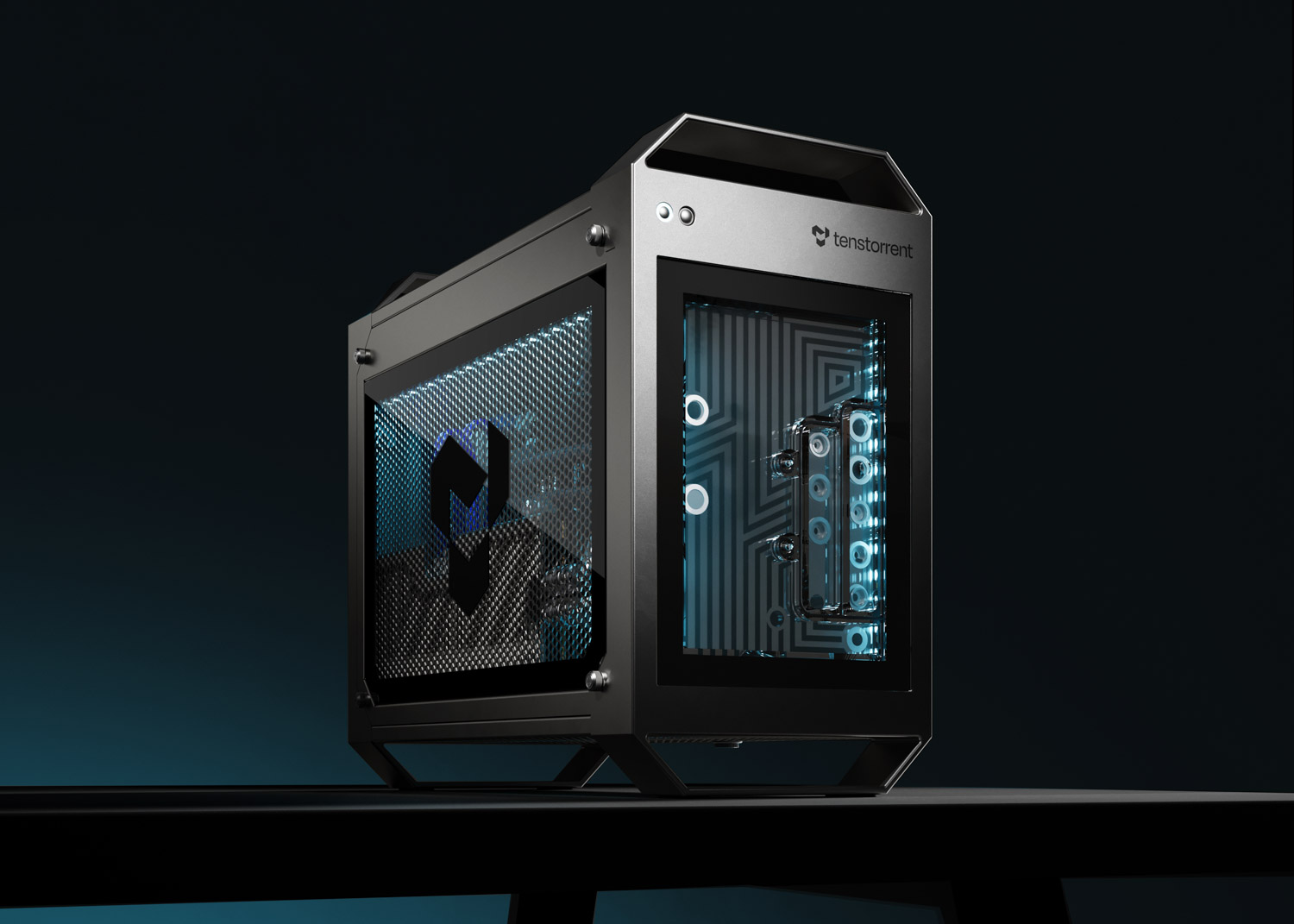
Developers gain full-stack open-source visibility from compiler to kernel, including TT-Forge (AI compiler), TT-Metalium (low-level SDK), and TT-LLK (kernel software). The system ships with Ubuntu 24.04 and is designed for immediate deployment in regulated or data-sensitive settings.
Power efficiency has reportedly improved by 50% over previous generations, with liquid cooling tailored for desk-side use under sustained loads. This positions it as a viable alternative to cloud inference for small labs and SMBs that need on-premises control without server-room overhead.
Availability is targeted for Q2 2026 at a starting price of $9,999. The platform may appeal most to developers and research teams prioritizing local execution, auditability, and avoiding cloud token limits or data residency risks.