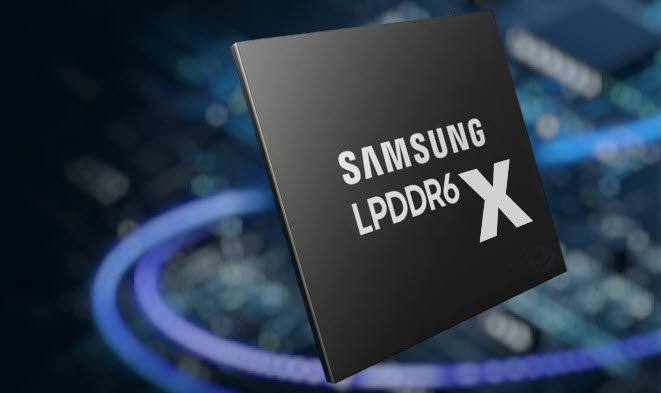
Samsung’s memory division has quietly begun delivering prototype samples of its upcoming LPDDR6X technology to Qualcomm, marking a pivotal step in the development of next-generation AI accelerators. While LPDDR6—expected to debut in mass production by late 2026—will initially offer speeds of 10.7 Gbps with 21% greater efficiency than its LPDDR5 predecessor, the LPDDR6X variant promises even more ambitious performance, potentially reaching 14.4 Gbps or higher once standardized by JEDEC.
The early samples are earmarked for Qualcomm’s AI250 chip, a follow-up to the AI200 accelerator launched earlier this year. Both chips rely on LPDDR memory—a stark contrast to the high-bandwidth, high-power HBM stacks favored by NVIDIA, AMD, and Huawei in data center GPUs. HBM’s complexity and cost make it impractical for many AI workloads, whereas LPDDR offers a more scalable, budget-friendly alternative.
Qualcomm’s AI200 already pushes LPDDR limits with up to 768 GB of memory, and the AI250 could shatter those boundaries entirely, potentially supporting capacities beyond 1 TB when paired with LPDDR6X. Yet despite the hype, widespread adoption of LPDDR6X remains at least two years out, with realistic expectations pointing to late 2027 or early 2028 for full commercialization.
The AI Memory Arms Race
For Qualcomm, the shift to LPDDR6X isn’t just about raw speed—it’s about redefining how AI inferencing hardware is built. While NVIDIA’s dominance in AI GPUs relies on HBM’s unmatched bandwidth, Qualcomm’s approach prioritizes cost efficiency and power savings, making it a compelling option for edge AI, cloud inference, and even high-performance computing clusters where budget constraints matter.
The tradeoff is clear: HBM delivers far superior performance per watt in tightly optimized data center setups, but its $10–$20 per GB pricing (compared to LPDDR’s $2–$5 per GB) and manufacturing complexity limit its accessibility. LPDDR6X, by contrast, leverages standard DRAM packaging and testing—no 3D stacking, no exotic interposers—while still offering nearly 50% faster speeds than LPDDR5 in its most advanced configurations.
What’s Next?
With JEDEC’s finalization of LPDDR6X specifications still pending, Samsung’s sample shipments suggest a rapid acceleration in the memory industry’s push toward AI-optimized hardware. Qualcomm’s AI250, when it arrives, will likely set a new benchmark for memory-intensive AI workloads, though its full potential hinges on whether LPDDR6X can deliver on its promises without sacrificing stability or yield.
For now, the tech remains in its infancy—mass production of LPDDR6 is still months away, and LPDDR6X is years from becoming a mainstream choice. But one thing is certain: the race to define the next era of AI memory has already begun.