Zalman’s foray into GPU stands with a twist has arrived just in time for CES 2026, where the ZM-VS3 DS models promise to redefine what a simple accessory can do. Unlike traditional anti-sag brackets or flashy RGB-laden alternatives, these stands eschew excessive lighting in favor of a single LCD screen paired with two narrow, understated ARGB strips—one black and one white variant. The result is a product that walks the line between functional utility and deliberate design statement.
At first glance, the ZM-VS3 DS appears to be a straightforward solution for securing large GPUs in vertical orientation. However, its most striking feature—the LCD panel—hints at something more ambitious. Promotional materials suggest the screen is software-controlled, drawing power from a 5V ARGB header while displaying critical system data: CPU temperature, GPU temperature, and the current time. This functionality, if executed well, could transform an otherwise static accessory into a dynamic element of a build’s aesthetic.
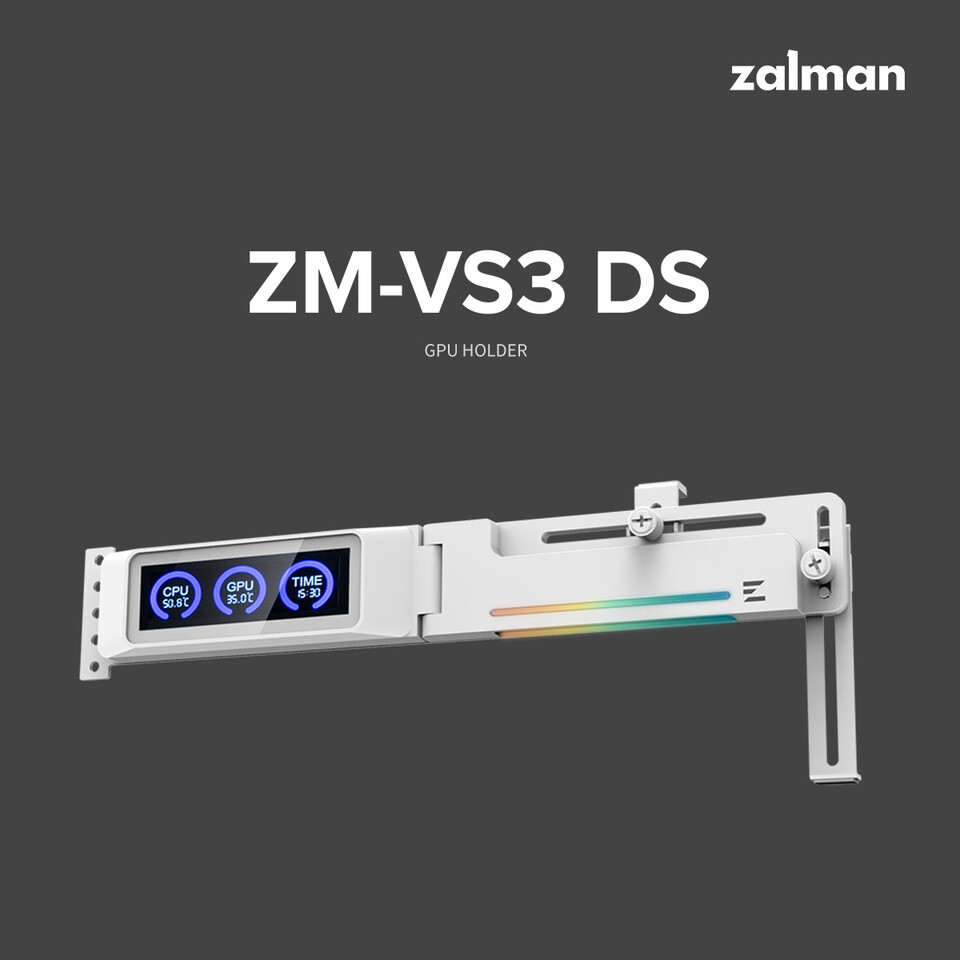
But practicality remains a question mark. The stand’s connection to the motherboard is mediated by a nine-pin USB 2.0 cable, which raises concerns about cable management and potential interference in builds with limited clearance. Additionally, while the price point—approximately $11–$12 for both variants—is hard to argue with, it remains to be seen whether the LCD’s software ecosystem will justify its inclusion or if it will become another gimmick that collects dust over time.
Zalman has a history of balancing innovation with accessibility, from their circular cooling towers at Computex 2025 to retro-inspired cases like the M4 SE Black. The ZM-VS3 DS follows this pattern, but its success hinges on execution. If the LCD proves reliable and the ARGB strips remain unobtrusive, it could carve out a niche for those who prioritize both form and function. However, in an era where even minor accessories are scrutinized for their place in increasingly complex builds, Zalman will need to prove that this isn’t just another flashy addition to a crowded market.
For now, the stands are available in South Korea, with no immediate word on global distribution. Whether they make it to CES 2026 remains speculative, but if they do, they’ll certainly be one of the more unconventional accessories on display—a reminder that even in utilitarian components, there’s always room for reinvention.