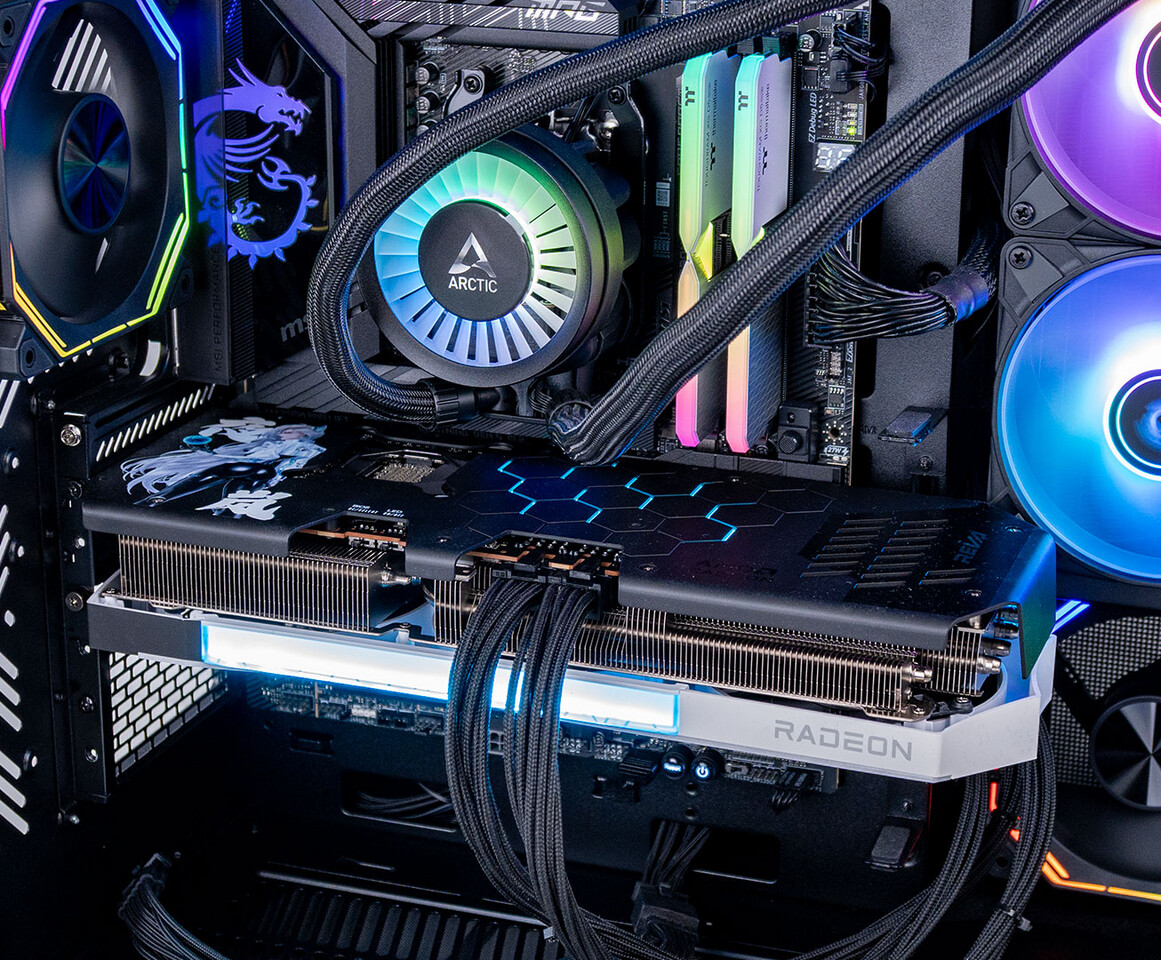
AMD’s Radeon RX 9070 XT continues to dominate sales charts, though not without context. In the latest data from a major European retailer, the RX 9070 XT secured 25.6% market share over three weeks, outperforming its closest competitor, NVIDIA’s RTX 5070 Ti, which held just 9%. This gap highlights AMD’s strong position in performance-per-dollar metrics, even as GPU sales plummet to roughly a third of typical levels.
That’s the upside—here’s the catch. While AMD captures nearly half (55.6%) of the retailer’s GPU sales, the broader market shows signs of strain. Prices for both AMD and NVIDIA GPUs have surged, with the RTX 5070 Ti, for example, now priced around €200–€300 above its AMD counterpart in some regions. Meanwhile, component shortages and economic pressures have slashed GPU purchases, raising questions about long-term demand.
Key Specs and Market Share
- AMD Radeon RX 9070 XT: 25.6% market share (top seller)
- AMD Radeon RX 9060 XT: 20.3% market share
- NVIDIA RTX 5080: 11.8%
- NVIDIA RTX 5070 Ti: 9%
- AMD’s total GPU share: 55.6% of retailer sales
The RX 9070 XT’s lead is particularly notable in a market where NVIDIA usually dominates. However, the data comes with caveats: it represents less than 0.1% of global weekly GPU sales, and regional price disparities (e.g., Germany) may skew results. For instance, while the RX 9070 XT undercuts the RTX 5070 Ti by €200–€300 in some areas, its performance edge at 1440p/4K remains a key factor for buyers.
Industry Context
The decline in GPU sales—estimated at a 67% drop from last year’s levels—mirrors broader trends in hardware demand. Rising costs (memory, motherboards) and economic uncertainty have pushed many consumers to delay upgrades or opt for lower-tier models. Even NVIDIA, which typically commands 90%+ market share globally, has seen production cuts for high-end SKUs like the RTX 5070 Ti.
Implications for Buyers
For enterprise buyers, the RX 9070 XT’s performance-per-dollar advantage could make it a compelling choice, especially in regions where price sensitivity is high. However, AMD’s roadmap—including Zen-based architectures and potential 2nm/3nm transitions—remains uncertain. If future GPUs deliver better efficiency or ray-tracing capabilities, the current value proposition may shift.
Where Things Stand Now
AMD holds a strong position in mid-range GPU sales, but the market’s volatility suggests caution. Prices are stabilizing slightly for AMD, though NVIDIA’s high-end offerings (RTX 5090) remain out of reach for most buyers due to AI-driven demand and supply constraints. For now, the RX 9070 XT stands as a rare bright spot in a challenging landscape.