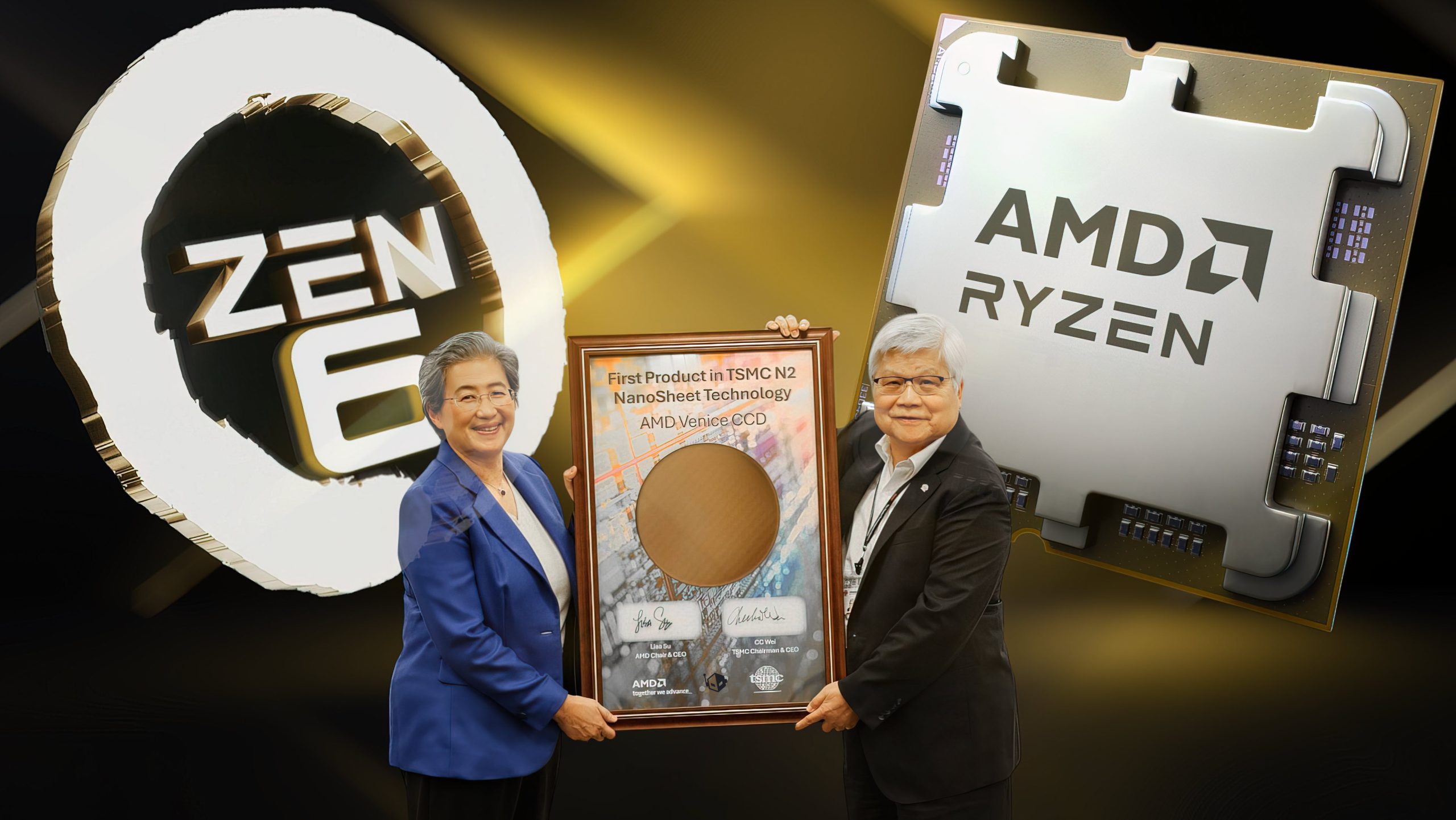
AMD’s Zen 6 chiplet design is taking a bold step forward in core density without expanding its footprint. While the company’s Zen 5 CCD measured just 71mm², the Zen 6 iteration—built on TSMC’s advanced 2nm process—will occupy a nearly identical 76mm² die. The catch? It will house 50% more cores and cache, a feat that highlights how far semiconductor technology has advanced in just two years.
The Zen 6 CCD will feature 12 cores paired with 48MB of L3 cache, up from 8 cores and 32MB on Zen 5. This isn’t just a modest upgrade—it’s a testament to TSMC’s N2 process, which delivers unparalleled transistor efficiency. AMD’s EPYC Venice servers will be the first to adopt this node, but the technology will soon trickle down to consumer Ryzen processors.
Why the Die Size Matters
Die shrinkage is a critical metric in CPU design, balancing performance, power efficiency, and manufacturing costs. Zen 2’s CCD started at 77mm², grew to 83mm² for Zen 3, then shrank to 72mm² for Zen 4 before settling at 71mm² for Zen 5. Zen 6’s 76mm² die represents a slight increase but delivers a massive leap in capability. For context, a Zen 6C variant—likely targeting high-end desktops and workstations—will span 156mm², packing 32 cores and a staggering 128MB of L3 cache. That’s double the die area of a single Zen 6 CCD but with twice the core count and 2.66x more cache.
A Glimpse at What’s Coming
While AMD has yet to reveal full Zen 6 specifications, leaks and early reports suggest several key improvements
- A potential double-digit IPC (instructions per cycle) boost, improving single-threaded performance.
- Support for higher DDR5 memory speeds, though dual-channel configurations will remain.
- An enhanced 3D V-Cache architecture, with hints of a third-generation upgrade for models like the Ryzen 7 9850X3D and Ryzen 9 9950X3D2.
- Possible clock speed increases, though thermal design power (TDP) may stay in line with current high-end models.
The shift to TSMC’s N2P node for most Zen 6 products—with N3P reserved for entry-level chips—reflects AMD’s strategy to balance performance and cost. This approach ensures that even budget-conscious buyers benefit from advanced manufacturing, while flagship models leverage the full potential of 2nm.
Looking Ahead
Zen 6’s arrival later this year will mark a turning point for AMD’s desktop and server ecosystems. The architecture’s focus on core density and cache efficiency aligns with growing demands for multi-threaded workloads, from gaming to AI acceleration. Early benchmarks for the Ryzen 9850X3D have already shown promising gains over its predecessor, hinting at what Zen 6 could achieve.
With the GeForce RTX 5060 Ti now commanding prices near $700 due to market fluctuations, AMD’s push for efficiency in both CPUs and GPUs takes on added relevance. The company’s ability to deliver more performance per watt—and per dollar—could redefine competitive dynamics in the high-end market.
One thing is certain: AMD isn’t just iterating—it’s redefining what’s possible in silicon density. The Zen 6 CCD proves that sometimes, the most revolutionary advances aren’t about bigger dies, but about doing more with less.