A user building a mid-range gaming rig today faces a familiar dilemma: should they commit to DDR5 now or wait for prices to stabilize? A new motherboard lineup from one of the industry’s leading PC component brands offers a practical answer, combining Wi-Fi 7 networking with both next-gen and legacy memory support—while keeping an eye on future GPU compatibility.
Announced recently, the refreshed Battle-ax series includes two models: one optimized for DDR5 and the latest Intel Core Ultra processors, the other targeting DDR4 users upgrading from older systems. Both feature PCIe 5.0 storage slots, reinforced PCIe 5.0 x16 slots for next-gen graphics cards like the RTX 5070, and a range of connectivity upgrades—including Wi-Fi 7—aimed at reducing latency in online gaming.
Dual platforms, dual strategies
The B860M-PLUS S WIFI7 model is designed for forward-looking builds. It supports the latest Intel Core Ultra 200S series processors and DDR5 memory up to 8800 MHz (overclocked), making it a strong candidate for systems that will run next-generation titles without immediate upgrade bottlenecks.
In contrast, the B760M-PLUS S WIFI7 sticks with DDR4, supporting speeds up to 4800 MHz and targeting users who want to leverage existing memory investments while still gaining access to PCIe 5.0 storage and Wi-Fi 7 performance. Both boards feature reinforced power delivery phases rated for sustained heavy workloads—including when paired with high-end CPUs like the Core i7-14700K.
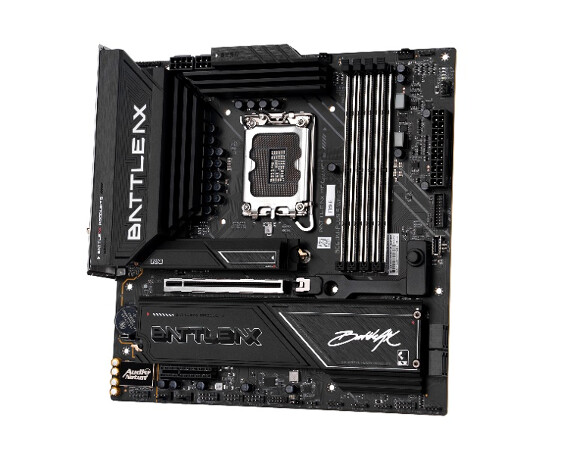
Specs that reflect real-world tradeoffs
- Power Design: 10+1+1+1 phase (60 A DrMOS) for B860M-PLUS; 12+1+1 phase (60 A DrMOS) for B760M-PLUS
- Memory Support: DDR5 up to 8800 MHz (OC), optimized for single-DIMM gaming performance on the B860M; DDR4 up to 4800 MHz (OC) on the B760M
- Storage: Three M.2 slots (one PCIe 5.0 x4 on both models), four SATA ports
- GPU Slot: Reinforced PCIe 5.0 x16 slot, ready for RTX 50 series and beyond
- Networking: 5GbE LAN plus Wi-Fi 7 module (IEEE 802.11be)
- USB Ports: Six Type-A rear ports, two Type-C
- User Experience: Tool-free GPU and M.2 heatsink installation on both models
The specs reflect a balance between performance and practicality. The B860M’s single-DIMM optimization, for example, is a nod to budget-conscious gamers who prioritize price-to-performance over multi-channel scaling. Meanwhile, the B760M’s DDR4 support avoids forcing users into higher memory costs if they’re upgrading from older Intel 12th or 13th Gen platforms.
What builders should watch
While both motherboards are shipping now, a few details remain unclear. Pricing has not been confirmed, which could influence whether the B860M’s DDR5 premium is justified for budget builds. Additionally, real-world performance with Intel APO (Audio Processing Object) and Wi-Fi 7 in gaming scenarios will depend on driver maturity—something that typically evolves over several firmware updates.
For creators and gamers, the bigger question is compatibility risk: will a DDR4-based board like the B760M remain relevant when DDR5 becomes the de facto standard? The answer may hinge on how long DDR4 memory prices stay stable. If they drop significantly in 2027 or later, the B760M could still serve as an affordable bridge—provided PCIe 5.0 storage and Wi-Fi 7 remain compelling upgrades.
In the short term, however, the Battle-ax lineup delivers on its promise of flexibility. Whether you’re teaming it with a Core i7-14700K or an RTX 5060, these motherboards position themselves as adaptable platforms for both today’s builds and tomorrow’s workloads.