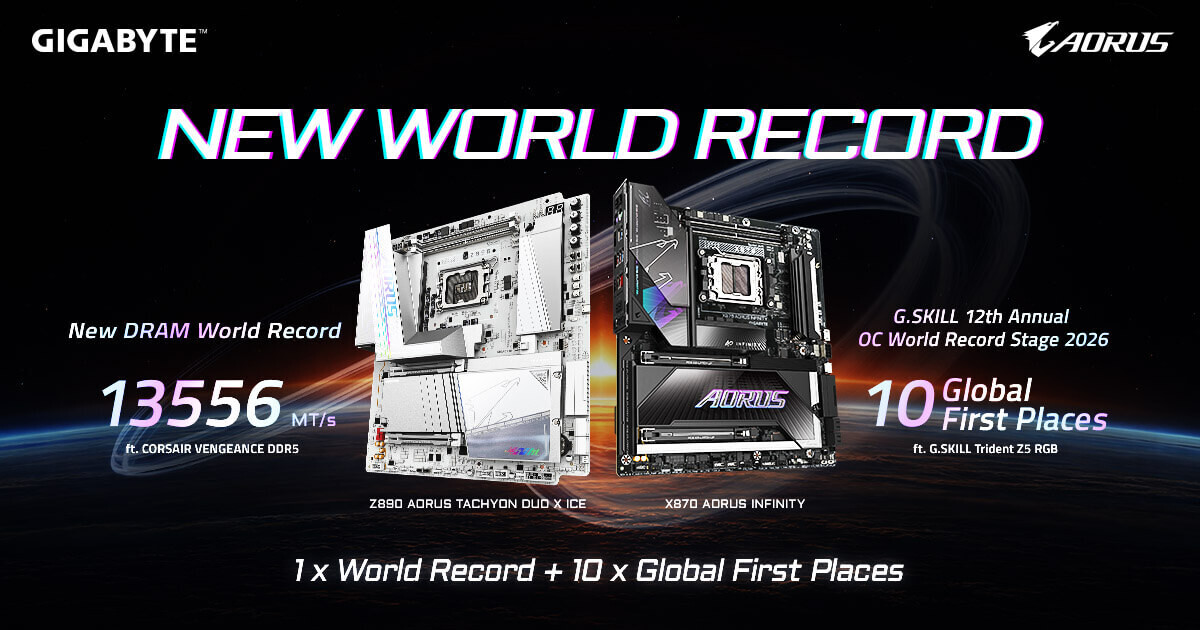
GIGABYTE has set a new standard for DDR5 memory performance with a world-record speed of 13,556 MT/s, achieved during the annual OC World Record Stage at Computex 2026. The milestone underscores the brand's commitment to pushing hardware limits while also addressing the growing demand for high-speed RAM in next-generation PC builds.
The record was set using Corsair VENGEANCE DDR5 memory on GIGABYTE's Z890 AORUS TACHYON DUO X ICE motherboard, a platform designed specifically for overclocking enthusiasts. This achievement is part of a broader trend where DDR5 speeds continue to climb, driven by both consumer demand and advancements in motherboard technology. For PC builders, this means that even the most aggressive memory configurations are now within reach—though with trade-offs that need careful consideration.
Performance Gains and Practical Implications
The new DDR5 world record is not just a symbolic achievement; it reflects tangible improvements in memory bandwidth and latency that can translate to real-world performance gains. For example, the RTX 5090, already a powerhouse for AI workloads and high-end gaming, could see further optimization when paired with such high-speed RAM. However, these gains come with constraints, including increased power consumption and thermal output, which must be managed in system design.
GIGABYTE's overclocking team also secured 10 global first places during the event, using the newly launched X870 AORUS INFINITY motherboard. This platform is engineered to deliver the lowest memory latency on the AMD X870 chipset, making it a compelling option for users looking to maximize performance with Ryzen 9 9950X3D2 processors. The combination of these two components—high-speed DDR5 and optimized motherboard support—represents a significant leap forward in what is possible for enthusiast builds.
Challenges and Considerations
While the record-breaking performance is impressive, it also raises questions about stability and real-world usability. DDR5 speeds at this level are pushing the boundaries of current hardware design, which can introduce compatibility risks for some users. For instance, not all motherboards or cooling solutions may be able to handle such extreme configurations without compromising system stability. Additionally, the power requirements for 16 GB modules running at these speeds add complexity to system planning, requiring careful consideration of PSU selection and thermal management.
For PC builders, this means that while the performance gains are substantial, they come with a need for more rigorous testing and validation. Users should weigh the benefits against the potential drawbacks, such as increased cost, power draw, and the learning curve associated with fine-tuning such high-end setups. The partnership between GIGABYTE and memory manufacturers like Corsair and G.SKILL is crucial here, as it ensures that these extreme configurations are not only possible but also supported by robust hardware and software ecosystems.
In summary, GIGABYTE's latest achievements in overclocking highlight the rapid evolution of DDR5 technology and its impact on PC performance. While the record-breaking speeds open new possibilities for enthusiasts, they also serve as a reminder that pushing hardware to its limits requires careful planning and an understanding of the trade-offs involved. As the market continues to evolve, these advancements will likely set the benchmark for what is expected in future generations of high-performance PCs.