Stress testing GPUs has become significantly more complex in 2024. The era of relying solely on tools like FurMark is over. Today’s comprehensive validation must integrate synthetic workloads, real-time rendering demands, and specialized compute tasks—such as AI acceleration and ray tracing—to accurately assess performance, thermal behavior, and long-term reliability.
This evolution mirrors broader shifts in GPU architecture. Modern graphics cards now feature advanced capabilities like dynamic power scaling, adaptive frame rate control, and hardware-accelerated compute units. Traditional stress tests often fail to fully exercise these features, leaving potential gaps in stability testing that could lead to thermal throttling or accelerated hardware degradation over time.
Key Components of Modern GPU Stress Testing
- Synthetic Benchmarks: Tools like FurMark remain useful but are no longer sufficient on their own. Newer synthetic tests, including 3DMark Stress Test and Unigine Heaven, supplement these with more nuanced workloads. AI-focused benchmarks, such as MLPerf inference tests, are also becoming essential for evaluating compute performance.
- Real-World Applications: Real-world stress testing now includes applications like Blender for render cycles, Adobe Photoshop’s GPU-accelerated filters, and NVIDIA Omniverse for real-time ray tracing. Game loops with DLSS or FSR enabled are also critical for assessing how GPUs handle modern rendering techniques.
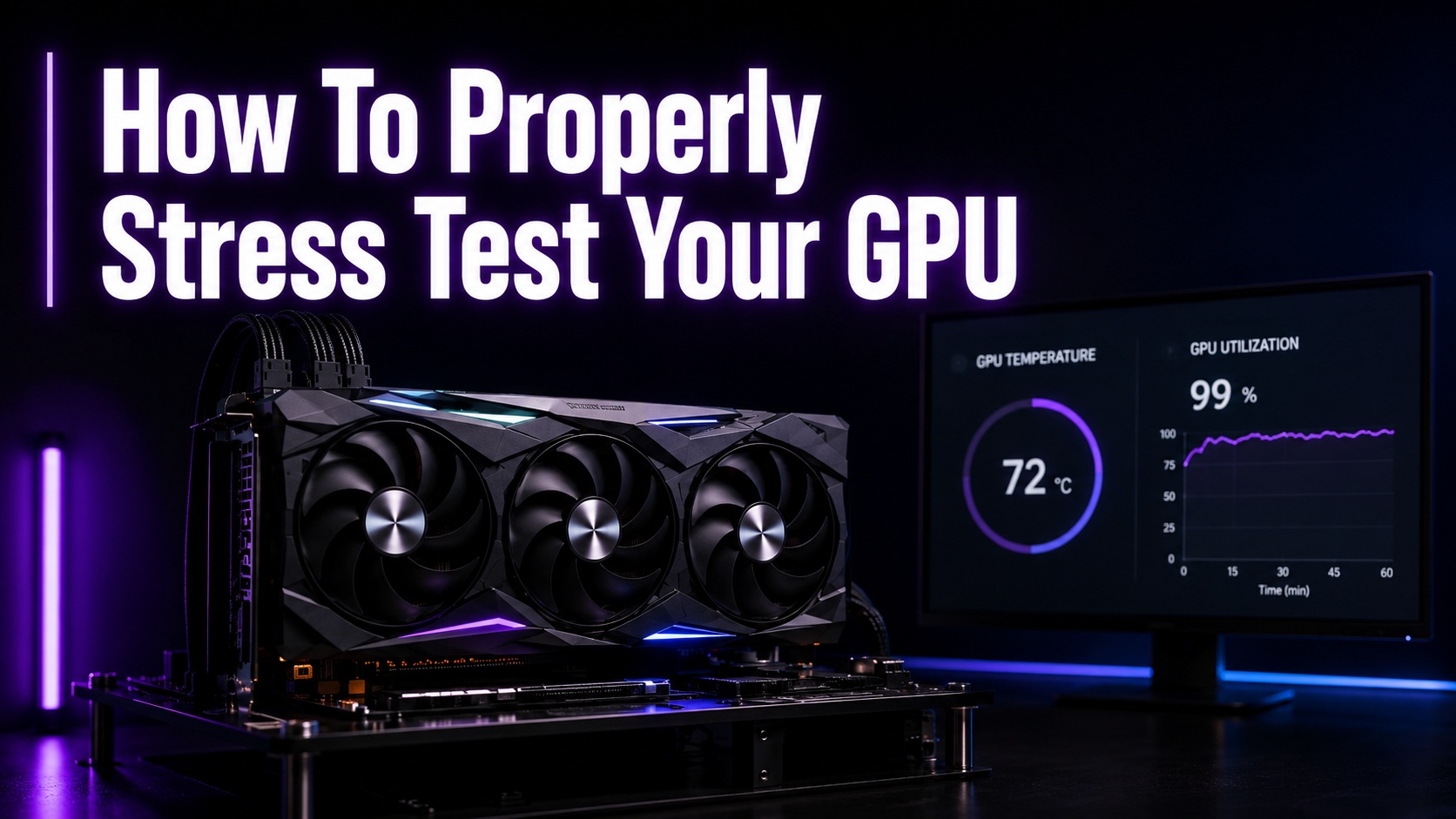
- Thermal Monitoring: Continuous temperature logging via tools like HWInfo or MSI Afterburner is necessary to track GPU behavior under sustained 100% load scenarios, ensuring that thermal throttling does not go unnoticed.
The dual-layer approach—combining synthetic and real-world testing—is crucial because modern GPUs are more than just raw FPS generators. A card that performs exceptionally in synthetic benchmarks may struggle with thermal management when rendering complex scenes or processing AI workloads. Conversely, a GPU optimized for efficiency might show hidden limitations under prolonged synthetic stress tests, revealing issues in power delivery or cooling.
Balancing Accuracy and Hardware Safety
There is an inherent tradeoff in modern GPU stress testing: deeper validation requires longer runtimes, higher power draw, and the risk of pushing hardware beyond its designed limits. Running FurMark at maximum intensity for extended periods can induce thermal stress that some GPUs are not built to handle without long-term degradation.
To mitigate these risks, a modular testing approach is recommended. This involves starting with shorter synthetic benchmarks, such as 3DMark Fire Strike, followed by longer, more targeted tests using applications that mirror actual use cases. For professionals in rendering or AI, this could mean overnight Blender benchmark runs paired with continuous GPU temperature monitoring to ensure sustained performance without overheating.
The future of GPU stress testing will likely continue to evolve alongside hardware advancements. As GPUs integrate more specialized compute units for tasks like neural network processing, the benchmarks used today may become outdated tomorrow. What is clear now is that no single tool can cover all bases. The challenge lies in whether industry-standard benchmarks will adapt quickly enough to keep pace with these changes.