Process nodes are typically about incremental progress: smaller transistors, marginally better performance, slightly lower power consumption. But Intel’s 18A-P node defies that convention entirely.
The new variant doesn’t reduce transistor density or push the boundaries of miniaturization further than its predecessor. Instead, it delivers a 9% performance boost at the same power level—or reduces power by 18% while maintaining identical performance—compared to standard 18A. This kind of leap is usually reserved for moving from one node generation to the next, such as transitioning from 20A to 14A. Yet here it arrives with no change in transistor density.
For PC builders and foundry customers, this represents a fundamental shift in how efficiency is achieved. Instead of waiting for a denser, more advanced node to see performance gains, they can now access these improvements without the usual trade-offs—no longer forced to choose between speed and power savings in every design cycle.
More Predictable, More Powerful
The 18A-P isn’t just about raw metrics. Intel’s engineering team focused on a less visible but equally critical aspect: manufacturing consistency. At the chip level, transistors naturally vary—some run faster, others slower—a phenomenon known as 'skew.' Reducing this skew leads to tighter performance and power margins, fewer yield issues, and more predictable behavior across production batches.
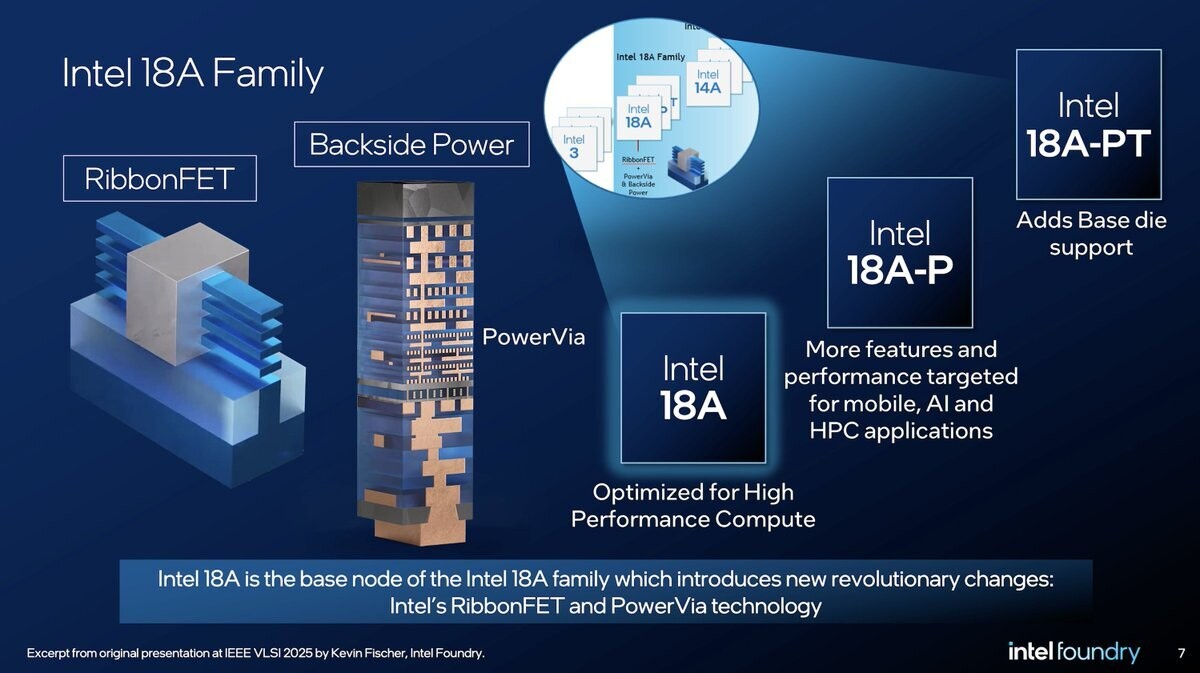
- Performance: 9% increase at iso-power or 18% lower power at iso-performance
- Skew reduction: 30% improvement in transistor consistency
- Thermal resistance: Lower thermal impedance for better heat dissipation
- Transistor type: RibbonFET with backside power delivery (PowerVia)
This isn’t merely about running a chip faster or cooler. It’s about stability—chips that perform more consistently under load, with less variation in power draw and thermal output. For high-end workstations or AI inference cards, where consistent performance is crucial, this could be transformative.
Why This Matters for PC Builders
Most node transitions follow a predictable pattern: smaller transistors, better density, modest gains in speed and power efficiency. The 18A-P disrupts that narrative. It delivers near-future-level performance without the usual downsides—no need to wait for 14A or 16A to see these improvements.
For PC builders, this could mean more efficient GPUs or CPUs that don’t throttle under sustained workloads, even if they’re built on the same physical process. It also provides foundry customers—such as AMD, Apple, and NVIDIA—with flexibility in design trade-offs, allowing them to adopt Intel’s technology without density constraints.
Looking Ahead
The 18A-P node won’t solve all efficiency challenges, but it redefines what’s possible at this node. As AI workloads become more demanding and power budgets tighten, the ability to extract extra performance—or reduce power consumption—without shrinking transistors could be a decisive advantage. For now, it serves as a reminder that progress doesn’t always follow the expected path.