Intel’s next-generation desktop platform, codenamed Nova Lake-S, is shaping up to challenge AMD’s Ryzen 9 9950X3D2 and other high-end CPUs with a refined chipset hierarchy. The company’s 900-series lineup will abandon the traditional H-series middle tier, instead offering a Z990 flagship, a Z970 enthusiast option, and a B960 mainstream model, each tailored to different user needs. This segmentation mirrors AMD’s approach but with key differences in I/O and overclocking capabilities.
The Z990 emerges as the most capable, featuring DMI 5.0 x4 (128 Gbps)—double the bandwidth of the Z970’s DMI Gen 5 x2—and 24 PCIe 5.0 lanes (12 Gen 5 + 12 Gen 4), enabling full-speed GPU, NVMe, and expansion card support. It also supports multiplier and BClk overclocking when paired with K-series CPUs, while the Z970 drops some PCIe 5.0 lanes and lacks overclocking flexibility. Meanwhile, the B960 focuses on cost efficiency, sharing silicon with the Z970 but omitting multiplier unlocks and PCIe 5.0 downstream lanes.
Key specs for the B960/Z970 include
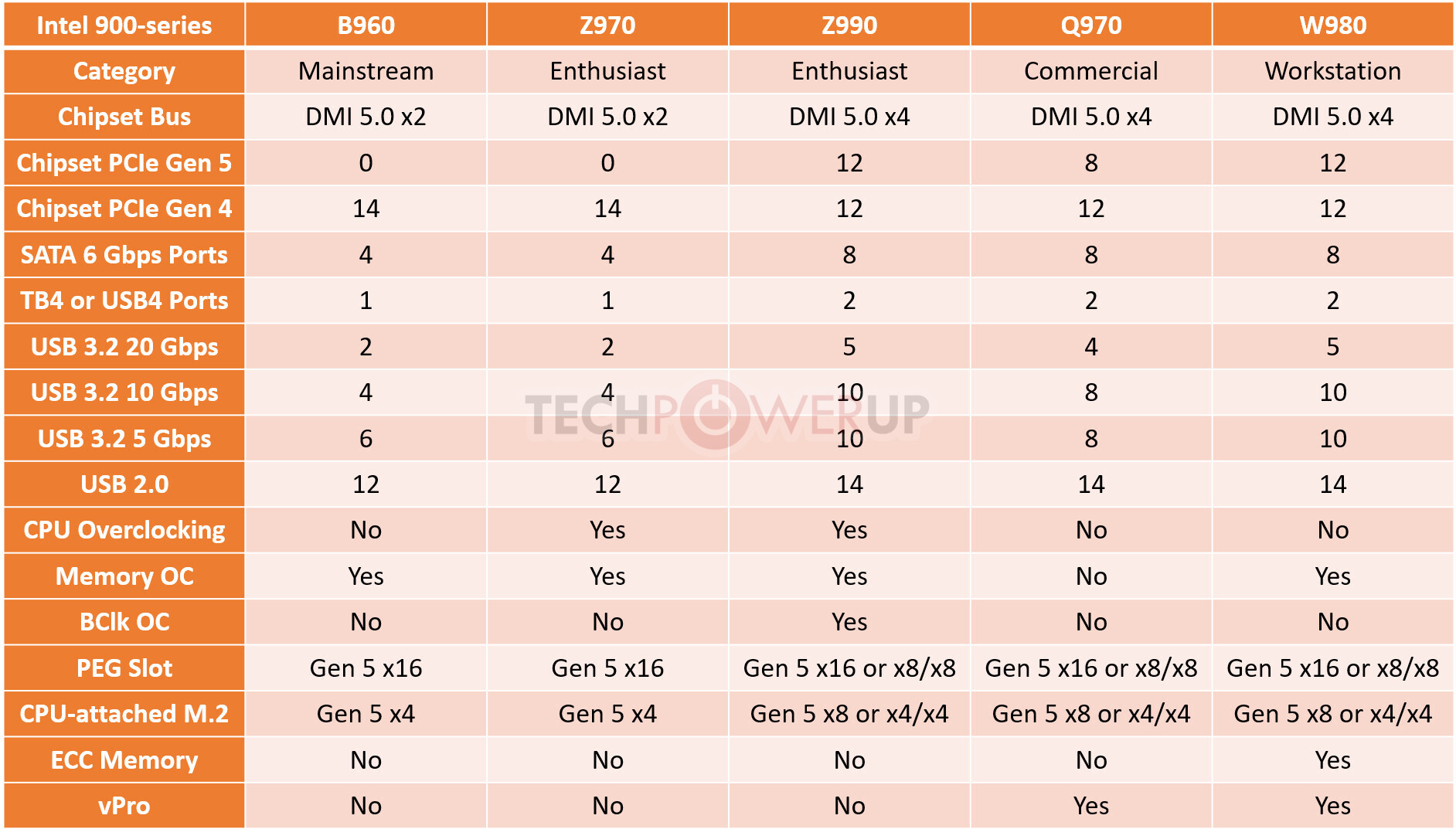
- Chipset Bus: DMI Gen 5 x2 (64 Gbps, comparable to current DMI 4.0 x4)
- PCIe Lanes: 14 Gen 4 downstream (no Gen 5)
- USB/Thunderbolt: 1x 40 Gbps USB4/Thunderbolt 4 (CPU-provided)
- M.2 Slots: 1x Gen 5 x4 (CPU-attached), 1x Gen 4 (or onboard)
- PCIe 5.0 x16: GPU slot only (segmentable on Z990)
The Z990 stands out with 128 Gbps DMI 5.0 x4, 24 PCIe 5.0 lanes, and two Gen 5 M.2 slots, along with dual 40 Gbps USB4/Thunderbolt 4 ports. It also enables lane segmentation for flexible GPU configurations. Both the Q970 (commercial) and W980 (workstation) follow suit with PCIe 5.0 support but lack overclocking features, instead prioritizing vPro management for enterprise use.
This tiered approach suggests Intel is balancing performance, cost, and feature differentiation—with the Z990 targeting high-end builds (e.g., Ryzen 9 9950X3D2 pairings) and the B960 appealing to budget-conscious users. The shift away from an H-series chipset reflects declining demand for mid-range overclocking platforms, while the expanded PCIe 5.0 and USB4/Thunderbolt 4 support aligns with next-gen hardware trends. Launch timings remain unconfirmed but are expected late in 2026, coinciding with CES 2026 announcements.