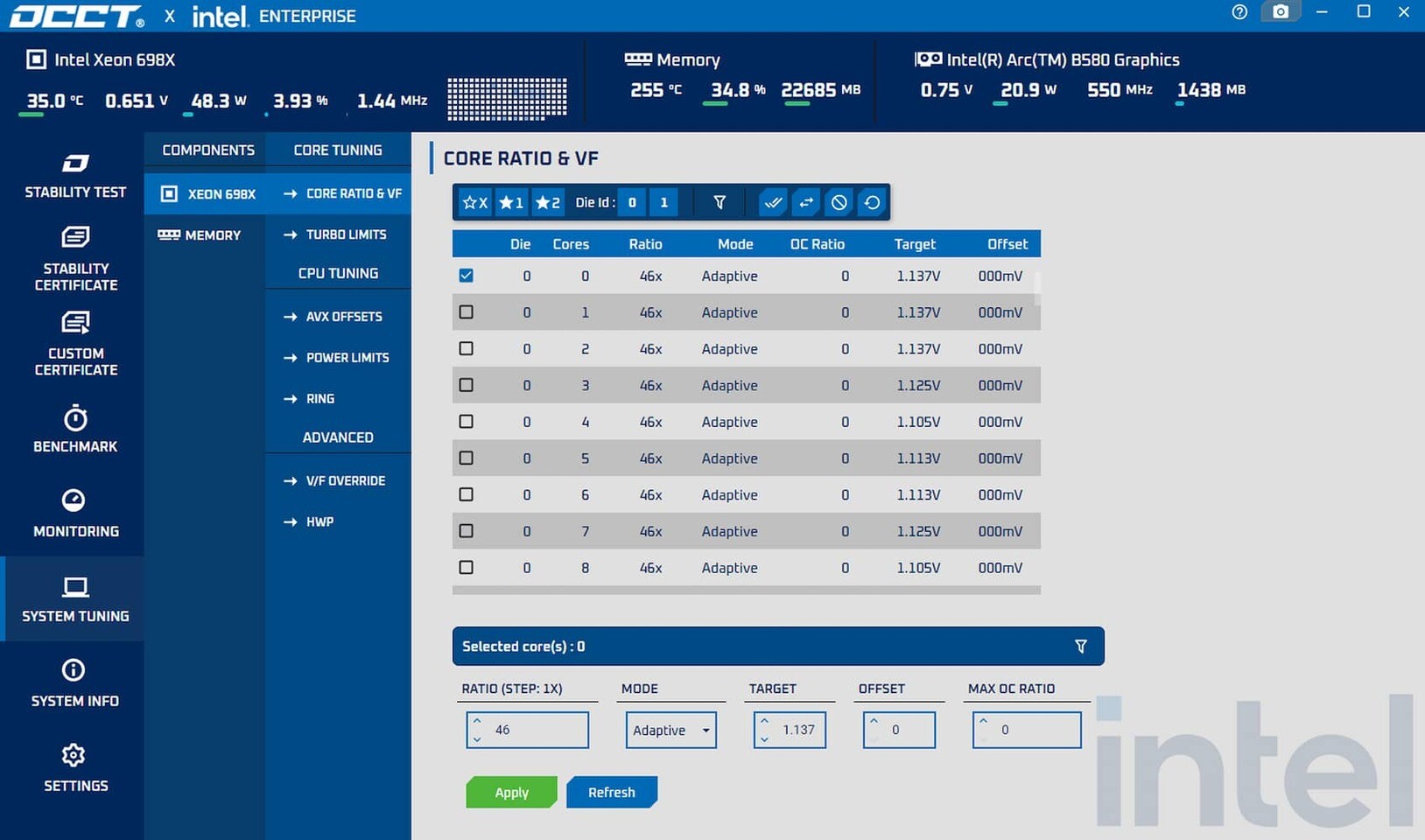
Intel’s latest high-end workstation CPU, the Xeon 698X, has quietly broken free from its traditional overclocking constraints, thanks to an update from OCCT. The tool now supports Granite Rapids-WS processors, including the 86-core flagship, enabling per-core clock adjustments and real-time stress testing—features rarely seen in Xeon’s conservative history.
The 698X, running at a base clock of 2.0 GHz with Turbo Boost Max 3.0 reaching 4.8 GHz and standard Turbo Boost at 4.6 GHz, is now fully unlocked. OCCT’s new interface allows users to tweak individual core speeds while monitoring stability under sustained workloads—a capability that blurs the line between enterprise reliability and enthusiast tuning.
What’s unusual is that Intel, which typically restricts overclocking in Xeon chips, has allowed this level of control for Granite Rapids-WS. The move suggests a shift toward accommodating high-performance computing (HPC) and AI workloads where every cycle matters, but it also raises questions about long-term reliability in mission-critical environments.
Key specs
- Core count: 86 cores / 172 threads
- L3 cache: 336 MB
- Base clock: 2.0 GHz
- Turbo Boost Max 3.0: 4.8 GHz
- Turbo Boost 2.0: 4.6 GHz
- Memory support: DDR3 (legacy) / LPDDR5X (emerging)
- Overclocking tool: OCCT (closed beta, Linux support incoming)
The 698X’s unlocked status is particularly notable for a Xeon processor, historically designed for stability over performance. While the tool is currently in closed beta, OCBASE expects a public release within weeks, including Linux compatibility—a critical feature for server and HPC environments.
For workstation users, this means finer control over clock speeds, but it also introduces risks. Overclocking Xeon CPUs, even in controlled environments, could void warranties or compromise data integrity in enterprise setups. Intel’s decision may reflect a growing demand for customizable performance in AI and rendering workloads, but it remains to be seen whether this will become a permanent feature or a one-off experiment.
One lingering question is whether this overclocking support extends beyond the 698X. The Granite Rapids-WS lineup includes other high-core-count models, but OCCT’s current update focuses solely on the flagship. If Intel’s unlocking policy expands, it could redefine expectations for Xeon’s role in high-performance tuning.