For users working on complex AI workloads, the line between cloud and local computing is becoming increasingly blurred. MSI’s latest initiative, AI Jinni, aims to bridge that gap by offering a seamless experience that balances performance with privacy.
The system, set to debut at COMPUTEX 2026, is designed as an all-in-one AI hub that integrates hardware scalability with strict data sovereignty. Unlike traditional cloud-only solutions, AI Jinni allows users to toggle between local and cloud-based AI models without compromising on performance or security.
At its core, AI Jinni features a hybrid architecture that supports agentic AI capabilities through an exclusive partnership with LuckyClaw. This integration enables users to switch between high-tier foundation models with minimal latency, while built-in security mechanisms ensure safe operations across multiple communication platforms, including Discord and Slack. The system also includes a 100% local computing mode for tasks like document summarization and offline chat, eliminating the need for internet connectivity or token fees.
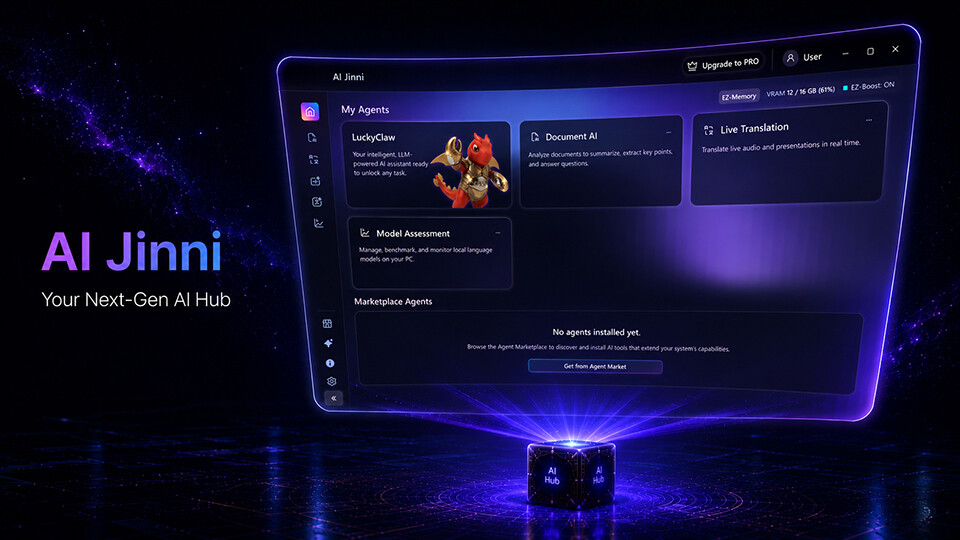
- Hybrid AI architecture that blends cloud and local processing.
- Exclusive agentic AI partner, LuckyClaw, with support for multiple platforms.
- 100% local computing mode for privacy-sensitive tasks.
The platform also introduces a four-step Model Assessment tool that evaluates AI model performance in terms of generation speed (TPS), providing standardized benchmarks for users to compare devices. Additional features include near-zero latency live translation and Guidance AI, which replaces traditional manuals with an intuitive conversational assistant.
While the concept promises significant advancements, industry observers note that the success of AI Jinni will hinge on its ability to deliver consistent performance across different hardware configurations. Early reactions suggest a mix of excitement and skepticism, particularly around how well the system can handle resource-intensive workloads without sacrificing usability.
The introduction of AI Jinni signals MSI’s ambition to position itself as a leader in the next generation of AI-driven computing. By merging the flexibility of cloud models with the security of local processing, the platform could reshape how users deploy AI tools—provided it meets the demands of both developers and end-users alike.