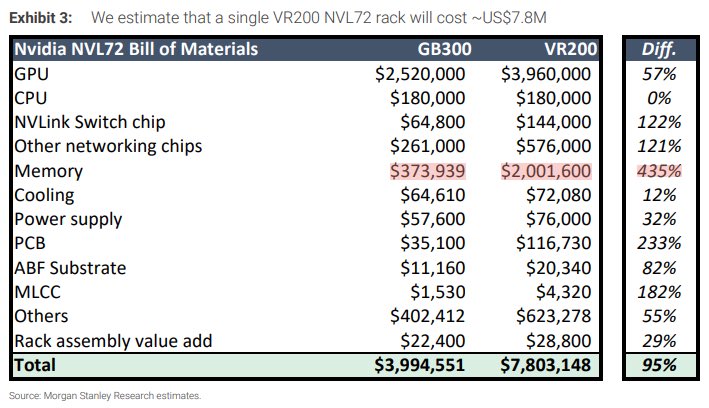
The cost of high-bandwidth memory has become a defining factor in next-generation computing, and nowhere is this more evident than in NVIDIA's upcoming Vera Rubin supercomputing rack. Priced at $9.1 million, the system represents both an engineering milestone and a financial challenge for data centers aiming to scale AI workloads without breaking the bank.
Vera Rubin is designed to deliver unprecedented compute density, leveraging NVIDIA's latest architecture to handle massive datasets efficiently. However, with HBM4 memory costs now tripling previous generations, the platform's value hinges on balancing performance with affordability—a critical consideration for organizations pushing the boundaries of data processing.
Memory Pricing and System Economics
The heart of Vera Rubin lies in its memory subsystem. Each rack houses 16 GPUs, each equipped with 48GB of HBM4, totaling 768GB of memory per unit. At the current price point of $53 per gigabyte for HBM4, this translates to a memory cost of approximately $40,704 per rack—a figure that underscores the economic realities of modern supercomputing.
For data centers, the question isn't just about raw performance but about how efficiently these systems can be deployed. Vera Rubin's architecture is optimized for AI training and inference tasks, where memory bandwidth is a bottleneck. However, with memory costs now representing a significant portion of the total system price, buyers must weigh the long-term benefits against immediate expenses.
Performance and Practicality
The platform promises to deliver 100 petaFLOPS of compute power per rack, a figure that dwarfs many existing systems. This level of performance is crucial for workloads like large-scale AI model training, where memory bandwidth can make or break efficiency. Yet, the financial implications cannot be ignored.
Industry observers note that while Vera Rubin's specifications are impressive, its real-world impact will depend on how NVIDIA addresses the cost barriers. If memory prices remain elevated, even the most powerful systems may struggle to justify their price tags for smaller or mid-sized data centers. The challenge lies in proving that the performance gains outweigh the financial hurdles.
Looking ahead, Vera Rubin could set a new benchmark for supercomputing, but its success will hinge on whether NVIDIA can deliver on both innovation and value. For now, buyers are left to navigate a landscape where cutting-edge technology comes at a premium—one that demands careful consideration of both capability and cost.