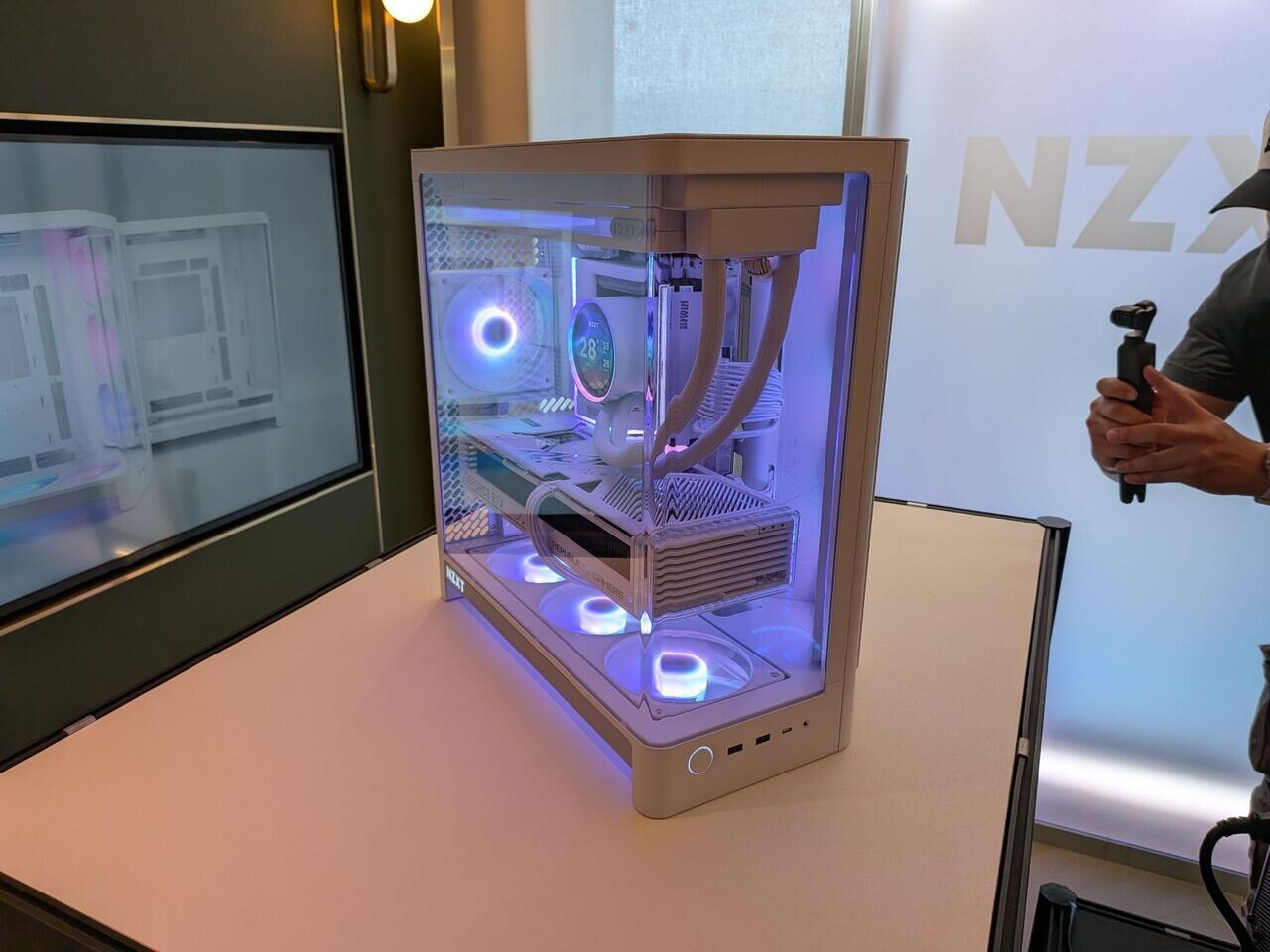
The trade-off between form and function has never been more evident than in the latest mid-tower PC cases. The NZXT H6 seeks to bridge that gap with a dual-chamber design that separates components while maintaining a sleek, modern aesthetic.
Measuring 448 × 292 × 420 mm and holding 55 liters of internal volume, the H6 is built for efficiency. Its steel construction supports ATX motherboards and back-connect models like ASUS BTF or MSI Project Zero, while the dual-chamber layout allows for organized cable management behind the motherboard tray—even when paired with a PSU. The right side panel features a curved tempered glass window that extends to the front, offering a seamless transition in design while keeping costs reasonable.
Key Specifications
- Design: Dual-chamber mid-tower with curved tempered glass side and front panels; available in black or white.
- Dimensions: 448 × 292 × 420 mm, 55 liters internal volume.
- Cooling Support: Up to 10 × 120 mm fans (3 front, 3 top, 1 rear) and radiators up to 360 mm; CPU coolers up to 165 mm tall.
- Storage: Two 2.5-inch and one 3.5-inch drive bays; supports GPUs up to 390 mm long, PSUs up to 200 mm.
- Front I/O: 2 × USB 3.2 Gen1 Type-A, 1 × USB 3.2 Gen2×2 Type-C, 3.5 mm audio jack.
- Pricing: $99.99 without fans; $199.99 with two F360 RGB Reverse fans (includes three 120 mm fans per unit).
The H6’s design shifts away from edgy angles, favoring rounded contours that appeal to both performance builders and those prioritizing a clean look. Its compatibility with high-end cooling solutions—including GPU support brackets to prevent sag—makes it suitable for systems pushing the limits of airflow without sacrificing structural integrity.
For small businesses or enthusiasts balancing cost and capability, the H6 offers a middle ground: it’s not the most expensive mid-tower on the market, but its dual-chamber layout and premium glass panel elevate its visual appeal. Whether opting for the base model or the fan bundle, buyers gain a case that prioritizes organization without compromising on aesthetics—a rare balance in today’s PC hardware landscape.