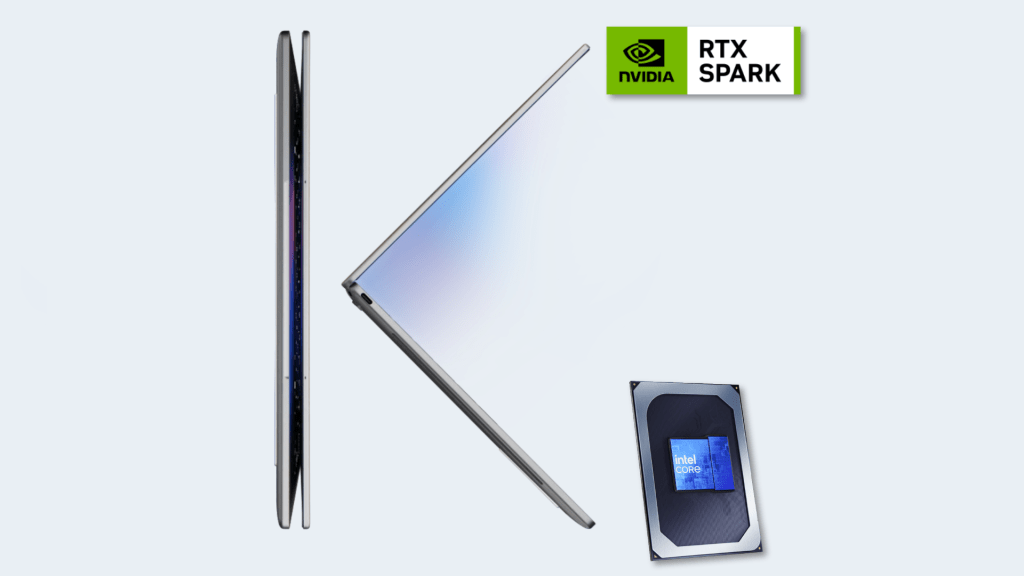
Nvidia’s RTX Spark isn’t just another GPU—it’s a high-performance computing unit designed to redefine what portable devices can achieve. At the heart of this module lies Nvidia’s Ada Lovelace architecture, the same foundation powering its flagship RTX 40-series GPUs, paired with 12 GB of GDDR6 memory and clock speeds that rival desktop graphics cards. The result is a device that can deliver ray tracing and AI acceleration on the go, but one that comes with significant trade-offs.
Traditionally, portable gaming has meant making concessions: smaller screens, weaker GPUs, or shorter battery life. The RTX Spark flips this script by packing the equivalent of a desktop GPU into a compact module. However, its 150-watt thermal design power (TDP) and $399 price tag challenge the very notion of what a gaming handheld should be. This isn’t just about raw power—it’s about rethinking the balance between performance and portability.
- Architecture: Ada Lovelace (same as RTX 40-series GPUs)
- Memory: 12 GB GDDR6
- TDP: 150 watts
- Price: $399 (module-only, no device included)
- Connectivity: PCIe 4.0 x8 interface for integration into handhelds
The module’s specs are impressive but familiar, reflecting Nvidia’s commitment to pushing boundaries in portable computing. However, the real story lies in what these specs imply. A 150-watt module in a handheld device means that manufacturers will need to rethink thermal management and battery life. Active cooling, likely fan-based, will become a necessity rather than an option, moving away from the silent, passive-cooled designs that have become standard in today’s top handhelds.
Battery life will also take a significant hit. Even with optimizations, a device running this hot for extended periods will struggle to last more than a few hours on a single charge. For creators or professionals who need raw power on the move, this might be an acceptable trade-off. But for casual gamers, it’s a hard pill to swallow.
Nvidia isn’t the first to attempt this—Qualcomm and others have tried to bridge the gap between desktop performance and portability—but the RTX Spark feels different. It doesn’t just promise power; it delivers it in a way that forces manufacturers to rethink what a handheld can be. The question is whether users will follow.
For now, the RTX Spark remains a curiosity, a glimpse into a future where portable devices are as powerful as their desktop counterparts. But that future isn’t here yet. Battery technology needs to catch up, cooling solutions need to evolve, and prices need to drop before this becomes more than just a high-performance experiment. Until then, it’s a reminder that progress often comes at a cost—and sometimes, that cost is worth paying.