What if Untitled Goose Game’s mischievous waterfowl had a darker, more existential purpose? Tingus Goose, a new idle clicker from internet artist MasterTingus, answers that question with a game where geese don’t just invade homes—they rewrite human biology. Released late last year on Steam, it’s a surreal, profit-driven nightmare where players cultivate living goose-trees that sprout from infected humans, harvest baby geese (called tingis), and optimize their grotesque production lines for maximum income.
The premise alone is enough to make even the most hardened gamer pause. Humans in this world are unwitting hosts, their bodies repurposed as incubators for towering, branch-laden goose structures. These trees don’t just grow—they process* their offspring, turning newborn tingis into currency through a mix of bouncing, aging, and, in one memorable case, defecation. The branches themselves are geese, each with its own macabre function: some bounce tingis, others devour them to spit out more, and a few even act as conveyor belts for aging them up—each level unlocking exponentially greater rewards.
At its core, Tingus Goose is an idle game, but it’s one that demands engagement. Players click to harvest tingis, strategically place branches to maximize efficiency, and unlock upgrades like a golden goose-head that multiplies offspring or a cow-root system that permanently boosts production. The deeper you go, the more the game twists its own rules. Level four begins with a goose transforming into a hospital oxygen mask, hatching lung-eggs that crawl out of a patient’s mouth like obedient pets. Every expansion of the goose-tree is accompanied by a wet, fleshy schlick sound, reinforcing the unsettling biological horror.
A Parasitic Economy
Earning money in Tingus Goose isn’t just about clicking—it’s about refining a system. Tingis generate gold simply by bouncing down the tree, but players can enhance their value by aging them through contact. Three tingis touching become one older tingi, and each evolutionary stage increases their monetary worth. Obstacles like goosey flasks, seated tingis who punt the young down rows, and even a waiter who occasionally drops useful items add layers of complexity. The game’s production chain feels almost industrial, with each branch serving a specific role in the goose-life cycle.
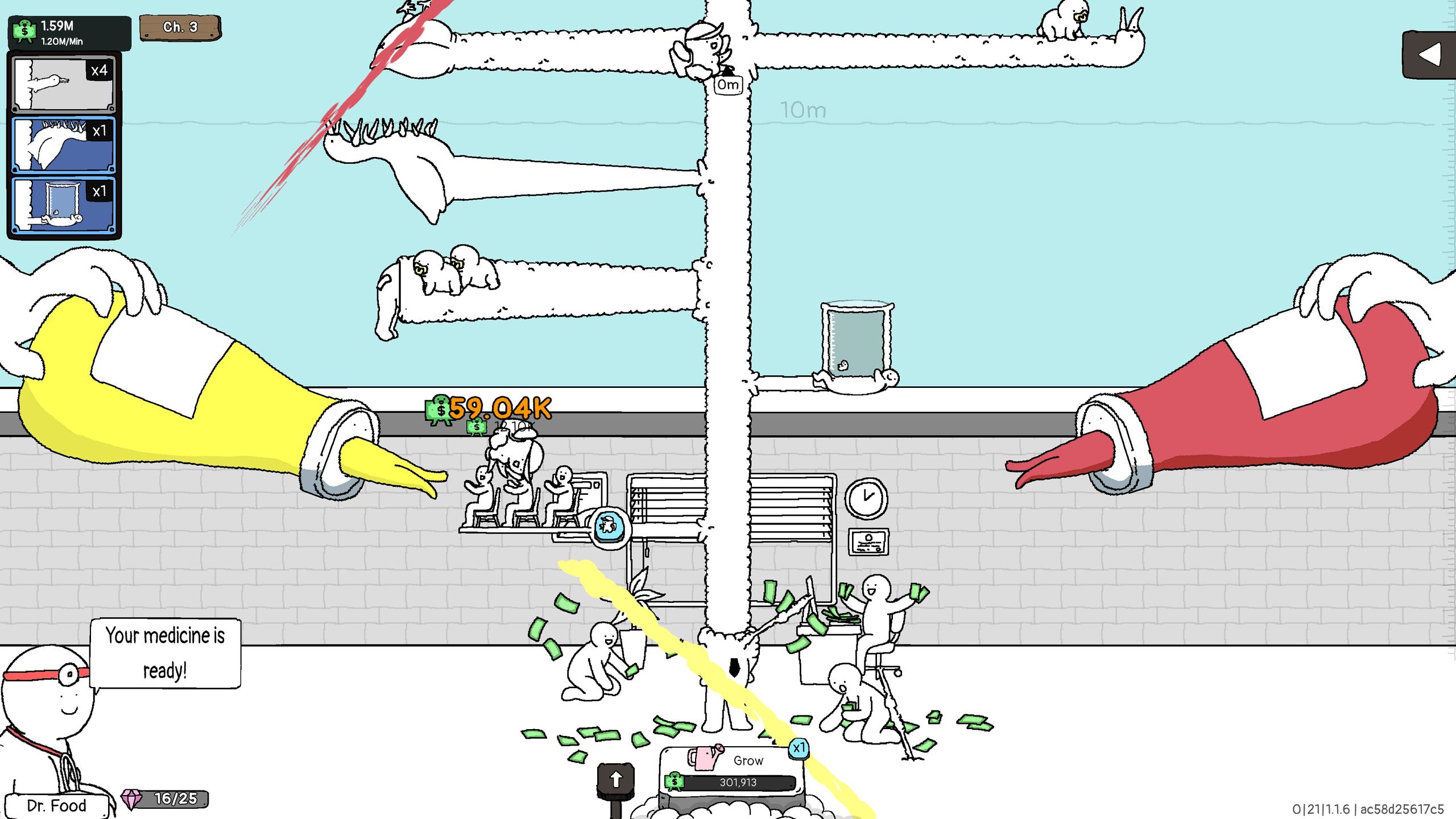
The unsettling doesn’t stop at mechanics. The game’s art style—MasterTingus’s signature blend of cute and grotesque—makes the horror feel intimate. A pregnant woman’s belly splits open to reveal a goose-tree. A man’s head bursts with a forest of feathers. The tingis themselves are wide-eyed, almost innocent, until they shatter into goose bits upon landing. It’s a world where biology and economics collide, and the player is both farmer and parasite.
Is It Good?
For those who enjoy idle games, Tingus Goose offers a refreshing twist. It’s not just about passive income—it’s about optimization, experimentation, and uncovering the game’s many bizarre systems. The more branches you unlock, the more the production line feels like a grotesque assembly line. And while the premise is deliberately off-putting, the gameplay loop is oddly satisfying. There’s a perverse joy in watching a goose-tree grow, in tweaking its branches to squeeze out every last coin, in seeing tingis evolve from helpless newborns to profitable adults.
That said, it’s not for everyone. The game’s horror isn’t gory or explicit, but it’s unsettling—the kind that lingers. Players who loved Untitled Goose Game* for its chaotic charm might find Tingus Goose too much to handle. Yet for those who thrive on surreal, thought-provoking games, it’s a masterclass in turning disgust into delight.
Final Verdict: Tingus Goose is a bizarre, deeply rewarding idle experience that pushes the boundaries of what a clicker can be. It’s grotesque, it’s clever, and it’s impossible to look away from—even when you’d rather.