Few Ubisoft games from the late 2000s are remembered today. Far Cry 2* and Assassin’s Creed II became landmarks, while Prince of Persia and Rayman faded into nostalgia. But buried in the archives is Avatar: The Game, a third-person shooter that arrived in December 2009—just as Avatar the movie was dominating cinemas and before Ubisoft’s open-world empire had fully taken shape.
The game’s premise is simple: you play as Able Ryder, a human soldier embedded in the RDA (Resource Development Administration), the Earth-based military occupying Pandora. Your mission? Secure tuning crystals scattered across the jungle to locate an abandoned Well of Souls, a na’vi sacred site that could give the RDA a backdoor into Eywa, the planet’s spiritual force. It’s a setup that feels like a lost Call of Duty mod—until you realize Ubisoft was still figuring out how to make a movie tie-in work without leaning too hard on its studio’s strengths.
What makes Avatar: The Game interesting isn’t its polish—it’s how aggressively it commits to its world. The game’s Dunia engine (shared with Far Cry 2) powers a jungle that’s less a playground than a warzone. Vines lash out like whips, toxic gas seeps from the ground, and every tree trunk is a potential ambush point. The na’vi aren’t just enemies; they’re the ecosystem’s favored species, while humans are invasive, disposable forces.
- A third-person shooter with a 10-hour campaign, released in 2009 for PC, PS3, and Xbox 360.
- Built on Far Cry 2’s Dunia engine, but with linear missions and no open-world freedom.
- Two playable factions: Humans (RDA soldiers) or na’vi (limited ability set).
- Vehicle-heavy gameplay: Exosuits, buggies, and gunships—though physics are stiff.
- No multiplayer—a missed opportunity given its Battlefield-like chaos.
- Never updated, despite later Ubisoft retroactively adding a third-person mode to Frontiers of Pandora.
The game’s faction choice is its most intriguing mechanic. Early on, you’re given a binary decision: side with the RDA or defect to the na’vi. The latter path is underwhelming—your na’vi avatar is little more than a giant, slow-moving soldier with no unique abilities. But as a human, you become a grunt in a colonial war, hunting crystals while RDA troops clash with na’vi warriors in the distance. The jungle isn’t just a stage; it’s an active threat. A single misstep could mean poison gas, a vine lash, or a viperwolf ambush. Even the flamethrower—a staple of Far Cry—feels like a necessity rather than a gimmick.
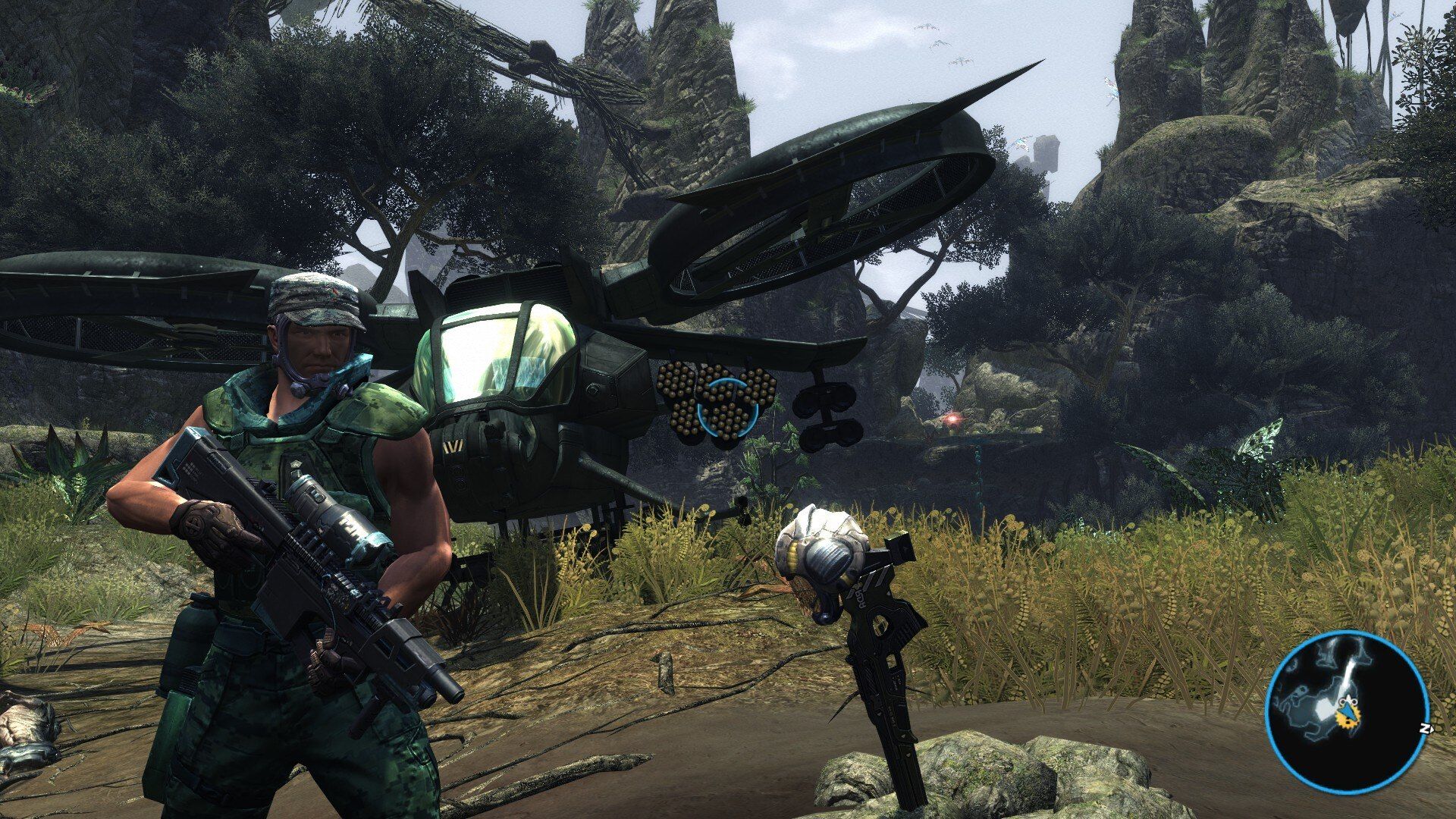
Vehicles are where Avatar: The Game gets its most Battlefield-like moments. You can swap between exosuits, buggies, and gunships mid-mission, though the physics are clunky. Steering a Scorpion gunship between floating islands or racing a buggy along tree branches is more about sheer chaos than skill—until you crash (which happens often). The game’s mission structure forces you to shuttle between frontlines, acting as a lone wolf in a war you don’t fully understand. Commanders bark orders, scientists fret over doomsday protocols, and the na’vi grow increasingly hostile as you push deeper into their territory.
The climax—reaching the Well of Souls—is anticlimactic. After a light show and some ominous rumbling, the game ends with Eywa’s cryptic warning: Next time, she’ll be ready. It’s clear this was never meant to be canon. Ubisoft moved on, and Avatar: The Game became a footnote—until Frontiers of Pandora proved the studio could do Pandora right.
Yet for all its flaws, Avatar: The Game has a raw, unfiltered energy that later Ubisoft titles lack. It’s not a masterpiece, but it’s not a failure—just a forgotten experiment from a time when Ubisoft was still learning how to balance licensed properties with gameplay innovation. And in an era where movie tie-ins are often safe, sanitized cash grabs, its brutal, vehicle-heavy take on Pandora’s war feels refreshingly uncompromising.
If you’re curious, the game is still playable today—though don’t expect miracles. What Avatar: The Game* lacks in polish, it makes up for in boldness. And in a world where Ubisoft’s Pandora games are now open-world epics, this linear, jungle-bound shooter remains a fascinating what-if.