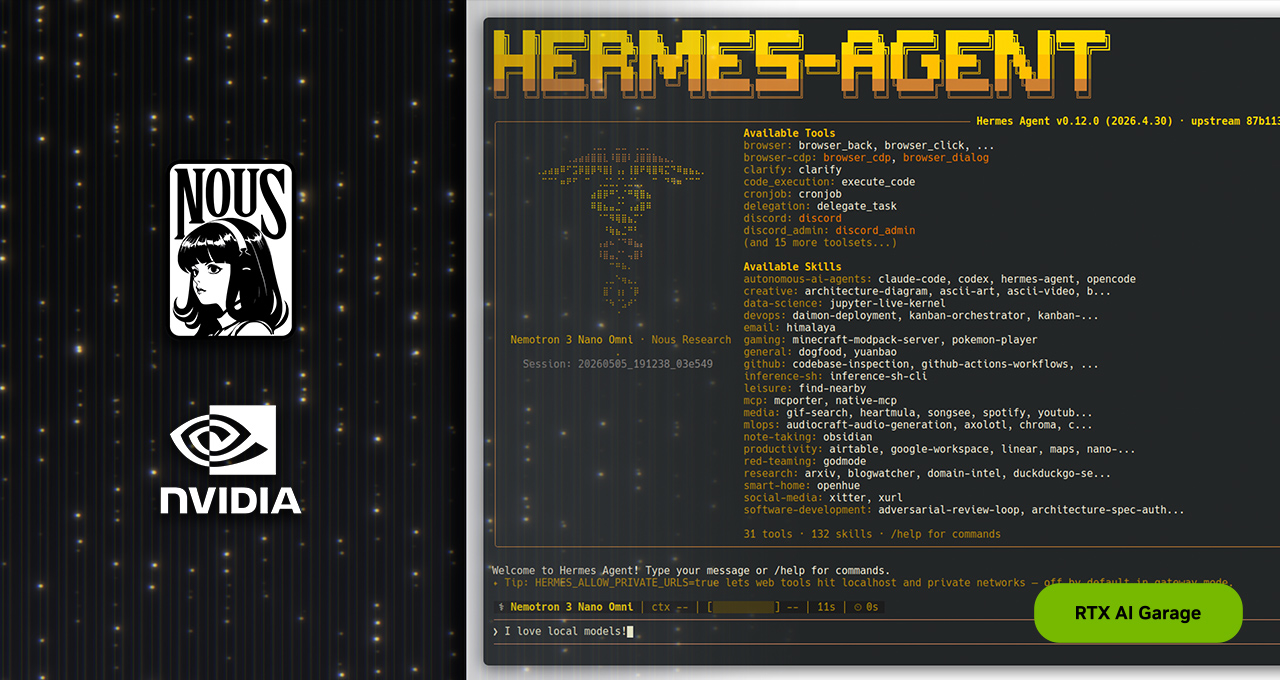
Hermes Agent, an open-source framework designed for self-improving AI, has quickly become a focal point in the tech community. Its rapid adoption—surpassing 140,000 GitHub stars in under three months—underscores the shifting landscape of agentic AI and its role in automating complex tasks.
Unlike traditional AI models that rely on static datasets, Hermes Agent is built to learn and adapt dynamically. This capability allows it to refine its performance over time without manual intervention, making it particularly valuable for tasks requiring iterative improvement, such as data analysis or content generation. The framework’s design leverages NVIDIA RTX PCs and DGX Spark, which provide the necessary computational power and efficiency for training and deployment.
Developers have already begun integrating Hermes Agent into their projects, with early adopters reporting significant improvements in workflow efficiency. For instance, one team using the framework for automated document processing saw a 30% reduction in manual review time after just two weeks of deployment. This kind of performance gain is not just about speed; it’s about redefining how AI can be harnessed to solve real-world problems.
The broader implications of Hermes Agent extend beyond individual projects. As agentic AI continues to evolve, frameworks like this one will play a critical role in shaping the future of automation. For power users and enterprises looking to streamline operations, Hermes Agent represents a tangible step forward—one that balances innovation with practical, immediate benefits.