In an era where professional workflows are pushing the boundaries of what hardware can handle, two new docking stations are stepping into the spotlight. The Echo 20 SecureDock and its successor, the Echo 21 SuperDock, both built around Thunderbolt 5, promise to address the growing demands for bandwidth, storage, and power delivery that come with high-resolution displays, powerful peripherals, and resource-intensive applications.
Thunderbolt 5 brings significant upgrades over its predecessors, including the ability to handle up to three downstream Thunderbolt ports for daisy-chaining. This is a game-changer for users who rely on multiple high-bandwidth devices, such as external GPUs or high-speed storage solutions. Additionally, both docking stations support a host connection capable of delivering 140 watts of power—sufficient to sustain even the most power-hungry laptops while docked. This level of power delivery is crucial for developers and creatives working on tasks that require sustained performance without interruptions.
The Echo 21 SuperDock takes this a step further by incorporating an internal M.2 NVMe slot, which can accommodate drives up to 8 TB with transfer speeds reaching 3,300 MB/s. This makes it an attractive option for users who need local media storage or backup solutions without the hassle of external enclosures. The Echo 20 SecureDock, on the other hand, focuses more on connectivity and power delivery, making it a strong choice for those who prioritize these features.
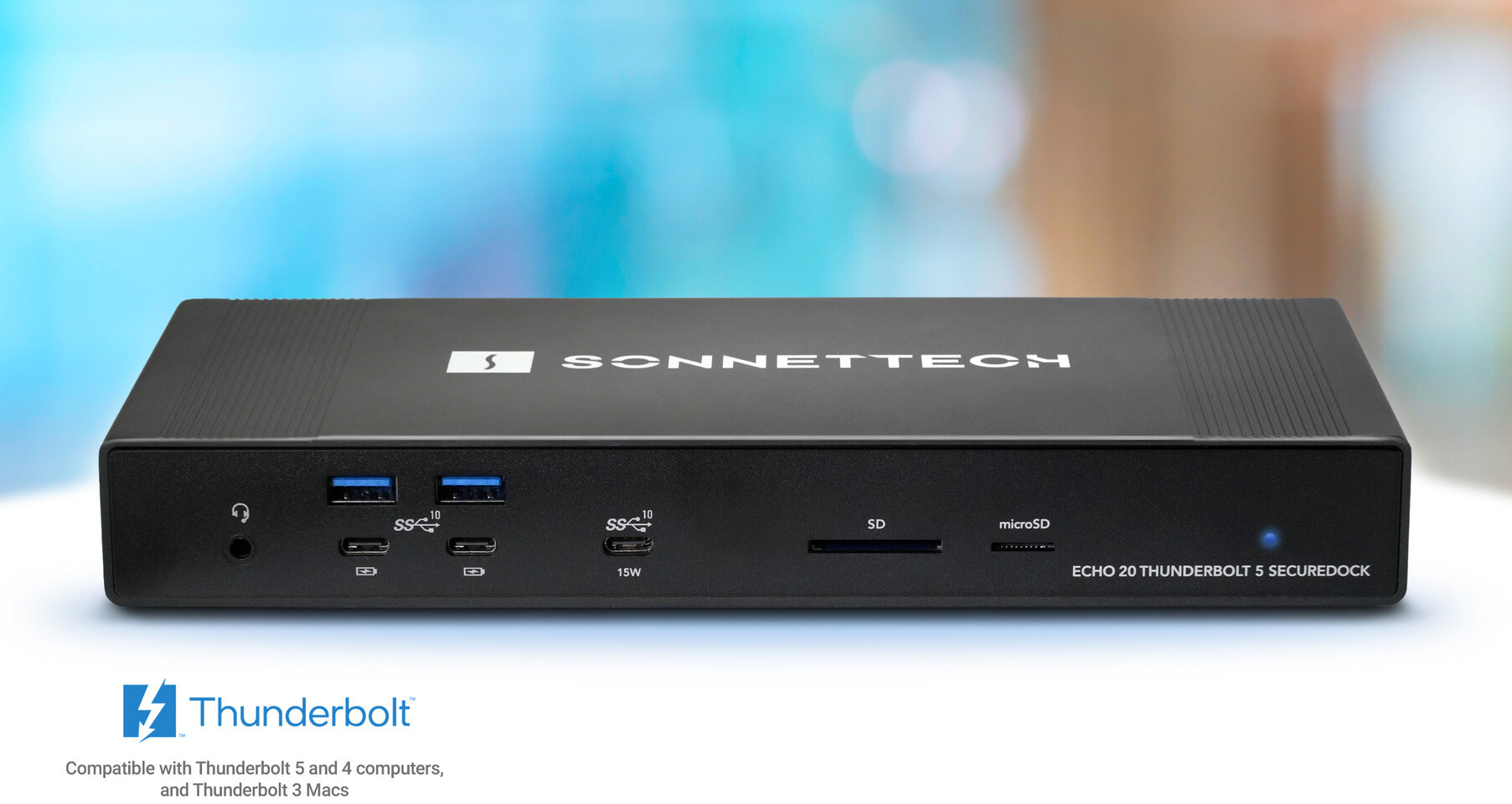
- Display and Connectivity:
- Support for up to four displays, including 8K at 60 Hz (Windows)
- Dual display outputs via HDMI and DisplayPort
- Three Thunderbolt 5 ports for daisy-chaining
- Nine USB 3.2 Gen 2 ports (Type-A and Type-C)
- 10 Gigabit Ethernet with backward compatibility
The inclusion of a 10 GbE port is particularly noteworthy, as it future-proofs the dock for bandwidth-heavy applications like video editing or large-scale data transfers. Both models also feature high-resolution audio I/O at up to 24-bit/192 kHz, ensuring lossless audio quality for professional-grade setups.
Compatibility is broad, covering a wide range of devices including Apple M-series Macs, older Intel Macs with Thunderbolt 3, and Windows or Chromebook machines with Thunderbolt 4, 5, or USB4. This flexibility means the docks can serve as a bridge between legacy systems and newer hardware, which is valuable in environments where upgrade cycles are staggered.
Pricing starts at $449.99 for the Echo 20 SecureDock, with the Echo 21 SuperDock following shortly after at $499.99. For users who prioritize storage and performance without sacrificing connectivity, these docks represent a compelling upgrade path—especially in markets where Thunderbolt 5 adoption is accelerating.
The real question for developers isn't just whether they need the extra storage or bandwidth, but when they'll start to feel constrained by older docking solutions. As workflows become more complex and demanding, the gap between what's possible with Thunderbolt 4 and what Thunderbolt 5 offers will only widen, making these new docking stations a timely solution for those looking to stay ahead of the curve.